2.3 Regional Strategic Outcomes
2.3 Regional Strategic Outcomes
The Regional Spatial and Economic Strategy (RSES) seeks to determine at a regional scale how best to achieve the shared goals set out in the National Strategic Outcomes (NSOs) of the NPF. To this end, the Strategy sets out 16 Regional Strategic Outcomes (RSOs), which are aligned with international, EU and national policy and which in turn set the framework for city and county development plans. Thus, the RSES can assist local authorities in aligning with EU priorities to leverage funding and partnership opportunities.
Collaboration
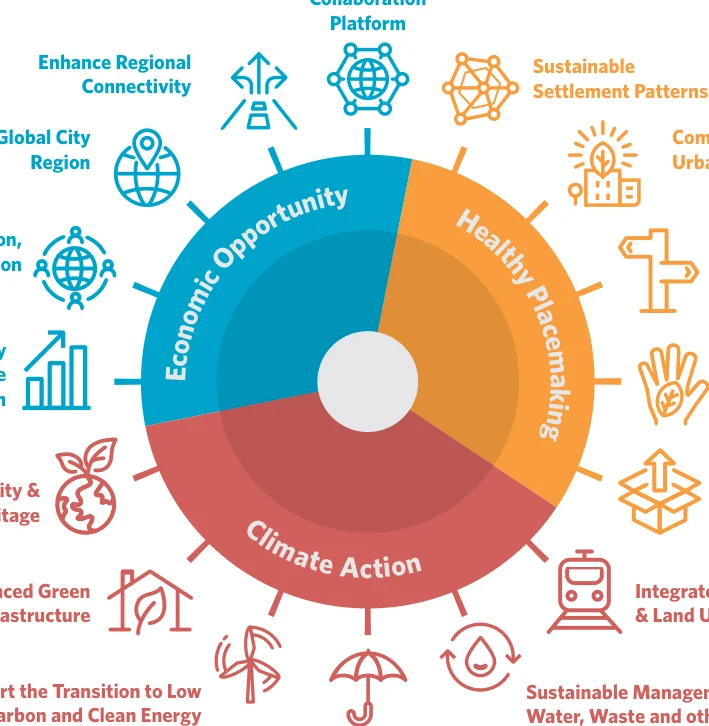
Figure 2.4 Regional Strategic Outcomes
Platform
Enhance Regional
Sustainable Settlement Patterns
Connectivity
Global City
Compact Growth & Urban Regeneration
Region
y
t
i
n
u
t
r
H
o
e
p
a
Rural Communities
p
Improve Education, Skills & Social Inclusion
l
O
t
h
y
c
i
P
m
l
o
a
c
n
e
o
A Strong Economy supported by Enterprise
m
c
Healthy Communities
E
a
& Innovation
k
i
n
g
Creative Places
Biodiversity & Natural Heritage
C
li
m
a
t
n
e
o
A
i
t
c
Integrated Transport & Land Use
Enhanced Green
Infrastructure
Support the Transition to Low
Sustainable Management of Water, Waste and other Environmental Resources
Carbon and Clean Energy
Build Climate
Resilience
KEY PRINCIPLES
Healthy Placemaking Climate Action Economic Opportunity
To promote people’s quality of life through the creation of healthy and attractive places to live, work, visit and study in.
To create the right conditions and opportunities for the region to realise sustained economic growth and employment that ensures good living standards for all.
The need to enhance climate resilience and to accelerate a transition to a low carbon economy recognising the role of natural capital and ecosystem services in achieving this.

Figure from page 25
Strategic Vision
The 16 RSOs set out in Figure 2.4 is also cross referenced and aligned with the 3 key principles of the RSES and have been developed in iteration with the Strategic Environmental Outcomes of the parallel Strategic Environmental Assessment process.
-
Sustainable Settlement Patterns Better manage the sustainable and compact growth of Dublin as a city of international scale and develop Athlone, Dundalk, Drogheda and a number of key complementary growth settlements of sufficient scale to be drivers of regional growth. (NSO 1, 7, 10)
-
Support the Transition to Low Carbon and Clean Energy Pursue climate mitigation in line with global and national targets and harness the potential for a more distributed renewables-focussed energy system to support the transition to a low carbon economy by 2050. (NSO 8, 9)
-
Compact Growth and Urban Regeneration Promote the regeneration of our cities, towns and villages by making better use of under-used land and buildings within the existing built-up urban footprint and to drive the delivery of quality housing and employment choice for the Region’s citizens. (NSO 1)
-
Enhanced Green Infrastructure Identify, protect and enhance Green Infrastructure and ecosystem services in the Region and promote the sustainable management of strategic natural assets such as our coastlines, farmlands, peatlands, uplands woodlands and wetlands. (NSO 8, 9)
-
Rural Communities Support sustainable rural development and strengthen rural networks, economies and communities. Manage urban generated growth in areas under strong urban influence and encourage sustainable growth in areas that have experienced decline or stagnation. (NSO 1, 3)
-
Biodiversity and Natural Heritage Promote co-ordinated spatial planning to conserve and enhance the biodiversity of our protected habitats and species including landscape and heritage protection. (NSO 7, 8)
-
A Strong Economy Supported by Enterprise and Innovation To build a resilient economic base and promote innovation and entrepreneurship ecosystems that support smart specialisation, cluster development and sustained economic growth. (NSO 5,10)
-
Healthy Communities Protect and enhance the quality of our built and natural environment to support active lifestyles including walking and cycling, ensure clean air and water for all and quality healthcare and services that support human health. (NSO 10)
-
Improve Education Skills and Social Inclusion To improve education and develop the right skills to attract employers and retain talent and promote social inclusion to ensure opportunities for quality jobs across the Region. (NSO 5,10)
-
Creative Places Enhance, integrate and protect our arts, culture and heritage assets to promote creative places and heritage led regeneration. (NSO 5, 7)
-
Integrated Transport and Land Use Promote best use of Transport Infrastructure, existing and planned, and promote sustainable and active modes of travel to ensure the proper integration of transportation and land use planning. (NSO 2, 6, 8,9)
-
Global City Region Promote Dublin as a global city region and protect and enhance international connectivity, including ports and airports and promote the Region as a gateway to Ireland. (NSO 6)
-
Sustainable Management of Water, Waste and other Environmental Resources Conserve and enhance our water resources to ensure clean water supply, adequate waste water treatment and greater resource efficiency to realise the benefits of the circular economy. (NSO 8, 9)
-
Enhanced Strategic Connectivity Protect and enhance international connectivity and regional accessibility to support economic development, build economic resilience and support strengthened rural communities and economies including the blue-green economy and tourism. (NSO 2, 3, 6)
-
Build Climate Resilience Ensure the long-term management of flood risk and build resilience to increased risks of extreme weather events, changes in sea level and patterns of coastal erosion to protect property, critical infrastructure and food security in the Region.(NSO 8, 9)
-
Collaboration Platform Provide a regional framework for collaboration and partnerships and to support local and regional bodies in leveraging funding and partnership opportunities. (NSO 2, 3, 5)
Regional Spatial & Economic Strategy
3
Growth Strategy
At the core of the RSES is the consideration of a settlement hierarchy for the Region, which sets out the key locations for population and employment growth, coupled with investment in infrastructure and services to meet those growth needs. This will set the framework for the development plans of each local authority and subsequently the quantum of residential and employment generating zoned land required. Therefore the approach taken in the RSES is robust, evidence based, and driven by clear sustainability and quality of life objectives.
The Growth Strategy for the Eastern and Midland Region will;
REGIONAL POLICY OBJECTIVE:
Growth Strategy
• Support the continued growth of Dublin as our national economic engine
RPO 3.1: Key stakeholders including local authorities in the Region shall, through their policies and objectives including development plans, commit to the delivery of the Growth Strategy as detailed in the RSES.
• Deliver sustainable growth of the Metropolitan Area through the Dublin Metropolitan Area Strategic Plan (MASP)
• Target growth of our Regional Growth Centres of Athlone, Drogheda and Dundalk as regional drivers
• Support our vibrant rural areas with a network of towns and villages
• Facilitate the collaboration and growth of the Dublin – Belfast Economic Corridor
• Embed a network of Key Towns through the Region to deliver sustainable regional development.
• Support the transition to a low carbon, climate resilient and environmentally sustainable Region.
Figure from page 27
Growth Strategy
Pages 24–27 · View in original PDF