2.2 Vision and Key Principles
2.2 Vision and Key Principles
In developing the vision for the Regional Spatial and Economic Strategy (RSES) a number of key national policy documents were considered including Ireland 2040 – National Planning Framework (NPF) and the National Development Plan 2018-2027 (NDP) along with Ireland’s National Enterprise Policy 2015-2025 namely Enterprise 2025: Innovative, Agile, Connected.
A key challenge facing the Region, along with all other regions, is the transition to a low carbon society. For the RSES this means five primary areas of transition which are at the core of the Strategy:
• sustainable development patterns which promote compact growth, reduce transport demand and encourage low carbon transport modes;
In addition to the above the Eastern and Midland Regional Assembly (EMRA) also considered submissions received during the initial public consultation period and carried out extensive engagement with our elected members through Strategic Planning Area (SPA) Committees and with other relevant stakeholders through Technical Working Groups (TWGs) and on an on-going and iterative basis.
• sustainable transport systems (people and freight);
• carbon storing and sequestering land uses;
• energy efficient buildings and industry; and
• renewable energy.
Our ambition is for the RSES to provide a platform for coordination and collaboration between local authorities, state and semi-state bodies to develop a shared responsibility and understanding about how we plan, to achieve a better future for all up to 2031 and beyond.
KEY PRINCIPLES
The Strategy is underpinned by key cross-cutting principles that reflect the three pillars of sustainability; Social, Environmental and Economic, and expressed in a manner which best reflects the challenges and opportunities of the Region. The central need is for the RSES to be people focussed, as ‘quality of life’ encapsulates strong economic output and stability, good environmental performance and a good standard of living for all.
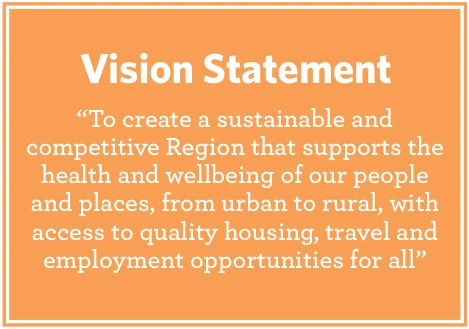
Figure from page 23
Vision Statement
“To create a sustainable and competitive Region that supports the
health and wellbeing of our people and places, from urban to rural, with
The 3 Key Principles are:
access to quality housing, travel and
• Healthy Placemaking To promote people’s quality of life through the creation of healthy and attractive places to live, work, visit, invest and study in.
employment opportunities for all”
• Climate Action The need to enhance climate resilience and to accelerate a transition to a low carbon society recognising the role of natural capital and ecosystem services in achieving this.
The place or environment in which we live or work has a profound impact on our health. The Region contains some of the fastest growing communities in the country and the long-term trend is for residential development moving further outwards from Dublin, with significant growth in many of the small towns and villages in the peri-urban area surrounding the city leading to an increase in car-based long-distance commuting. At the same time an overall lack of adequate housing supply to meet a growing population has resulted in affordability issues and increasing homelessness, with a resulting negative impact on quality of life and regional competitiveness.
• Economic Opportunity To create the right conditions and opportunities for the Region to realise sustainable economic growth and quality jobs that ensure a good living standard for all.
One of the key challenges facing the Region is the need for better alignment between population growth, location of residential development and employment to create healthy and attractive places, and this is reflected in the Vision Statement.

Figure from page 24
Regional Spatial & Economic Strategy
Pages 23–24 · View in original PDF