1.4 Spatial and Economic Policy Background
1.4 Spatial and Economic Policy Background
Developing the Strategy is achieved through the integration of spatial and economic policy both horizontally (across sectors) and vertically. By ensuring good alignment with European and National policy, the RSES can ensure that investment is targeted towards identified policy and objectives. Key policy parameters for the RSES growth strategy are also set by national policy documents including the NPF and the National Development Plan 2018- 2027 along with Ireland’s National Enterprise Policy 2015-2025 Enterprise 2025.
European Socio-Economic Policy
Project Ireland 2040 – National Planning Framework and National Development Plan
European spatial planning is closely interlinked with a number of trans-national, regional, economic and environmental policies and programmes. The European Union’s cohesion policy is currently divided into 11 Thematic Objectives (TO) aimed at reducing disparities in the development of its territories and to contribute to the priorities of smart, sustainable and inclusive growth envisaged by the Strategy “Europe 2020”. The European Regional Development Fund (ERDF) aims to strengthen economic and social cohesion in the European Union by correcting imbalances between its Regions. It is implemented at regional level through Regional Operational Programmes (ROPs) for the period 2014-2020.
With the publication of a new national spatial policy in February 2018 with Project Ireland 2040 (PI 2040)– National Planning Framework (NPF), which is underpinned by capital investment in the National Development Plan (NDP) 2018- 2027, Ireland is undergoing a review of planning and economic policy from the national level, to the regional and the local. The preparation of the RSES has been directly informed by PI 2040 and the National Policy Objectives contained therein.
One of the key drivers for the NPF is the promotion of effective regional development that manages more balanced growth between the three Irish Regions; the Eastern and Midland Region, the Northern and Western Region and the Southern Region. The NPF sets out a preferred ‘regional parity’ scenario where the growth of the other Regions would at least match that of the Eastern and Midland Region.
ROP objectives include; to increase competitiveness; to support innovation and investment in human capital; to enhance the natural attractor; to promote energy efficiency and sustainable mobility and to promote policies for social inclusion.
While it is recognised that Dublin is at the forefront of international competition for investment, the NPF encourages significant regional concentration towards the second-tier cities of Cork, Limerick, Galway and Waterford and some regionally important larger settlements, such as Athlone, Dundalk and Drogheda.
The next EU programming period 2021-2027 is under development, there is an emerging convergence of territorial and cohesion policy in this process, which will give greater focus on the delivery of national and regional spatial policy. The European Commission has proposed a new framework for the future Regional Development and Cohesion Policy that identifies five main objectives:
The key elements of the growth strategy identified at the national level, which set the parameters for the development of the RSES growth strategy include:
• A smarter Europe (innovative and smart economic transformation)
• Regional parity between the EMRA, and NWRA and SRA combined
• A greener, low-carbon Europe (including energy transition, the circular economy, climate adaptation and risk management)
• Regional concentration toward cities and some regionally important larger settlements
• A focus on contained growth and reduced sprawl by targeting infill and brownfield lands in existing built-up areas
• A more connected Europe (mobility and ICT connectivity)
• Sequential provision of infrastructure with some critical infrastructure in place to promote investment
• A more social Europe (European Pillar of Social Rights)
• A Europe closer to citizens (sustainable development of urban, rural and coastal areas and local initiatives).
• A Metropolitan Area Strategic Plan to deliver compact regeneration and growth in the Dublin metropolitan area and
• A comprehensive approach to rural fabric supporting sustainable growth and reversing decline.

Figure from page 11
Introduction
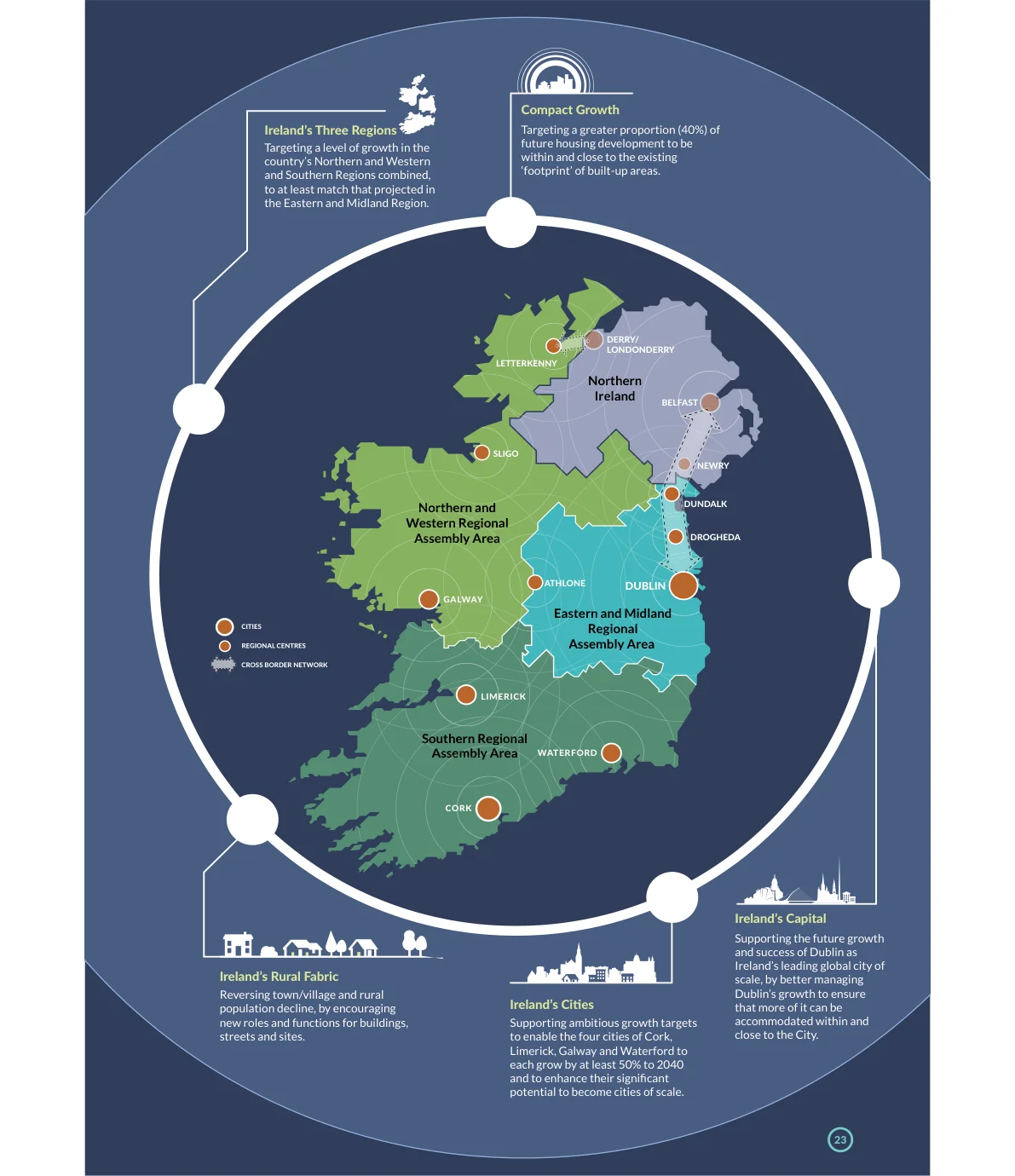
Figure 1.3 NPF map
Ireland’s Capital
Supporting the future growth and success of Dublin as Ireland’s leading global city of scale, by better managing Dublin’s growth to ensure that more of it can be accommodated within and

Figure from page 12
Regional Spatial & Economic Strategy
Enterprise 2025
Review of the National Spatial Strategy and the Regional Planning Guidelines
The national vision is that the Country is best placed to succeed in business by delivering sustainable employment and higher standards of living for all. Policies re-assert an export-led growth strategy underpinned by talent and innovation. This national policy aims to deepen resilience in the enterprise base to support the creation of quality jobs throughout Ireland so that full employment is sustainable over the longer term.
The National Spatial Strategy, 2000 introduced the concept of polycentric development in Ireland, with a focus on strengthening of the role of urban centres which have the potential to develop into ‘nodes’ or gateways’ to promote a more balanced regional development and counterbalance to the dominant capital.
The Regional Planning Guidelines (RPGs) were to support the implementation of the NSS as a policy tool to achieve the Government’s objective of more balanced regional development. The RPGs provided the link between the national and local planning frameworks providing more detail and establishing a development and spatial framework that was used to inform local authority development plans and other planning strategies at county, city and local level.
Key national economic priorities in Enterprise 2025 that set the parameters for the development of the RSES growth strategy include to;
• increase the emphasis on developing Irish owned enterprises – embedding resilience in our enterprise base, enhancing productivity and delivering quality jobs – including supporting companies to navigate their way through Brexit

Figure from page 12
• harness the distinctive characteristics of our foreign and Irish owned enterprise mix through collaboration and clustering
• place a spotlight on innovation and talent and leverage our strengths in disruptive technologies so that we achieve our ambition with more enterprises developing new products, services and solutions to compete effectively against international competition
• realise the full potential of our Regions through investments in placemaking - developing places that are attractive for business investment and for people to live and work
• develop our international relationships and strengthen economic diplomacy to raise Ireland’s visibility, protect Ireland’s reputation and provide opportunities for our enterprises.

Figure from page 13
Introduction
Pages 10–13 · View in original PDF