Values
As a Department, we foster a culture of accountability, efficiency, innovation and value for money, which is rooted in a public service ethos of
independence, equality, integrity, impartiality, openness, fairness, dignity and respect. As Civil Servants, we espouse the highest standards of
professionalism, honesty, objectivity and quality, which are central to fulfilling our roles in serving Government, the democratic system and the public.
Contents
Introduction ………………………………………………………………………………………………………………………………………………………………………………….……………….4
Figure from page 3
Guiding Principles…………………………………………………………………………………………………………………………………………………………………………………..………….6
Our Strategic Goals…………………………………………………………………………………………………………………………………………………………………………………..………..9
Goal 1: Maintain full employment and ensure sustainable and regionally balanced economic development…………………………………………..……….10
Goal 2: Advance the green and digital transitions to ensure the competitiveness and sustainability of Irish-based enterprise………………..……….11
Goal 3: Promote safety, better pay and conditions, more secure jobs and gender equality in the workplace…………………………………………..……….12
Goal 4: Enhance our business regulatory environment and Ireland’s attractiveness as a place to do business……………………………………………..…..13
Goal 5: Deepen and extend Ireland’s global business and trade in a responsible, fair and sustainable manner supportive of high living standards
and grow the all-island economy…………………………………………………………………………………………………………………………………………………………….………….14
Goal 6: Build an innovative and agile Department with a strong public service ethos driving effective and responsible policy implementation…15
Measuring Success and Implementing this Strategy……………………………………………………………………………………………………………………………………………16
Introduction
Figure from page 4
The Department of Enterprise, Trade and Employment leads in advising and implementing the Government’s policies of stimulating the productive capacity of the economy and creating an environment which facilitates employment creation and sustainability. The Department is also charged with promoting fair competition in the marketplace, protecting consumers and safeguarding workers. Working with our Offices and Agencies, the Department’s remit covers a wide range of activity including:
Assisting entrepreneurs and businesses to create and sustain high quality employment across all parts of our country, by developing a strong indigenous enterprise base, attracting Foreign Direct Investment and strengthening innovation and trade. Orienting policy to help enterprise reduce energy consumption and carbon emissions, meet the costs of decarbonisation and exploit the opportunities of the transition to a low carbon economy. Pursuing an ambition for Ireland to become a digital leader to drive productivity and enable a decoupling of economic growth from resource consumption. Assisting enterprise to research and innovate to maintain and create high quality jobs and contribute to building a better society. Identifying the future skills needs of enterprise and working across Government to develop policies to meet these needs, including through upskilling. Leading a whole-of-Government approach to developing a competitive environment for investment, productivity and sustainable jobs. Promoting quality employment, positive workplace relations, well-functioning dispute resolution mechanisms, safe working environments and legislating for enhanced workers’ rights. Ensuring our business regulation facilitates sustainable investment and development, competition in the market place, high standards of consumer protection and corporate governance, and provides Ireland with a competitive advantage in the global market. Working ambitiously across Government with our EU and international partners to advance Ireland’s interests, influence and values in our shared world. Ensure best value for money and alignment of Departmental expenditure with policy priorities, informed by data, evidence and robust evaluation. Since 2020, the Department has been working to achieve the commitments and priorities set out in the Programme for Government: Our Shared Future. We implemented our 2021-2023 Statement of Strategy and progressed our strategic goals during a period when the COVID-19 pandemic, the United Kingdom’s withdrawal from the EU and the impacts of the war in Ukraine were creating unprecedented challenges for the business community in Ireland.
The Department’s priorities are informed by a number of policies and strategies, including the recently published White Paper on Enterprise2022-2030 which sets out the priorities for Irish enterprise policy in the period to 2030. It provides a vision for Irish-based enterprise to succeed through competitive advantage founded on sustainability, innovation and productivity. We are also pursuing a range of new funding initiatives to boost our enterprise innovation performance and to deliver on the objectives set out in the Government’s research and innovation strategy, Impact 2030.
Figure from page 5
Advancing the green and digital transitions in Irish enterprise is imperative. During the lifetime of this Strategy, we will work to deliver on our commitments in the Government’s Climate Action Plan 2023. Our vision accords with the EU Green Deal, which aims to “transform the EU into a fairer and more prosperous society, with a modern, resource-efficient and competitive economy, with no net emissions of greenhouse gases by mid-century”. Our overriding policy focus will be on transitioning to a low carbon, sustainable economic model, both to meet our emissions abatement targets and to seize the economic opportunities arising. Harnessing Digital – the Digital Ireland Framework sets out an ambition for Ireland to become a digital leader to ensure competitiveness, drive productivity and enable a decoupling of economic growth from unsustainable resource consumption. Our enterprise agencies will act as advocates for digital transformation, with the agenda being integral to their engagement with business.
We are continuing to navigate the effects of Brexit and the finalisation of the future trading relationship between the UK and the EU. Ireland’s connectedness to the EU agenda and internationally is fundamental to the shape of our domestic agenda. We will continue to advocate at EU level for policy and regulation that is pro-enterprise, pro-trade and pro-consumer and that promotes an innovation-friendly economy. We will implement the Trade and Investment Strategy 2022-2026: Value for Ireland, Values for the World to enhance the positive contribution that trade and investment can make to our economic development. Ireland’s response to changing globalisation patterns and associated market and supply chain fragmentation will be flexible and agile while providing continuity and stability as an investment destination of choice.
Successful enterprise policy requires an integrated, whole-of-government approach. We are working to ensure that essential framework conditions are in place to support our policy ambitions and to contribute to the development of a stronger enterprise ecosystem. There are a number of cross-cutting issues that will be crucial to position Ireland for the challenges and opportunities ahead, ranging from infrastructural investment and taxation to regulation and talent.
The Department is committed to engaging directly with the business community and other stakeholders to assist us in identifying, understanding and developing policy responses to the opportunities and challenges in our economy. We have established a number of fora to facilitate consultation, engagement and partnership. This strategy has also been developed in the context of our role in contributing to progressing the UN Sustainable Development Goals in areas including employment, safe and secure working environments, fostering innovation and encouraging companies to adopt and report on sustainable practices.
Guiding Principles
Figure from page 6
In a dynamic environment, globally and domestically, we will be guided by five over-arching principles to steer delivery of our Strategy.
Strengthen Ireland’s economic position
In line with the ambitions of the White Paper on Enterprise 2022-2030, we will prioritise actions that enable strong, resilient growth and maintain full employment. We will build on enterprise strengths and opportunities through clustering, Smart Specialisation and Regional Enterprise Plans, strengthening our exporting sectors and enabling our locally trading sectors to thrive. We will strive to ensure an attractive quality of life in all parts of Ireland with high productivity and well-paid jobs.
Future-proof enterprise for sustainable growth
Sustainable growth can only be realised though delivery of responsive policies and programmes to help businesses to meet the challenges of the climate crisis mitigation and adaption, accelerating digital transformation, and developing the resilience and agility required to respond to the shocks and uncertainty which are increasingly becoming a feature of the global economy.
Our success in strengthening enterprise driven research, development and innovation will directly impact on Ireland’s ability to create and maintain a thriving and prosperous economy, to grow employment, to develop the products and services that can deliver a low carbon economy and society, and to maximise the opportunities of digital transformation for all.
Protect consumers and safeguard workers
In a time of economic uncertainty and rising costs it becomes increasingly important to give customers more choice, protection and to ensure that markets work fairly and effectively. We will maintain an agile, efficient regulatory regime that promotes fair competition for both businesses and consumers; and we will safeguard strong, transparent consumer rights to ensure value for money, quality customer care and protection from unsafe products.
At the outset of this strategy, we have more people employed in the country than at any other point in the history of the state. Our aim is to continue to create the conditions for good quality, high productivity jobs and to make sure work pays. We will build on our progress to date to improve terms and conditions for workers, and to strengthen collective bargaining. We will lead by example, supporting our staff to develop their potential in a changing workplace. We will maintain a company law framework that facilitates enterprise and safeguards stakeholders such as employees, creditors and the State.
Advance responsible trade and enterprise
Values based trade is a key tenet of our national Trade and Investment Strategy 2022-26 ‘Value for Ireland, Values for the World’. We will retain our strong commitment to open and inclusive trade with the WTO at the core of a rules based multilateral system, while promoting our values in relation to human rights, environment and climate, social and labour rights, sustainable development and gender equality.
Figure from page 7
At home, we will continue to build a regulatory environment to reinforce positive and responsible business behaviours. We will work to deliver strong accountability and transparency frameworks, including through Corporate Sustainability Reporting and the Digital Services Package.
Deepen and extend our international relationships
Ireland’s openness to trade, investment, people and ideas has long been integral to our national prosperity. Sustaining our valuable international connectivity is an increasing priority in a time of fragmenting global relationships.
Foreign Direct Investment and trade will remain central to our growth model and economic strategy. Our response to changing globalisation patterns and a fracturing trading landscape will be flexible and agile while providing continuity and stability as an investment destination of choice. We will encourage Irish businesses to take full advantage of the EU Single Market and to strike out for global markets fully utilising the extensive network of EU Free Trade Agreements.
We will strive to build the alliances necessary to advance our interests and defend our positions in the EU, in particular by leveraging our Presidency of the Council of the EU in 2026. We will continue to develop our deep and positive relationship with the UK and its constituent parts into the future.
Human Rights and Equality Public Sector Duty
In line with our obligations under the Irish Human Rights and Equality Commission Act 2014, the Department is committed to ensuring our policies, procedures and services comply with requirements in the areas of human rights and equality.
Figure from page 8
Our Department’s Equality, Diversity and Inclusion (ED&I) Statement articulates our commitment to embedding ED&I into our way of doing business.
As an organisation, we recognise that our people are our greatest asset. We want to support our staff to achieve their full potential by nurturing an inclusive environment that champions diversity. As an open and welcoming workplace, we aim to attract and retain the talent required to deliver on the Department’s strategic agenda.
During the lifetime of this strategy we will:
Publish our new ED&I Statement, which outlines how we as a Department are meeting our duty to eliminate discrimination, promote equality, and protect the human rights of our staff and our service users; Develop a broader ED&I Strategy which will build on the ED&I statement, and outline the actions we will take to build a more inclusive, equitable and diverse organisation. We will also ensure that fairness, respect, and equality are integral to our provision of services to the public; Promote and foster our human rights and equality duty as part of the training cycle; Report on progress in our Annual Report; Continue to implement Ireland’s trustworthy, ethical and human-centric approach to Artificial Intelligence under the AI – Here for Good strategy; Continue to engage with the Irish Centre for Diversity to secure our ‘Investors in Diversity’ EDI Mark as a measure of our progress to foster equality, diversity and inclusion across the Department. Throughout the Department’s broad remit of work, we continue to value and promote equality, inclusiveness and human rights through our development of policy and legislation and through our active participation in international organisations and multilateral fora.
Our Strategic Goals
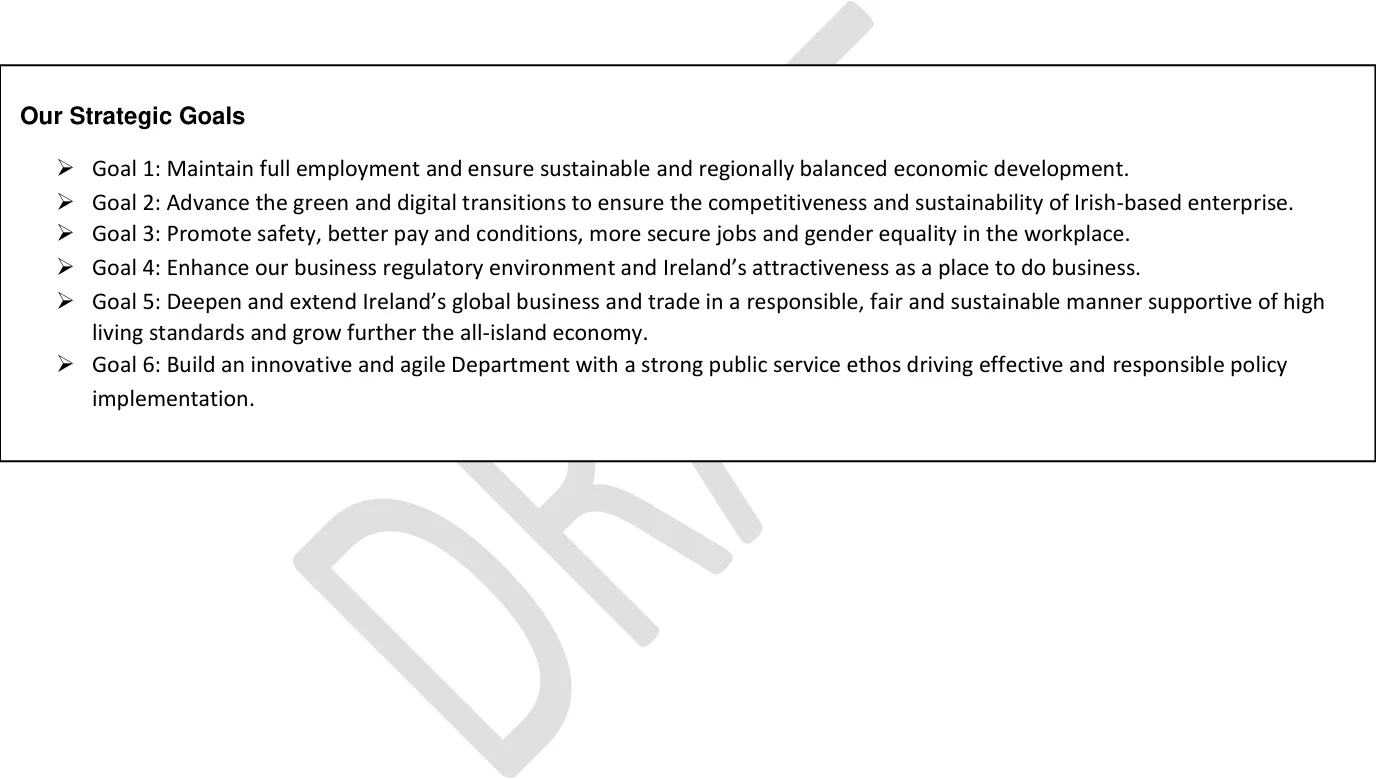
Figure from page 9
Our Strategic Goals
➢Goal 1: Maintain full employment and ensure sustainable and regionally balanced economic development. ➢Goal 2: Advance the green and digital transitions to ensure the competitiveness and sustainability of Irish-based enterprise. ➢Goal 3: Promote safety, better pay and conditions, more secure jobs and gender equality in the workplace. ➢Goal 4: Enhance our business regulatory environment and Ireland’s attractiveness as a place to do business. ➢Goal 5: Deepen and extend Ireland’s global business and trade in a responsible, fair and sustainable manner supportive of high
living standards and grow further the all-island economy. ➢Goal 6: Build an innovative and agile Department with a strong public service ethos driving effective and responsible policy
implementation.
Goal 1: Maintain full employment and ensure sustainable and regionally balanced economic
development
How we achieve this
Implement the White Paper on Enterprise to build the resilience and sustainability of our economy and ensure Irish-based firms are best positioned to realise opportunities and respond to challenges. Develop policies with our enterprise agencies to create high quality jobs, productivity growth, strong management and leadership capacity. Support the expansion of Ireland as a location for Foreign Direct Investment, including through growth and transformation of existing investments. Strengthen linkages between foreign and Irish-owned firms, developing stronger ecosystems to help local firms to embed themselves in the value chains of FDI intensive sectors. Implement the enterprise workstreams set out in the National Economic Plan and implement the Regional Enterprise Plans to 2024. Help SMEs to start up, scale up and access international markets to maximise productivity. Broaden and deepen innovation capability across the enterprise sector, in particular the innovation performance of our SMEs. Promote construction sector innovation and modern methods to accelerate delivery of high quality, environmentally sustainable and more-affordable housing. Progress Ireland’s National Space Strategy for Enterprise to further expand our space-active industry. Build on Ireland’s enterprise strengths and potential by leveraging clustering policy and implementing Ireland’s Smart Specialisation Strategy, supported by the rollout of ERDF programmes. Ensure that Irish SMEs can access finance, including microfinance, loan guarantees, and seed and venture capital. Manage an efficient employment permits system, maximising the benefits of economic migration and minimising the risk of disruption to Ireland’s labour market. Engage with stakeholders and across Government to drive NDP delivery and align investment with economic and enterprise development. Continue to engage at EU level on the development of the State Aid Framework to ensure Ireland’s national interests are represented. Ensure the Department’s Industrial Development schemes are compliant and take advantage of the opportunities available under the EU State Aid rules and advise and assist other Departments to achieve the same in relation to their schemes.
Outcome Full employment in all parts of the country, underpinned by a competitive and conducive environment with a resilient, innovative and productive enterprise base.
Goal 2: Advance the green and digital transitions to ensure the competitiveness and sustainability of
Irish based enterprise
Figure from page 11
How we achieve this Contribute to Ireland’s 2050 carbon neutrality ambition, while strengthening the resilience of our enterprise base, by developing and implementing policies to deliver on the enterprise and non-residential buildings sectoral emissions ceilings in the Climate Action Plan 2023. Embed decarbonisation measures into enterprise policy and introduce supports for industry to transition to more sustainable environmental practice, reduce carbon emissions, and exploit the opportunities of the low carbon economy, including renewable energy opportunities. Assist SMEs to start their journey towards lower emissions and improved energy efficiency through encouraging the visibility and services of bodies such as SEAI, and utilisation of resources such as the Climate Toolkit 4 Business online tool. Progress the development of new EU and global standards development including the objectives of the EU’s Standardisation Strategy. Reflect the circular and waste economy strategies in the development of sustainable product standards. Advocate at EU level for policy and regulation that promotes an innovation-friendly digital economy. Stimulate the digital transformation of manufacturing industry to achieve a competitive, innovation-driven manufacturing hub. Lead the cross-Government implementation of the National Artificial Intelligence Strategy that aims to optimise socio-economic opportunities while also paying attention to ethical and societal considerations. Establish the Digital Services Coordinator,in cooperation with The Department of Tourism, Culture, Arts, Gaeltacht, Sport and Media, to ensure robust regulation of the Digital Services Act. Facilitate increased digitalisation and improved productivity across all enterprise sectors through the continued rollout of the Digital Transition Fund and development of the Digital Portal to help businesses to self-assess their digital needs as well as signposting to training, resources and funding options. Establish the European Digital Innovation Hubs to help SME and public sector bodies with their digital transformation as well as providing training, research and testing and advice. Implement Government policy on data centres to facilitate balanced development of the sector as key infrastructure to facilitate the digital economy Contribute to progressing the UN Sustainable Development Goals (SDGs), lead on ten SDG targets, and share responsibility for further targets. Lead by example in reducing emissions in our organisation by continuing with our Green Team Initiatives, implementing energy saving projects and embedding further a Green Culture in the Department. Continue work with the OPW particularly in the areas of energy conservation, waste generation and biodiversity.
Outcome Alignment with the Climate Action Plan target of halving our overall greenhouse gas emissions by 2030, followed by a net zero economy by 2050, whilst mitigating the costs of decarbonisation and fostering opportunities for growth in the green economy. Progress towards Ireland becoming a leading digital economy to enhance productivity and the decoupling of economic growth from resource consumption.
Goal 3: Promote safety, better pay and conditions, more secure jobs and gender equality in the
workplace.
How we achieve this
Ensure that employment rights and insolvency and redundancy legislation continues to be fit for purpose and is updated to reflect national and international developments, including at EU, Court of Justice and International Labour Organisation level. Provide employees with a statutory entitlement to request remote working. Implement outstanding actions from the Plan of Action for Collective Redundancies Following Insolvency. Review and implement the report of the Labour Employer Economic Forum on collective bargaining. Deliver positive workplace relations, well-functioning dispute resolution mechanisms and robust enforcement of employment rights. Ensure that the Workplace Relations Commission and the Labour Court continue to provide a world-class workplace relations service and employment rights framework. Through the Construction Contracts Adjudication Service, ensure that sub-contractors can swiftly resolve payment disputes. Progress towards a National Living Wage (to be achieved by January 2026) and oversee sectoral wage setting in certain economic sectors. Provide support for the Low Pay Commission. Ensure that a robust and effective occupational safety and health regime is in place for workers and assists employers in operating safe, productive and competitive businesses. Ensure Ireland has a strong chemical regulatory framework in place by leading across Government and working with stakeholders and industry. Work with the Local Authorities to ensure the Dangerous Substances licensing and enforcement regime is implemented. Engage with industry to promote best practice and monitor private sector progress in building diverse and inclusive workplaces. Lead on Ireland’s engagement with the Council of Europe in relation to the European Social Charter and the International Labour Organisation, coordinating their wide-ranging agendas across Government with a focus on employment and labour market standards.
Outcome A policy, legislative and institutional framework which enables quality employment, good industrial relations and safe working environments, thereby assisting a strong economy and a fair society, balancing flexibility and security and providing protection for all employees.
Goal 4: Enhance our business regulatory environment and Ireland’s attractiveness as a place to do
business.
How we achieve this
Analyse and develop evidence and data-based policy recommendations on the competitiveness and productivity performance of the economy, including the recommendations of the National Competitiveness and Productivity Council. Provide a progressive Intellectual Property regime that stimulates economic growth by encouraging innovation and creativity across society and which is responsive to the challenges and opportunities of a digital economy. Ensure that corporate and regulatory policy and legislation is responsive and reflects international best practice so that Ireland can facilitate enterprise and entrepreneurship, while protecting employees, members and creditors with appropriate safeguards. Support the regulatory and enforcement bodies established under the Companies Act 2014 and ensure company law enables the bodies to undertake their statutory functions effectively. Modernise consumer protection legislation. Facilitate the Personal Injuries Resolution Board to resolve personal injury claims without the need for litigation, thereby reducing the costs of personal injury claims and facilitate reductions in insurance premiums. Maintain a strong connection between enterprise and the higher education sector to ensure that future skills needs of business are met, including through upskilling. Continue to work collaboratively with colleagues across Government and to engage with stakeholders to ensure that our taxation regime works for all businesses from self-employed sole traders to local SMEs and right up to large multinationals. Ensure effective business regulation and reduced administrative burdens, without undermining the policy goals of regulation and the protections provided, through the development of policy that is evidence-based, employing the SME Test, public consultation and impact analysis. Continued structured engagement with relevant stakeholder bodies and representative organisations. Promote a coherent and effective regulatory framework to maintain Ireland’s position as a digital regulatory hub.
Outcome A business environment facilitating investment and development, competition in the marketplace, and high standards of consumer protection
d
Goal 5: Deepen and extend Ireland’s global business and trade in a responsible, fair and sustainable manner supportive of high living standards and grow the all-island economy.
Figure from page 14
How we achieve this Work with our EU and international partners and build and strengthen alliances to shape emerging policies, regulation and international agreements that impact Ireland’s economic and business environment. Promote free, open trade in support of Ireland’s economic model, advocate for new EU Free Trade Agreements and for maintaining and deepening transatlantic trade relations, working with the EU Commission in the EU-US Trade and Technology Council. Ensure that Ireland’s position on all trade deals supports the transition to a sustainable global economy. Work across Government and with our EU partners to identify and remove barriers to trade, particularly in services, to secure a fully functioning EU Single Market for the benefit of our exporters, businesses and other consumers. Mitigate the impacts of Brexit on Irish business and on our trading relationship with the UK. Strengthen important supply chains on the island of Ireland to grow cross-border trade, and foster opportunities for collaboration in the context of a Shared Island. Implement the Government’s Trade and Investment Strategy 2022-2026: Value for Ireland, Values for the World, overseen by the Trade and Investment Council. Assist enterprise to enter and benefit from international markets and to expand into new markets by taking full advantage of the network of EU Free Trade Agreements. Work with our agencies as part of Team Ireland abroad to promote our exports and highlight Ireland’s attractiveness for investment and innovation, to capitalise on global shifts in business models and emerging disruptive technologies and attract the next wave of technology and business activity. Advance Ireland’s economic and trading interests in multilateral contexts, including the WTO and the OECD, and work jointly with the EC and EU Member States to ensure that the WTO is at the heart of a global, rules-based, multilateral trading system, delivering on its negotiating, dispute settlement and trade capacity building and outreach remits. Ensure that Ireland has a robust legal and operational framework for regulating the export of controlled goods, in support of global security. Implement UN and EU Trade Sanctions in support of international law and human rights. Introduce a mechanism to screen third country investment into Ireland, which will send a clear signal to our international trade and investment partners that Ireland is a responsible member of the global community. Promote responsible business practices against the background of developments at an EU and international level. Outcome New enterprise opportunities in an all-island economy, in international trade and investment, andincreased and new types of FDI investments.

Figure from page 14
Goal 6: Build an innovative and agile Department with a strong public service ethos driving effective and
responsible policy implementation
How we achieve this
Embed our Blended Working Policy to fulfil our business objectives and provide staff with a positive work/life balance. Build on wellbeing and other relevant initiatives in the Department and deliver a clear and compelling ‘responsible business’ offering, as part of our ambition to be an Employer of Choice. Ensure a strong commitment to diversity and equality for our staff and in the services we deliver as a Department, engaging with the Irish Human Rights and Equality Commission and in line with the Act, 2014. Continue to implement our People Strategy 2021-2024 and invest in learning and career development to support our staff to deliver the Department’s mandate. Embed innovation into the work of the Department through stimulating ideation, supporting ‘design thinking’ and creating opportunities for teams to foster innovative approaches to service delivery. Implement our ICT strategy to deliver stable, secure and scalable digital and data solutions and services, optimising the user and citizen experience. Implement our Communication Strategy 2022-2024 to support effective communication with our staff, stakeholders and the general public. Ensure best value for money and alignment of Departmental expenditure with policy priorities, informed by data, evidence and robust evaluation. Continue to demonstrate excellence in corporate governance which will provide transparency and ensure value for money. Ensure compliance with the obligations on public bodies to make buildings and services accessible in line with Part 3 of the Disability Act 2005. Streamline and enhance our accommodation in order to optimise space, future proof our buildings and deliver savings in energy usage. Ensure a safe and healthy working environment for all staff and visitors to the Department in compliance with statutory provisions, through the effective implementation of a Department Safety Statement and Safety Policy. Outcome
A Department with staff who are innovative, flexible, responsive and agile, ensuring high standards of public service and corporate governance, and optimised resources to deliver our Strategy, Mission and Goals
Measuring Success and Implementing this Strategy
Figure from page 16
The Department of Enterprise, Trade and Employment Dashboard which can be accessed here presents approximately 100 economic indicators across the areas of enterprise, trade and employment. A summary of UK and Northern Ireland data is also provided in the context of a focus on Brexit and its implications from an Irish trade perspective. The data is sourced from national and international sources such as the CSO and Eurostat, as well as from Business Units across the Department and our Agencies and Offices. The strategic objectives, actions and outcomes outlined in this Statement of Strategy will inform and be reflected in the annual business and risk management plans produced by each business area across the Department. These will contain specific targets which each business area will be expected to deliver on each year, the aggregation of which should ensure that the commitments outlined in the Statement are met. Heads of business units are required to report progress on unit business plans twice each year. The Annual Report will detail the progress achieved each year on the strategic objectives and actions contained in this Statement of Strategy. The White Paper on Enterprise includes 15 targets for enterprise policy in the period to 2030. The Department of Enterprise, Trade and Employment is leading on developing consecutive two-year Implementation Plans of cross-government activity to implement the White Paper and deliver on these targets. The Implementation Plans will set out how the various Government Departments, agencies and offices will deliver their respective commitments as timetabled deliverables with the Department and its offices and agencies taking a lead role. Progress will be reported on biannually to the Cabinet Committee on Economic Recovery and Investment and monitored on an ongoing basis via the associated Senior Officials Group. The biannual reports will include updates on progress towards the 15 targets with new data under each of the measures included as it becomes available from the relevant sources. The Public Service Performance Report provides citizens with clear and accessible information on how public funds were allocated, how those funds have been used and outlines the outputs and impacts of Departmental programmes. The Department reports against a range of indicators related to the three programmes of expenditure set out in its part of the Revised Estimate Volume.
Pages 2–16 · View in original PDF