8.6 Patronage
8.6 Patronage
Although the education system is state funded, the majority of schools are owned and managed by private organisations. The Department sanctions teaching posts and pays teacher salaries, whereas the board of management is the employer of teachers in a school.
There is a range of patronage models in operation
While the State provides for free primary and post-primary education, schools are established by patron bodies who define the ethos of the school and appoint the board of management to run the school on a day-to-day basis. The patron’s responsibilities are set out in law under the Education Act 1998. There is a range of patronage models in operation in primary and special schools and in post-primary schools.
At primary school level, the Department of Education currently classifies schools as denominational, inter-denominational and multi-denominational, offering education through the medium of English or Irish.
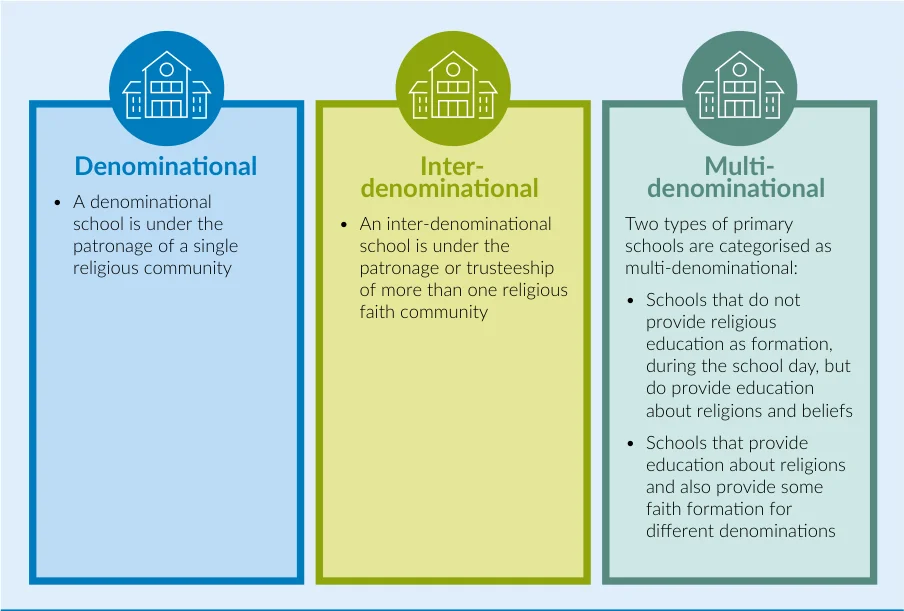
Figure 8.1: Models of school patronage
Denominational
Interdenominational
Multidenominational
• A denominational school is under the patronage of a single religious community
• An inter-denominational school is under the patronage or trusteeship of more than one religious faith community
Two types of primary schools are categorised as multi-denominational:
• Schools that do not provide religious education as formation, during the school day, but do provide education about religions and beliefs
• Schools that provide education about religions and also provide some faith formation for different denominations
Within the above models of school patronage, there are four models of post-primary provision: voluntary secondary, vocational (including community colleges), community schools and comprehensive schools, all of which are funded by the Department. Within the four categories, there is a degree of variation as particular school types have been adapted to meet local circumstances, for example, in order to meet the religious composition of a particular community.
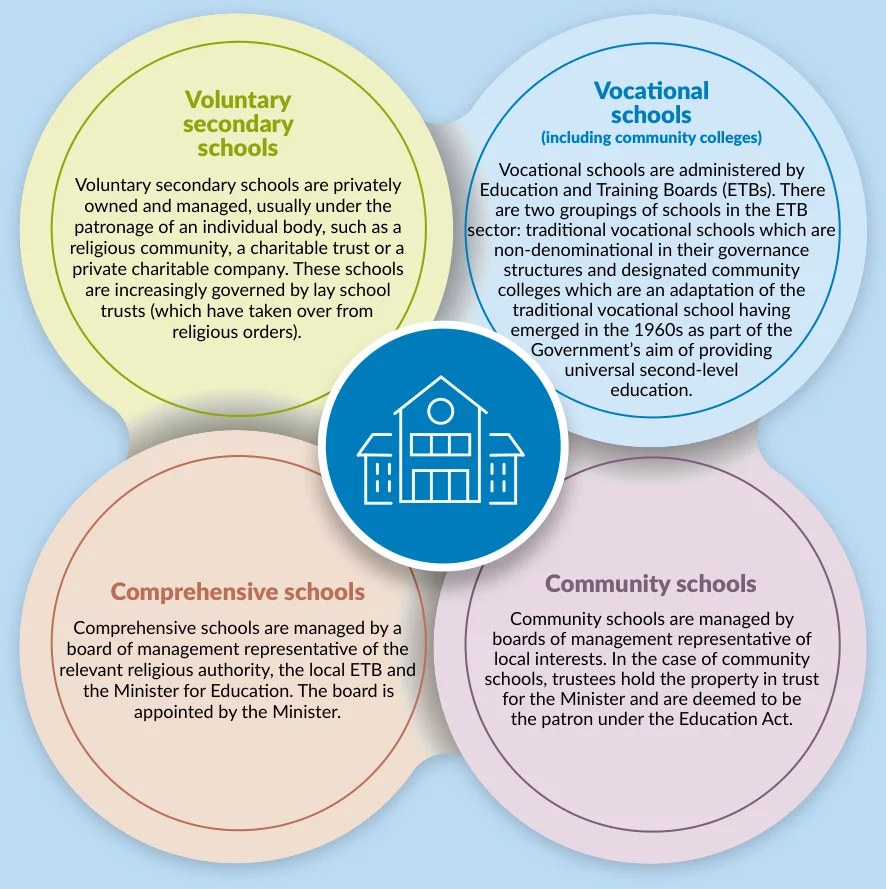
Figure 8.2: Models of post-primary provision
Vocational
Voluntary secondary
schools (including community colleges)
schools
Vocational schools are administered by Education and Training Boards (ETBs). There
Voluntary secondary schools are privately
owned and managed, usually under the patronage of an individual body, such as a religious community, a charitable trust or a
are two groupings of schools in the ETB sector: traditional vocational schools which are
non-denominational in their governance
private charitable company. These schools
structures and designated community colleges which are an adaptation of the
are increasingly governed by lay school
traditional vocational school having emerged in the 1960s as part of the
trusts (which have taken over from
religious orders).
Government’s aim of providing
universal second-level
education.
Community schools
Comprehensive schools
Community schools are managed by boards of management representative of
Comprehensive schools are managed by a board of management representative of the relevant religious authority, the local ETB and
local interests. In the case of community schools, trustees hold the property in trust
the Minister for Education. The board is
for the Minister and are deemed to be
appointed by the Minister.
the patron under the Education Act.
Most schools are under the patronage of religious denominations
The vast majority of primary schools in Ireland are owned by, and under the patronage of, religious denominations. In 2020, 94% of the 3,102 primary schools were denominational, and 89% were under the patronage of the Catholic Church (Table 8.9). At post-primary level, voluntary secondary schools, community schools and comprehensive schools are generally denominational, and vocational schools and community colleges are inter-denominational. In 2020, 50% of the 730 post-primary schools were denominational, (47% Catholic and 3% Protestant) and 49% were multi-denominational (Table 8.10).
Table 8.9: Mainstream primary schools by ethos: 2016-2020
| Catholic | Church of Ireland | Multi- denominational/ Inter- denominational143 | Other | Total | |
|---|---|---|---|---|---|
| 2020 | 2,756 | 171 | 159 | 21 | 3,107 |
| 2019 | 2,760 | 172 | 153 | 21 | 3,106 |
| 2018 | 2,776 | 173 | 136 | 21 | 3,106 |
| 2017 | 2,785 | 174 | 132 | 20 | 3,111 |
| 2016 | 2,794 | 175 | 126 | 20 | 3,115 |
Source: Statistics Section, Department of Education
Table 8.10: Mainstream post-primary schools by ethos: 2016-2020
| Catholic | Church of Ireland | Multi- denominational/ Inter- denominational144 | Other | Total | |
|---|---|---|---|---|---|
| 2020 | 344 | 22 | 359 | 5 | 730 |
| 2019 | 344 | 22 | 352 | 5 | 723 |
| 2018 | 346 | 22 | 349 | 5 | 722 |
| 2017 | 345 | 23 | 343 | 4 | 715 |
| 2016 | 344 | 23 | 340 | 4 | 711 |
Source: Statistics Section, Department of Education
The schools’ reconfiguration for diversity process is changing the profile of the patronage of schools
In recent years, society has changed rapidly and it now includes families of many different nationalities, religions and beliefs. Education legislation has also evolved. With the commencement of certain sections of the Education (Admissions to Schools) Act 2018, since October 2018, primary schools are prohibited from using religion as a selection criterion in school admissions. However, as also outlined in the Act and in Circular 0007/2020, there are protections in this provision to ensure that a child of a minority faith can still access a school of their own faith.
143 One non-denominational school is included in the data for multi/inter-denominational primary schools 144 One non-denominational school is included in the data for multi/inter-denominational post-primary schools.
While schools (denominational, multi-denominational and inter-denominational) welcome children and young people of all beliefs and none, it is evident that increased diversity of patronage is required to respond fully to the changing needs of society.
The schools’ reconfiguration for diversity process was initiated in 2017 by the Government to provide more multi-denominational schools. To improve parental choice, the Government has committed to achieving the target of at least 400 multi-denominational primary schools by 2030. While new schools will account for a certain amount of this provision, transfers of existing schools from religious patronage are also required to achieve that target. There is evidence that progress has been made. The number of multi-denominational or inter-denominational primary schools almost doubled from 85 in 2011145 to 159 (out of a total of 3107) in 2020 (Table 8.9). Of the 730 post-primary schools in 2020, almost half (359 in total) were multi-denominational or inter-denominational (Table 8.10).
To cater for all the different traditions and religions from which pupils/students come, it is evident that the school patronage system needs to continue to evolve.
Pages 240–243 · View in original PDF