8.1 Introduction
8.1 Introduction
Good leadership and effective management play key roles in ensuring that schools are effective and responsive to the needs of children and young people. Leadership is often a key factor where there are significant shortcomings in educational provision in schools or education centres. This chapter outlines some key findings relating to the leadership and management of schools from inspections in the period 2016-20. It looks at the supports that have been put in place to promote effective leadership and management in schools. Leadership and management for learning in early learning and care (ELC) settings has been considered in Chapter 3.
This chapter also comments on what our experience of working with schools and their leaders, as well as the organisations and bodies involved in their management, is telling us about the sustainability of the current arrangements for the management of schools. Finally, it summarises the key messages arising from developments and inspection findings, which are intended to inform the way forward.
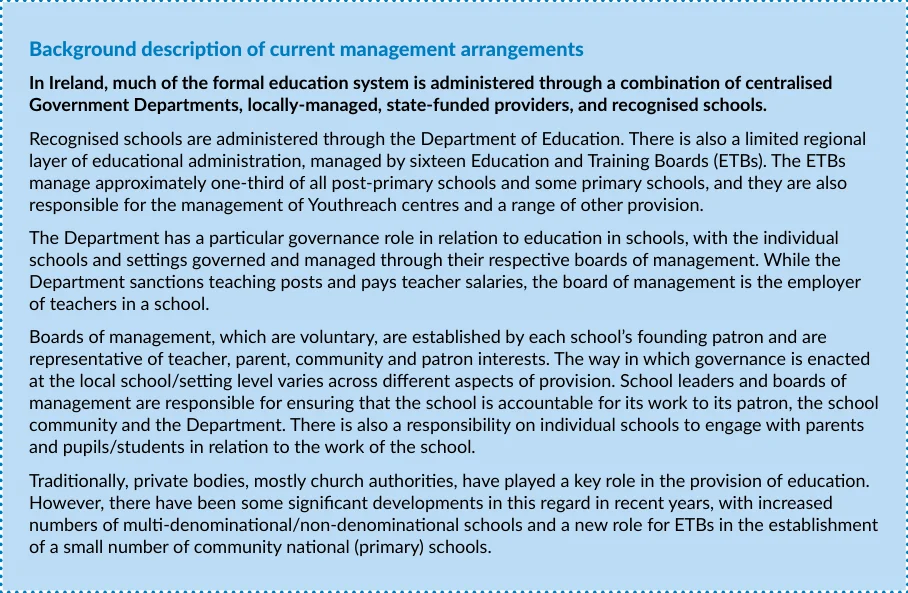
Figure from page 224
Background description of current management arrangements
In Ireland, much of the formal education system is administered through a combination of centralised Government Departments, locally-managed, state-funded providers, and recognised schools.
Recognised schools are administered through the Department of Education. There is also a limited regional layer of educational administration, managed by sixteen Education and Training Boards (ETBs). The ETBs manage approximately one-third of all post-primary schools and some primary schools, and they are also responsible for the management of Youthreach centres and a range of other provision.
The Department has a particular governance role in relation to education in schools, with the individual schools and settings governed and managed through their respective boards of management. While the Department sanctions teaching posts and pays teacher salaries, the board of management is the employer of teachers in a school.
Boards of management, which are voluntary, are established by each school’s founding patron and are representative of teacher, parent, community and patron interests. The way in which governance is enacted at the local school/setting level varies across different aspects of provision. School leaders and boards of management are responsible for ensuring that the school is accountable for its work to its patron, the school community and the Department. There is also a responsibility on individual schools to engage with parents and pupils/students in relation to the work of the school.
Traditionally, private bodies, mostly church authorities, have played a key role in the provision of education. However, there have been some significant developments in this regard in recent years, with increased numbers of multi-denominational/non-denominational schools and a new role for ETBs in the establishment of a small number of community national (primary) schools.
Context & developments
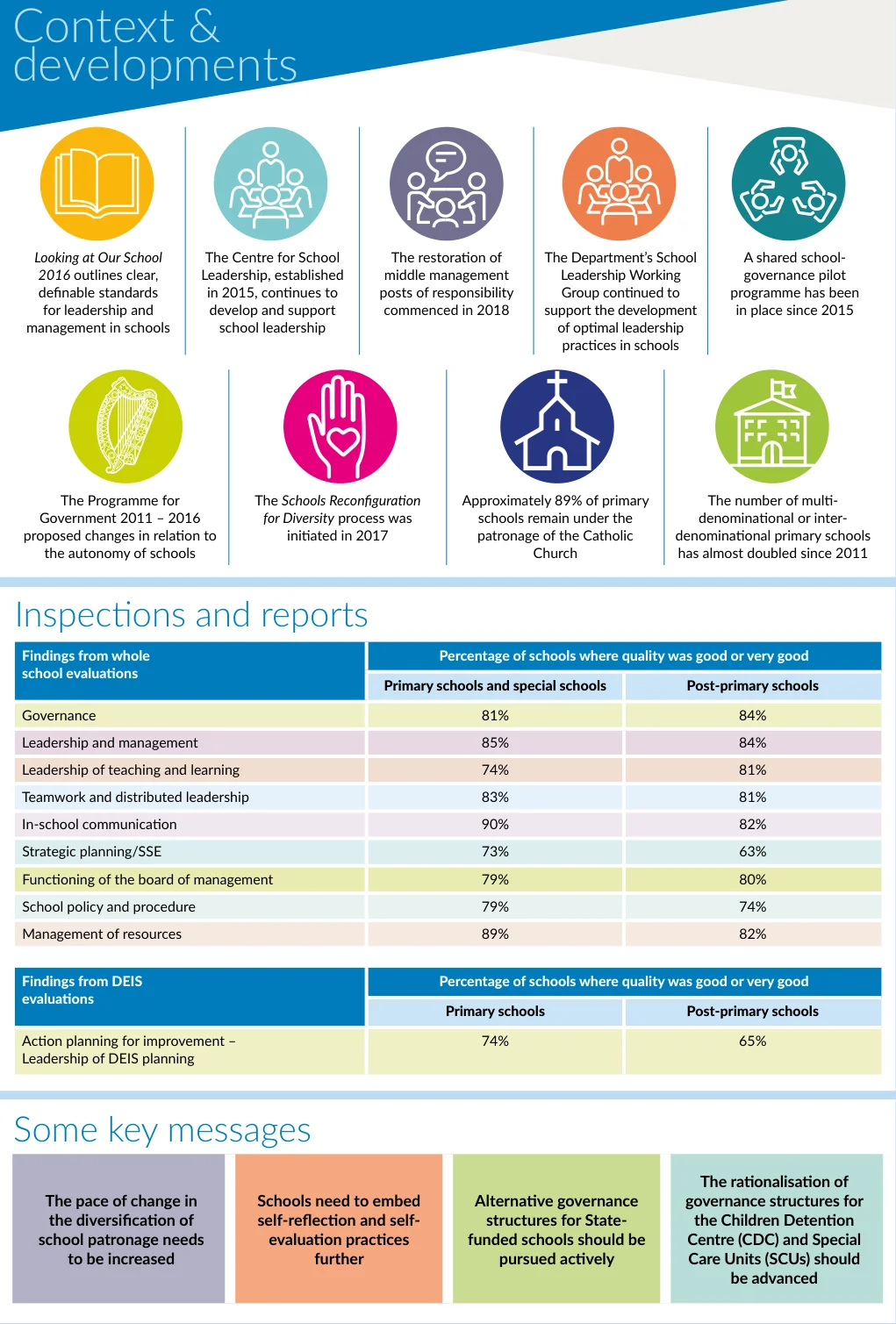
Figure from page 225
The Centre for School Leadership, established
The restoration of middle management posts of responsibility
The Department’s School
A shared schoolgovernance pilot programme has been
Looking at Our School
2016 outlines clear, definable standards
in 2015, continues to
for leadership and management in schools
develop and support
commenced in 2018
support the development
in place since 2015
school leadership
The Programme for Government 2011 – 2016 proposed changes in relation to
Approximately 89% of primary
The number of multidenominational or interdenominational primary schools
schools remain under the patronage of the Catholic
the autonomy of schools
Church
has almost doubled since 2011
Inspections and reports
| Findings from whole school evaluations | Percentage of schools where quality was good or very good | |
|---|---|---|
| Primary schools and special schools | Post-primary schools | |
| Governance | 81% | 84% |
| Leadership and management | 85% | 84% |
| Leadership of teaching and learning | 74% | 81% |
| Teamwork and distributed leadership | 83% | 81% |
| In-school communication | 90% | 82% |
| Strategic planning/SSE | 73% | 63% |
| Functioning of the board of management | 79% | 80% |
| School policy and procedure | 79% | 74% |
| Management of resources | 89% | 82% |
| Findings from DEIS evaluations | Percentage of schools where quality was good or very good | |
|---|---|---|
| Primary schools | Post-primary schools | |
| Action planning for improvement – Leadership of DEIS planning | 74% | 65% |
Some key messages

Figure from page 225
Pages 224–225 · View in original PDF