7.1 Introduction
7.1 Introduction
This chapter focuses on important partnerships that enhance children’s and young people’s learning. When schools and settings work well with the communities and families that they serve, the education and wellbeing of children and young people can be enhanced considerably. Giving voice and agency to children, young people and their parents116 is a key element of partnership. The importance of such partnerships is recognised officially in public policies and documents, as well as in national strategies. To enable children and young people to express their views, we must give them opportunities to form that view, and they also should know that it will be listened to, and acted upon, as appropriate. Meaningful partnerships with parents require recognition of the role of parents, and their right to be involved in their child’s education, as well as practical strategies to ensure genuine partnerships can be established and maintained.
The first part of this chapter looks at two aspects of these relationships: firstly, the partnerships that schools and settings foster with parents, and secondly, how schools and settings listen and respond to the voices of children/young people and their parents and promote their participation in meaningful ways.
Engaging more fully with children, young people and their parents is not just a task for schools, early learning and care (ELC) settings or other education settings. Alongside the Tusla Early Years Inspectorate and other bodies concerned with supporting the quality of provision, the Inspectorate of the Department of Education is conscious that it, too, must listen to and include the perspectives of children/young people and their parents during inspections, given the valuable and unique insights that they can provide into educational provision in schools and the importance of valuing and respecting their views. We are mindful that a well-integrated system of evaluation combines the external perspectives of inspectors with the reflective and collective insights of leaders, educators/teachers, parents and children/young people in schools and early learning and care settings in order to better understand the quality of education provision. We are also mindful of the need to ensure that parents, children and young people are given information about the quality of the education provided in the school or setting that has been inspected. The provision of this information serves an important accountability and improvement function by promoting transparency and discourse about quality in education settings. In the September 2016 to December 2020 period, the Inspectorate developed its processes in a number of ways so that the insights of children/young people and their parents could be incorporated more effectively into its work. We are also looking at how we can improve how we give parents, children and young people information about the quality of the education provided in settings/schools. The second part of this chapter describes this aspect of the Inspectorate’s work.
116 The term parent is used to refer to a child’s father(s) and/or mother(s) and/or guardian(s).
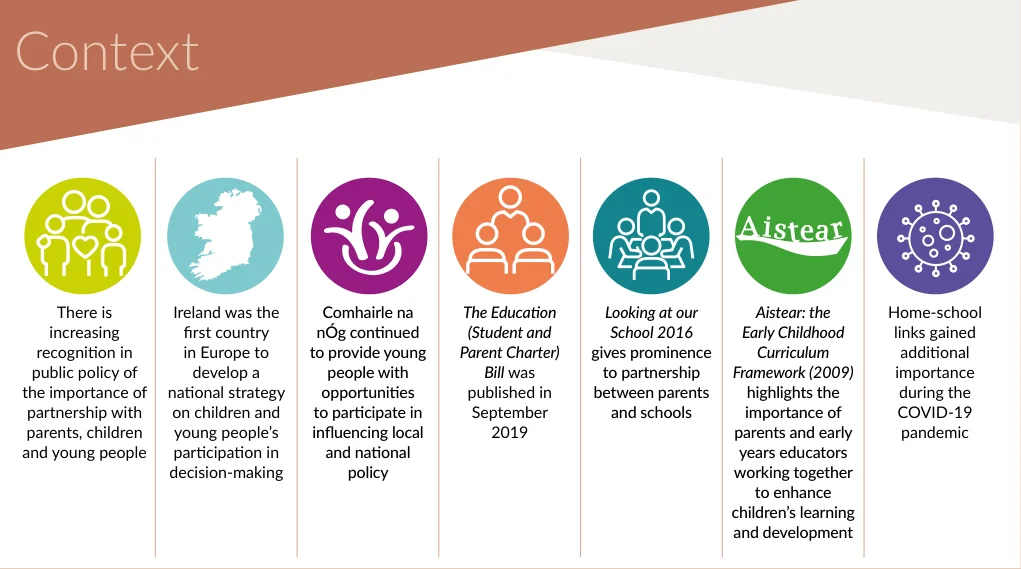
Figure from page 205
Context
There is increasing recognition in public policy of the importance of
Ireland was the
first country in Europe to
develop a national strategy
partnership with parents, children and young people
on children and
young people’s participation in decision-making
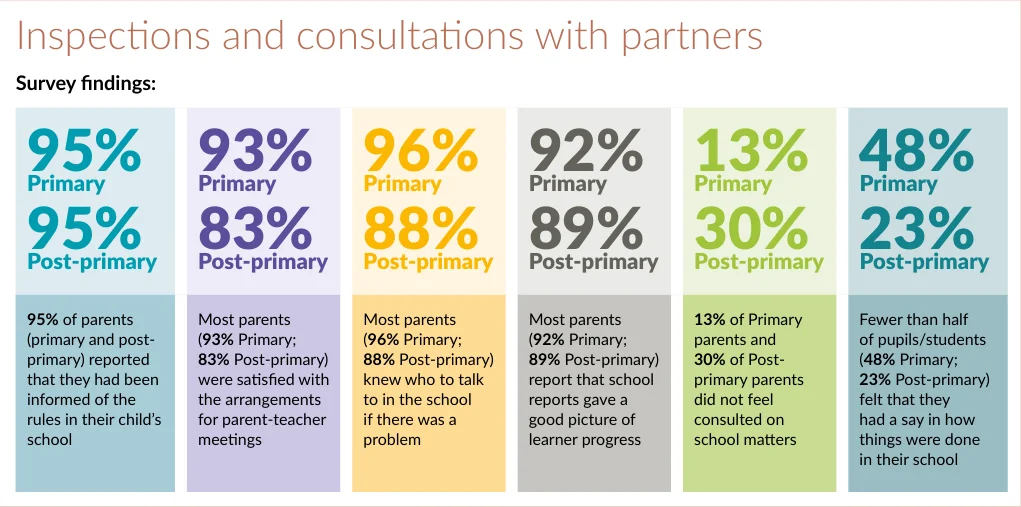
Figure from page 205
Inspections and consultations with partners
| Survey findings: | |||||
|---|---|---|---|---|---|
| 95% Primary 95% Post-primary | 93% Primary 83% Post-primary | 96% Primary 88% Post-primary | 92% Primary 89% Post-primary | 13% Primary 30% Post-primary | 48% Primary 23% Post-primary |
| 95% of parents (primary and post- primary) reported that they had been informed of the rules in their child’s school | Most parents (93% Primary; 83% Post-primary) were satisfied with the arrangements for parent-teacher meetings | Most parents (96% Primary; 88% Post-primary) knew who to talk to in the school if there was a problem | Most parents (92% Primary; 89% Post-primary) report that school reports gave a good picture of learner progress | 13% of Primary parents and 30% of Post- primary parents did not feel consulted on school matet rs | Fewer than half of pupils/students (48% Primary; 23% Post-primary) felt that they had a say in how things were done in their school |
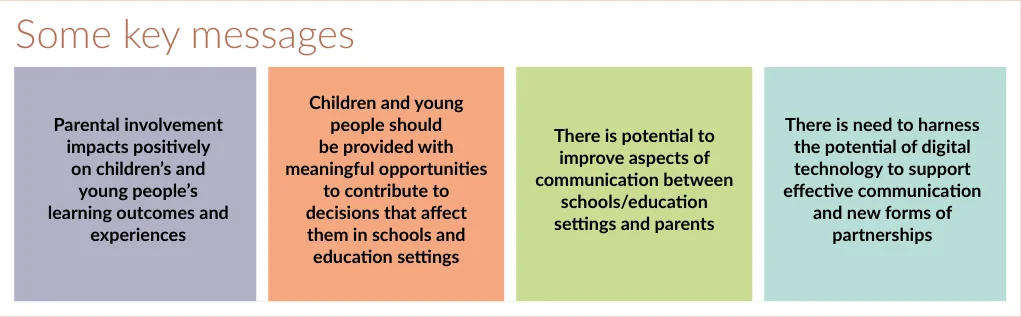
Figure from page 205
Some key messages
Figure from page 205
Pages 204–205 · View in original PDF