6.1 Introduction
6.1 Introduction
This chapter presents the findings of inspections during the September 2016 to December 2020 period in relation to targeted provision for the inclusion of children and young people with special educational needs (SEN), and those at risk of educational disadvantage. The opening section of the chapter provides an overview of developments related to policy, resource provision and practice in these areas in the 2016-2020 period. When considering the commentary on provision for special education, it is important to bear in mind that there are three distinct categories of pupils/students with special educational needs (SEN) as provided for across a continuum of provision: those in mainstream classes who receive additional support in-class and/or through withdrawal; those in special classes in mainstream schools; and those in special schools.
The chapter draws on data gathered during focused inspections of SEN provision and inspections of Delivering Equality of Opportunity in Schools (DEIS) action planning in DEIS schools, as well as wholeschool evaluations, curriculum evaluations and subject inspections that were carried out in the 2016- 2020 period. It also draws from the findings of inspections of Youthreach centres, and inspections in schools attached to Special Care Units (SCUs) or the Children Detention Centre (CDC), as well as a number of composite reports that the Inspectorate published during this period.
During the September 2016 to December 2020 period, there was extensive resource provision and policy development in support of educational inclusion94 and provision for children and young people with SEN or who were at risk of educational disadvantage. Inspection findings indicate that many aspects of provision for these pupils/students in schools were either good or very good. It is also evident that there was scope to develop a number of important aspects of provision, such as those relating to action planning, enrolment and attendance. These are essential in meeting the needs of all children and young people, and in supporting their inclusion in educational settings in accordance with Department policy.
During the COVID-19 pandemic in 2020, there was enhanced resource provision for children and young people with SEN and for those most at risk of educational disadvantage, both when schools were closed and also when schools re-opened. During the period of school closure and in advance of school reopening in September 2020, the Department published specific guidance to support schools in providing for children and young people with SEN, and children and young people at risk of educational disadvantage. The findings of Inspectorate research conducted during the periods of school closure and re-opening during 2020 indicated that remote teaching impacted negatively on many children with SEN in particular, from both a learning and wellbeing perspective (see Chapter 10). The findings of an Economic and Social Research Institute (ESRI) report95, produced in partnership with the Department of Children, Equality, Disability, Integration and Youth (DCEDIY) in 2020, indicated that the disruption of learning was likely to have long-term consequences for many, especially for more disadvantaged children and young people. To help address the challenges that these pupils and students experienced, the Department established a range of specific summer programmes, significantly enhanced in comparison to previous years, in mainstream and special schools.
94 According to the NCSE’s 2019 Progress Report – Policy Advice on Special Schools and Classes, an inclusive education has been interpreted as providing a continuum of educational provision that encompasses mainstream classes, special classes in mainstream schools and special schools. The report is available at: https://ncse.ie/wp-content/uploads/2019/11/Progress- Report-Policy-Advice-on-Special-Schools-Classes-website-upload.pdf 95 Darmody, M., Smyth E. and Russell H. (2020) Implications of the COVID-19 Pandemic for Policy in Relation to Children and Young People. Available at: https://www.esri.ie/news/esri-report-finds-that-action-needed-to-address-the-short-and-longer-termimpacts-of-covid-19
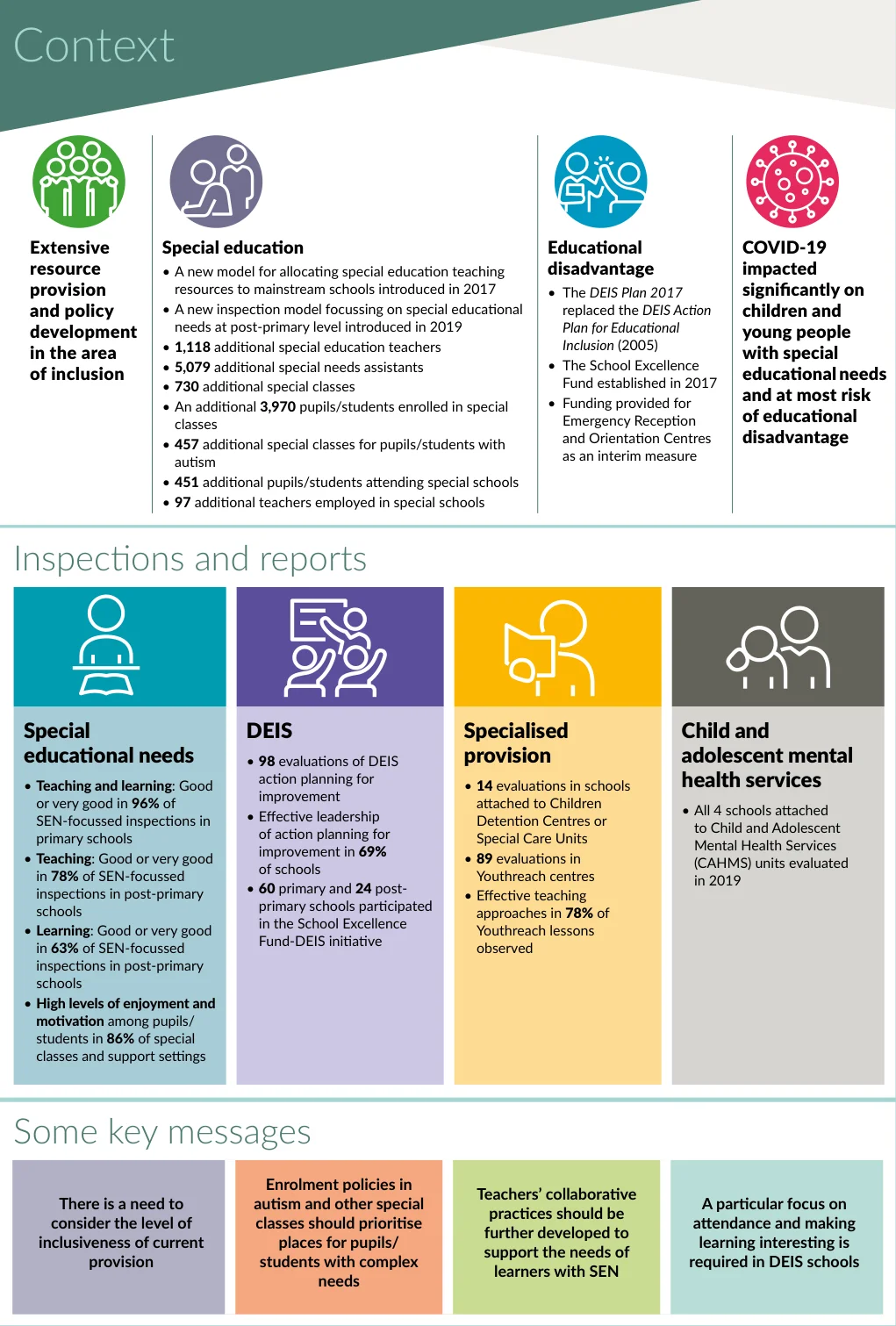
Figure from page 175
Context
Extensive resource provision and policy development in the area of inclusion
Educational disadvantage
COVID-19 impacted significantly on children and young people with special educational needs and at most risk of educational disadvantage
• The DEIS Plan 2017 replaced the DEIS Action Plan for Educational Inclusion (2005) • The School Excellence Fund established in 2017 • Funding provided for Emergency Reception and Orientation Centres as an interim measure
- A new inspection model focussing on special educational
- 451 additional pupils/students attending special schools
Inspections and reports
| Special educatoi nal needs • Teaching and learning: Good or very good in 96% of SEN-focussed inspections in primary schools • Teaching: Good or very good in 78% of SEN-focussed inspections in post-primary schools • Learning: Good or very good in 63% of SEN-focussed inspections in post-primary schools • High levels of enjoyment and motvi atoi n among pupils/ students in 86% of special classes and support setnti gs | DEIS • 98 evaluations of DEIS action planning for improvement • Efef ctive leadership of action planning for improvement in 69% of schools • 60 primary and 24 post- primary schools participated in the School Excellence Fund-DEIS initiative | Specialised provision • 14 evaluations in schools attached to Children Detention Centres or Special Care Units • 89 evaluations in Youthreach centres • Efef ctive teaching approaches in 78% of Youthreach lessons observed | Child and adolescent mental health services • All 4 schools attached to Child and Adolescent Mental Health Services (CAHMS) units evaluated in 2019 |
Some key messages

Figure from page 175
Pages 174–175 · View in original PDF