5.3.7 Home Economics
5.3.7 Home Economics
Teaching and learning in Home Economics were of a high standard overall; assessment practices were in need of further development
Home Economics is offered as an optional subject at Junior Cycle and Leaving Certificate levels.
The overall quality of teaching was good or very good in 89% of home economics inspections. The overall quality of learning was good or very good in 82% of these subject inspections. In such instances, highquality learning experiences were observed in practical lessons where the design brief process was used incrementally to develop theoretical, practical and procedural skills. Teachers made effective use of demonstrations to model skills and enhance students’ understanding and participation. Teachers’ ongoing monitoring of students’ progress, together with the provision of formative feedback, enabled students to develop and refine their knowledge and skills. The identification of success criteria facilitated students to reflect on and evaluate their own work and the work of their peers.
Student engagement in learning was good or very good in 86% of the home economics lessons observed. High levels of engagement were typically observed when students saw their learning as relevant to their personal and family lives, and when students were supported to identify links between their prior knowledge and the new material being explored. The learning for students was optimised when, and where, challenging lesson tasks provided opportunities for them to apply their knowledge and skills to reflect on practical real-world household problems.
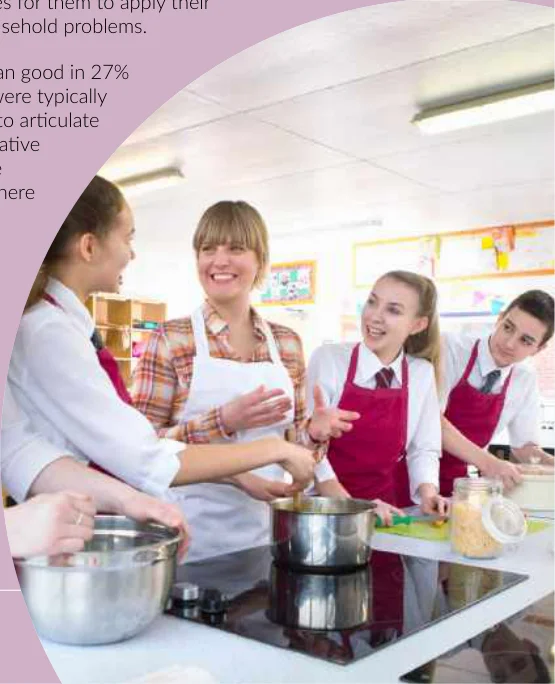
Figure from page 155
The overall quality of assessment was found to be less than good in 27% of home economics inspections. In such cases, students were typically not provided with sufficient opportunities during lessons to articulate and consolidate their learning and/or regular written formative feedback was not provided on their work. Highly effective summative assessment practice was noted in instances where the range of assessment modes facilitated feedback on students’ progress in both the theoretical and practical coursework components.
Data from state examinations in the period 2016 to 2020 shows a significant increase in the uptake of higher level Home Economics in Senior Cycle (Table 5.20). The proportion of students taking higher level in Junior Certificate Home Economics also increased steadily.
Table 5.20: Numbers of students taking Home Economics examination in Leaving Certificate and Junior Certificate: 2016-2020
| Leaving Certificate Home Economics | Junior Certificate Home Economics | |||||
|---|---|---|---|---|---|---|
| Year | Higher level | Ordinary level | Total candidates | Higher level | Ordinary level | Total candidates |
| 2020 | 85.5% | 14.5% | 11,988 | N/A* | N/A | N/A |
| 2019 | 81.1% | 18.9% | 12,002 | 85.4% | 14.6% | 23,043 |
| 2018 | 79.5% | 20.5% | 11,558 | 84.6% | 15.4% | 22,644 |
| 2017 | 79.7% | 20.3% | 11,814 | 84.8% | 15.2% | 22,257 |
| 2016 | 75.2% | 24.8% | 11,642 | 83.5% | 16.5% | 21,464 |
Source: State Examinations Commission * As a result of the COVID-19 pandemic, the Junior Cycle 2020 examinations were cancelled.
Subject provision and whole-school support for Home Economics was of a very high standard overall; timetabling was an area for improvement
Inspectors found that the overall quality of subject provision and whole-school support was good or very good in a very high proportion of subject inspections. Inspectors noted well-maintained facilities and stimulating learning environments that showcased students’ work. Access to the subject was optimal where subject option bands, based on students’ preferences, were created. Difficulties in recruiting suitably-qualified teachers of Home Economics was an issue noted in some reports. Timetabling arrangements that were less than optimal in facilitating practical lessons in food studies were noted in a number of reports. In some instances, for example, there was inadequate time to facilitate student participation and learning in practical food-studies lessons because the timetable was constructed around one-hour lesson periods.
Preparation and planning for home economics teaching and learning were of a high standard overall; planning for Home Economics in Junior Cycle was an area for development
Inspectors found well-organised subject departments in most of the schools visited. There were many examples of collaborative practice evident through the sharing of resources and expertise. Inspectors noted highly-effective practice when teachers’ reflections informed improvements in teaching and learning. The Junior Cycle Home Economics specification was introduced in 2018 and was due to be examined in 2021. However, the full implementation of the specification has been impacted due to the revised assessment arrangements arising from the COVID-19 pandemic. Inspectors noted that planning for the implementation of the Junior Cycle Home Economics specification in schools is in the early stages of development. To support teachers in delivering the specification, inspectors have recommended frequently that, in designing units of learning, an incremental and integrated approach to the development of cognitive, practical and procedural skills be adopted. In addition, in order to ensure that the intended learning has taken place, units of learning should be inclusive of the modes of assessment which are aligned to the chosen learning outcomes.
Pages 155–156 · View in original PDF