4.3.2 Irish
4.3.2 Irish
The quality of language use in Gaeltacht primary schools and in gaelscoileanna was good overall, with scope to develop pupils’ academic language
Inspection findings during the September 2016 to December 2020 period demonstrate that the quality of language use in Gaeltacht primary schools and gaelscoileanna was good overall. Since 2017, the systematic development and enrichment of pupils’ proficiency in Irish in Gaeltacht primary schools has been progressed through the implementation of language-based criteria under The Gaeltacht School Recognition Scheme. Pupils were motivated to speak Irish through the use of school-based initiatives and, in general, they expressed themselves with fluency and confidence. Inspectors advised that further emphasis on the discrete teaching of subject-specific vocabulary, particularly in Mathematics, was required to support pupils’ language learning in some Gaeltacht schools inspected.
In most gaelscoileanna where evaluations took place during this period, pupils displayed a positive disposition towards the language, demonstrated an appropriate level of fluency in Irish, and were afforded opportunities to participate in worthwhile co-curricular and extra-curricular activities. Inspectors recommended that teachers develop pupils’ awareness of themselves as language learners through the greater use of self-assessment, and make greater use of digital technology to support relevant and meaningful learning experiences.
In the majority of these schools, inspectors reported that there was scope to develop pupils’ academic, cognitive and social language to enable them to use the language more independently, confidently and creatively. The inspection findings suggest that schools should make further use of school self-evaluation and assessment processes to develop pupils’ literacy and communication skills in Irish to support their accurate use of the language.
Pupils’ learning outcomes in Irish in English-medium primary schools remain very concerning
In 2016, the Chief Inspector’s Report had noted a slight deterioration in learning outcomes in Irish for pupils at primary level since the publication of the previous Chief Inspector’s Report in 2013. Data relating to learning in Irish in English-medium primary schools between September 2016 and December 2020 shows that pupils’ learning outcomes in Irish are still of concern.
During the 2016 to 2020 period, inspectors found that pupils’ attainment of learning objectives was good or very good in just 67% of Irish lessons evaluated during WSE, WSE-MLL and curriculum evaluations in English-medium primary schools. The quality of learning outcomes was noted to be good or very good in just 72% of lessons observed during unannounced inspections. Overall, across a range of inspection models, inspectors found that there was scope to improve the quality of pupils’ learning in 33% (announced inspections) and 28% (unannounced inspections) of lessons observed. During their engagements with inspectors in 2020, schools highlighted that children’s learning in Irish had suffered disproportionately as a result of the disruption caused by the COVID-19 pandemic. In particular, it was noted that there was insufficient opportunity for children to communicate through Irish and to develop their language skills in meaningful communicative contexts.
While teachers make good efforts to provide suitable learning experiences in Irish, more fun and engaging Irish language learning activities need to be provided
Inspection findings from curriculum evaluations of Irish in English-medium schools show that many teachers worked to provide pupils with a wide range of language-rich games and activities to stimulate their interest in the language. Successes included the positive attitude to Irish evident during pupil focus-group interviews. In these interviews, pupils highlighted their enjoyment of co-curricular language activities and the value they placed on being able to recite songs and poems in Irish. Where effective pedagogical practice was noted, inspectors typically praised the use of Irish as the language of communication in the classroom.
Although these findings are encouraging, there remains a need to create language learning experiences that are more engaging and enjoyable. In almost a quarter (24%) of lessons evaluated during announced inspections, inspectors found that pupils’ engagement in learning during Irish lessons was less than good. In a quarter of the lessons, inspectors noted the potential to improve the quality of pupils’ enjoyment and motivation further in Irish lessons.
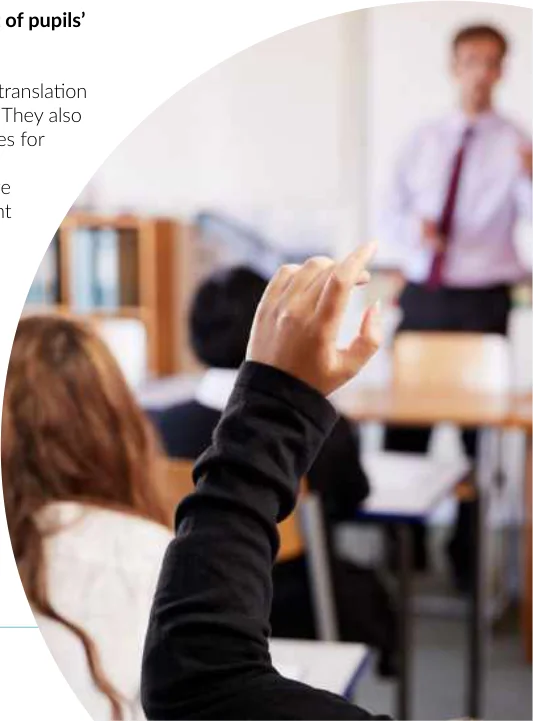
Figure from page 117
There is a need for an increased focus on the development of pupils’ communication skills in Irish
During inspections, inspectors observed an over-reliance on translation from Irish to English as part of the pupils’ experience of Irish. They also highlighted the need for teachers to create more opportunities for pupils to speak Irish individually and naturally in a sustained manner. While pupils were typically able to use basic language structures and to ask and answer questions that were relevant to the specific lesson content, they experienced notable difficulties in transferring this new language to other communicative scenarios. This is due largely to the insufficient provision of opportunities to practise the language in pairs and small groups on a regular basis. In many cases, pupils experienced difficulties in constructing sentences and using verbs independently. Inspectors also observed that pupils generally experienced an overly-narrow range of writing, with limited opportunities to write for different audiences and in different genres.
Pages 116–117 · View in original PDF