10.1 Introduction
10.1 Introduction
Education systems all over the world have been impacted by the COVID-19 pandemic. It has caused immense disruption in all walks of life and led to a seismic shift in how educators, children and young people work and interact with one another.
COVID-19 brought great challenges, but it also prompted impressive responses from people working in many sectors and services, including the education sector. All stakeholders in the education system committed themselves to working together to solve problems and find solutions that would protect learning opportunities for children and young people.
The Inspectorate was involved with our colleagues across the Department and with stakeholders, settings and schools in responding to the challenges of COVID-19. The rapidly evolving environment required us to respond with agility and imagination. We had to reconfigure the ways in which we interacted with settings and schools, and how we supported them. We developed new ways to monitor the quality of the experiences of children and young people, both at home and in schools and settings. Information from our interactions with schools informed policy-making in the Department and the provision of guidance to schools, including advice on their safe operation in an extremely challenging and changing context. We also played a key role in putting in place and implementing alternative systems to the state examinations in 2020 and in 2021. Our expertise was also called upon by the Health Service Executive (HSE) during this period. A large number of Department inspectors and staff from Department-funded organisations were assigned, for a significant period of time, to support HSE teams in following up with schools where cases of COVID-19 had been reported.
This chapter focuses on both the initial closure of schools during March to June 2020, and the return to school in September 2020. It outlines the supports provided by the Department of Children, Equality, Disability, Integration and Youth (DCEDIY) and other agencies to assist early learning and care settings during 2020. It also outlines the supports that were provided by the Department of Education, including the Inspectorate, to support teaching and learning during school closures and to enable them to reopen safely and resume teaching and learning. The chapter looks at the many ways in which the Inspectorate adapted to the pandemic and continued to support the work of schools and settings. It also presents the main findings from advisory sessions and research conducted by the Inspectorate during both phases.
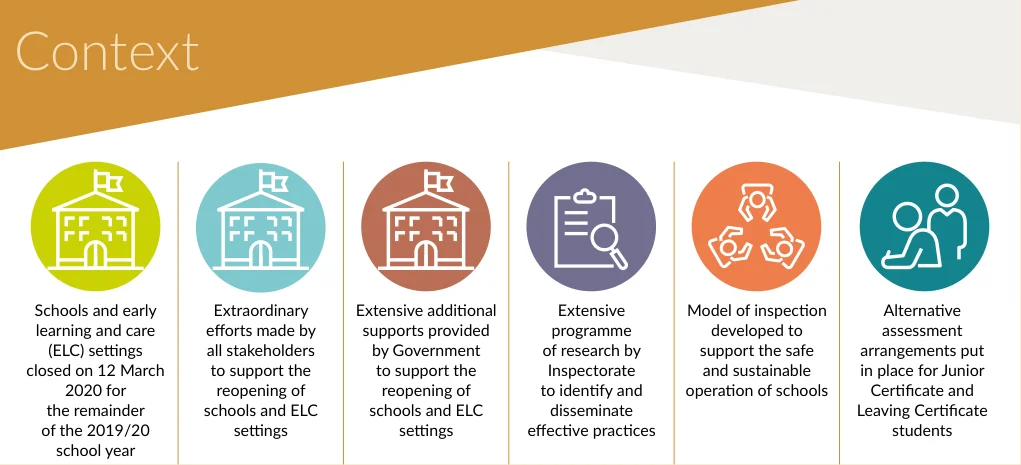
Figure from page 287
Extensive additional
Extensive programme of research by
supports provided
by Government
to support the
Inspectorate to identify and
reopening of schools and ELC
disseminate effective practices
settings
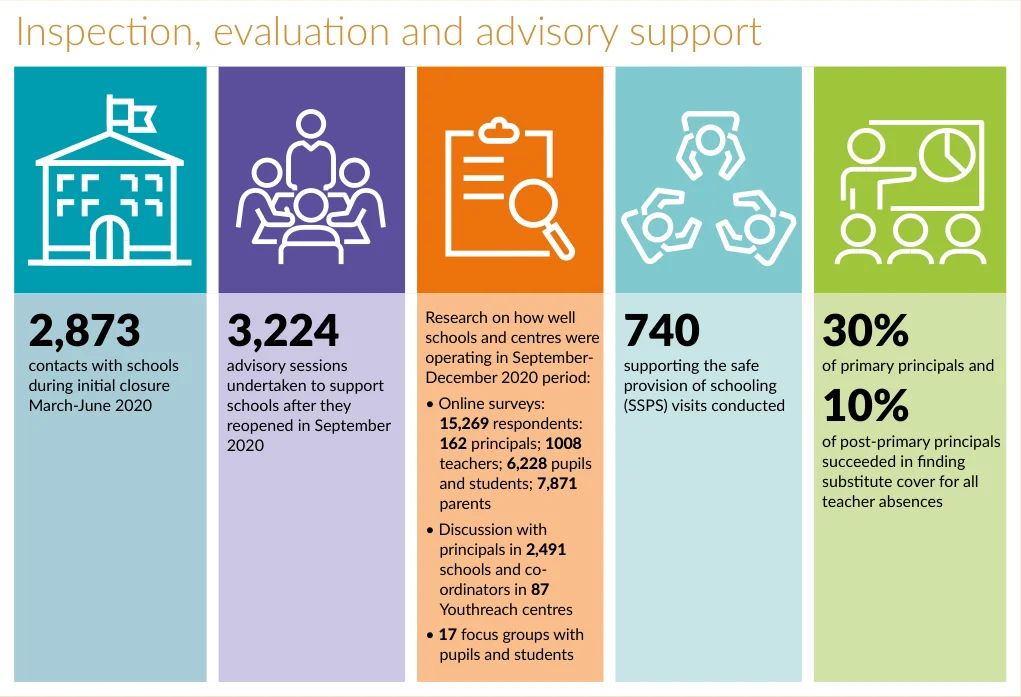
Figure from page 287
Inspection, evaluation and advisory support
| 2,873 3, contacts with schools advis during initial closure unde March-June 2020 scho reope 2020 | 224 R s o ory sessions D rtaken to support ols afet r they • ned in September • • | esearch on how well chools and centres were peratni g in September- ecember 2020 period: Online surveys: 15,269 respondents: 162 principals; 1008 teachers; 6,228 pupils and students; 7,871 parents Discussion with principals in 2,491 schools and co- ordinators in 87 Youthreach centres 17 focus groups with pupils and students | 740 supporting the safe provision of schooling (SSPS) visits conducted | 30% of primary principals and 10% of post-primary principals succeeded in finding substitute cover for all teacher absences |
Figure from page 287

Figure from page 287
Pages 286–287 · View in original PDF