1.1 Introduction
1.1 Introduction
‘Excellence in learning for all’ is the vision that the Inspectorate of the Department of Education aims to achieve.
The Inspectorate carries out evaluation and advisory work in a range of settings, including recognised primary schools, special schools and post-primary schools, early learning and care settings, centres for education and other education settings. We use the evidence from our visits to these settings to provide information on the quality of educational provision, and to encourage better learning experiences and learning outcomes for all children and young people. Through our direct engagement with settings and schools, and through the provision of evidence and advice to inform policy and practice, we also seek to build the capacity of settings and schools to become self-improving learning organisations.
Most of this Chief Inspector’s Report examines what we have learned about the quality of educational provision across the education system in the period from September 2016 to December 2020. At the outset, however, it is important to note some of the trends and factors that influenced the Irish education system during that period. These trends and factors influenced the context in which the schools, centres for education and other education settings that we inspect were working at that time.
This chapter focuses on six key elements of the context:
■Developments in early learning and care
■Policy development relating to primary and post-primary education
■Education expenditure
■Trends in participation and retention
■Teachers and the teaching profession
■The COVID-19 pandemic
Later chapters outline the work of the Inspectorate, and the way that we have developed our inspection approaches in schools in response to the evolving quality-assurance needs of the system.
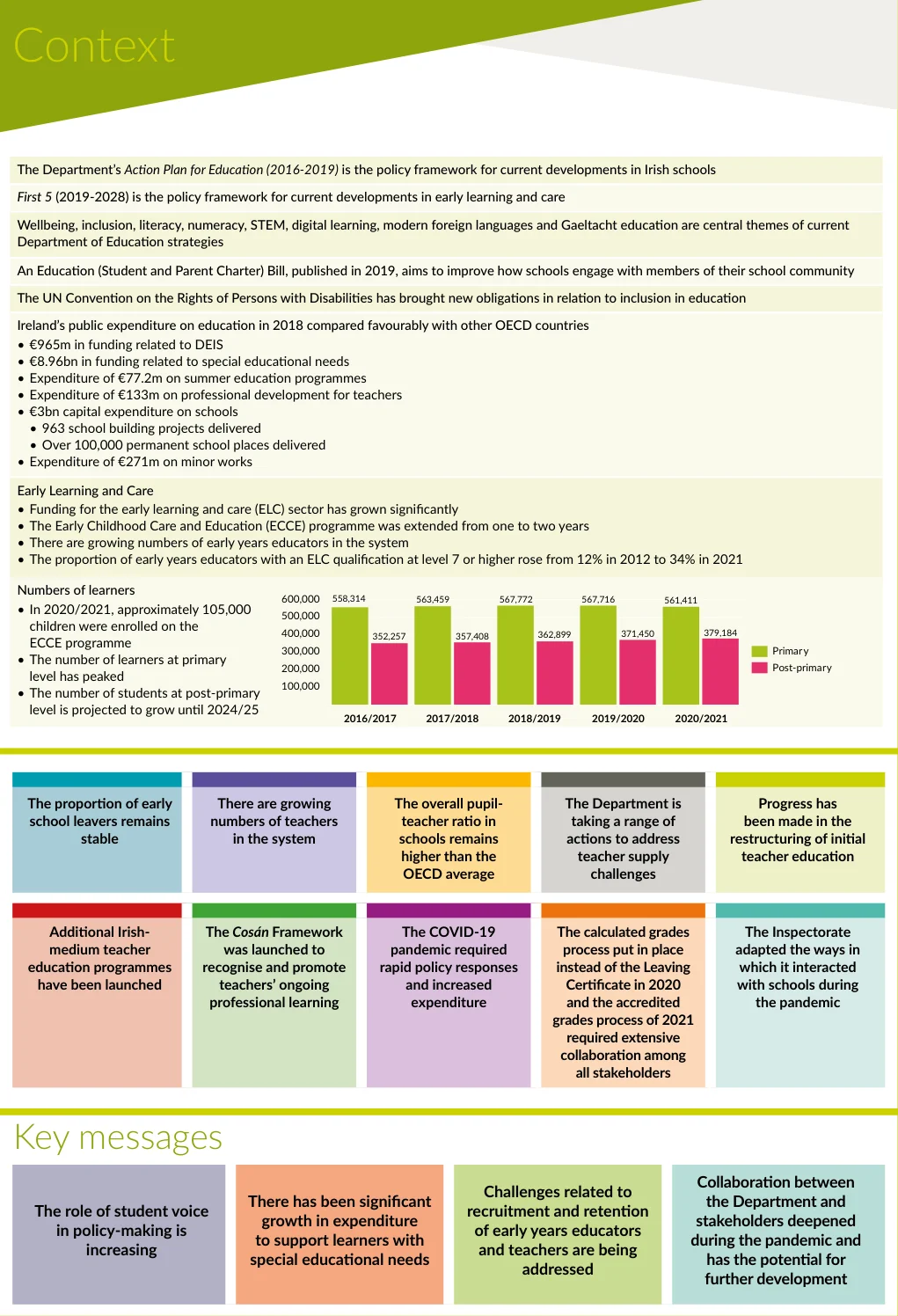
Figure from page 13
Context
The Department’s Action Plan for Education (2016-2019) is the policy framework for current developments in Irish schools
First 5 (2019-2028) is the policy framework for current developments in early learning and care
Wellbeing, inclusion, literacy, numeracy, STEM, digital learning, modern foreign languages and Gaeltacht education are central themes of current Department of Education strategies
An Education (Student and Parent Charter) Bill, published in 2019, aims to improve how schools engage with members of their school community
The UN Convention on the Rights of Persons with Disabilities has brought new obligations in relation to inclusion in education
Ireland’s public expenditure on education in 2018 compared favourably with other OECD countries • €965m in funding related to DEIS • €8.96bn in funding related to special educational needs • Expenditure of €77.2m on summer education programmes • Expenditure of €133m on professional development for teachers • €3bn capital expenditure on schools • 963 school building projects delivered • Over 100,000 permanent school places delivered • Expenditure of €271m on minor works
Early Learning and Care • Funding for the early learning and care (ELC) sector has grown significantly • The Early Childhood Care and Education (ECCE) programme was extended from one to two years • There are growing numbers of early years educators in the system • The proportion of early years educators with an ELC qualification at level 7 or higher rose from 12% in 2012 to 34% in 2021
Numbers of learners • In 2020/2021, approximately 105,000 children were enrolled on the ECCE programme • The number of learners at primary level has peaked • The number of students at post-primary level is projected to grow until 2024/25
567,716
567,772
561,411
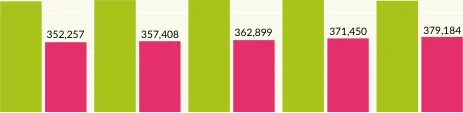
Figure from page 13
2017/2018 2018/2019 2019/2020
| The proportion of early school leavers remains stable | There are growing numbers of teachers in the system | The overall pupil- teacher ratio in schools remains higher than the OECD average | The Department is taking a range of actions to address teacher supply challenges | Progress has been made in the restructuring of initial teacher education |
| Additional Irish- medium teacher education programmes have been launched | The Cosán Framework was launched to recognise and promote teachers’ ongoing professional learning | The COVID-19 pandemic required rapid policy responses and increased expenditure | The calculated grades process put in place instead of the Leaving Certfi ci ate in 2020 and the accredited grades process of 2021 required extensive collaboratoi n among all stakeholders | The Inspectorate adapted the ways in which it interacted with schools during the pandemic |
Key messages

Figure from page 13
Pages 12–13 · View in original PDF