strategy statement03 - 05

Figure from page 11
After several years of low inflation during the mid-nineties, inflation has re-emerged as a concern in recent years. There was a particularly large increase in the Consumer Price Index (CPI) of 5.6 per cent in the year 2000. In 2001, inflation increased by a still substantial 4.9 per cent. Estimates for inflation for the year 2002 are in the region of 4.7 per cent, compared with 2.2% in the Euro area. Since 2001, inflationary pressures have been particularly strong in services. Central Bank data show that for 2001, the services component of inflation was responsible for Ireland having faster inflation than the euro area.
Figure 2 Consumer Price Index: Annual Rates
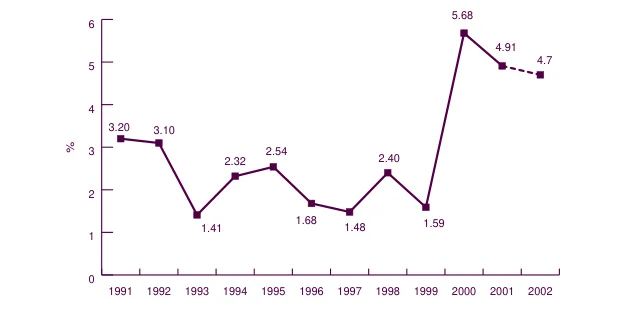
Figure 2
5.68
6
4.91 4.7
5
4
3.20 3.10
%
2.54 2.32
3
2.40
2
1.68 1.48
1.59
1.41
1
0
1991 1992 1993 1994 1995 1996 1997 1998 1999 2000 2001 2002
A range of factors has contributed to the re-emergence of inflation in Ireland. The weakness of the euro contributed directly to higher inflation by increasing import prices and also by contributing to stronger demand in the economy. At the time of writing, the Euro was undergoing a significant appreciation, however there was no substantial evidence that consumer prices were falling. Reductions in personal taxation and increasing net incomes also contributed to the strength of demand in the economy, this a key influence on inflation. In addition, employers are facing higher non-wage costs, particularly higher insurance costs. The weakness of competitive forces in some parts of the economy in the context of strong demand growth is also likely to have contributed to inflation.
Department of Enterprise, Trade & Employment
Over this strategy period inflation will continue to be a major competitiveness concern, requiring concerted action to bring Irish rates into line with those of our trading partners. On a positive note, the ESRI’s Quarterly Economic Commentary estimates inflation in 2003 will average 4.3% over the year, falling to 3.2% in 2004.
A Forfás study published in June 2002 found that consumer price levels in Ireland were the second highest in the Eurozone. An examination of non-labour costs across the business environment in the National Competitiveness Council’s Annual Competitiveness Report 2002 confirms that there has been a sustained and strong rise in firm-level costs over recent years. For example, Ireland ranks:

Figure from page 12
4th highest out of 16 countries in terms of office occupation
total costs;
2nd highest out of 8 major economies for industrial electricity
prices for mid/large capacity users, with further increases planned for 2003, as well as price increases for gas transmission tariffs, which will translate into gas price increases;
10th most expensive of 16 countries surveyed for
Telecommunication costs.
Against the background of the Forfás study’s finding, there is evidence to suggest that consumers in Ireland are not as organised as in other Member States and therefore do not have the same opportunity as other stakeholders to participate in the policy making process. While the development of a strong consumer lobby is primarily the responsibility of organisations that represent the interests of consumers, there is a growing concern to ensure that such development is to be encouraged by whatever means possible, including ensuring that there are adequate opportunities and mechanisms for the interests of consumers to be reflected in the policy making process.
Pages 11–12 · View in original PDF