strategy statement03 - 05
The World Competitiveness Yearbook (WCY) termed 2001 “a year to forget” for the global economy. In its 2002 edition it noted that “countries with rapid growth suffer from volatility in this year’s overall ranking. High fliers such as Singapore (5th) Hong Kong (9th) and Ireland (10th) lose three ranks each and pay the price of a huge turnaround in economic performance”. The WCY notes also that the current global downturn is different in character from those which have preceded it in that consumption has remained relatively strong, while over-investment by businesses and the rapid fall in stock market values have been the significant causal factors. These have been compounded by the effects of unpredictable shocks such as the Enron affair and the terrorist attacks of September 11. The WCY notes that while the further decline in stock values arising from these events was quickly corrected, damage to the insurance, transport and tourism industries has been more lasting. The World Competitiveness Yearbook 2003 indicates a further drop in Ireland’s relative position. Among countries with a population of less than 20 million, Ireland has dropped from ninth to eleventh position on the World Competitiveness Scoreboard 2003.
From Ireland’s perspective, the current wave of consolidations in the electronics and telecommunications sectors is of particular concern. It is difficult to know the full ramifications of this trend as these industries move to correct the imbalance between capacity and demand.
However, even in the face of these negative factors, the global economy is set to continue to expand. Significant global population increases, particularly in developing countries, are set to generate increased worldwide demand, while the accelerating process of European integration constitutes an additional potential source of new demand.
That said, the current performance of the Euro area economies does not give great cause for optimism. The Central Bank quarterly bulletin for Winter 2002 notes that recent forecasts are for growth of 0.8 percent in 2002 and 1.8 percent in 2003. While these growth levels are only marginal, the review also notes that the outlook is particularly vulnerable to developments in the global economy, where downside risks predominate.

Figure from page 10
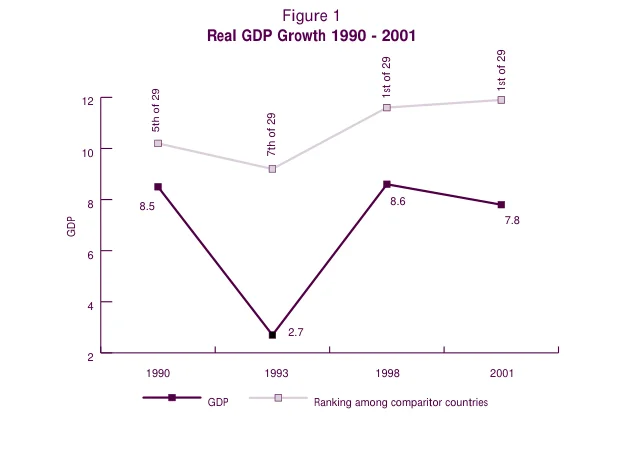
Figure from page 10
Figure 1 Real GDP Growth 1990 - 2001
1st of 29
1st of 29
5th of 29
12
7th of 29
10
8.6
8
8.5
7.8
GDP
6
4
2.7
2
1998 2001 1990 1993
GDP Ranking among comparitor countries
From 1993 to 2000, the average growth in GDP was 9.3 per cent per year and the average growth in GNP was 8.3 per cent per year. In a comparison with a sample of 29 other countries, figure 1 shows Ireland’s excellent comparative GDP performance, moving from fifth in 1990 to first in 1998 and 2001. However, the year 2001 was characterised by a sharp slowdown in economic growth. GNP growth for 2001 was 4.6 per cent, less than half the remarkably high growth of over 10 per cent in the previous year. Although growth over the year 2001 as a whole was substantial at 5.7%, it was largely due to strong growth in the early part of the year. According to ESRI, while GDP growth for 2002 was 5.7%, GNP growth was a sluggish 1.1%.
The ESRI Quarterly Economic Commentary indicates GDP growth for Ireland in the order of 3.0% in 2003 and 3.7% in 2004. This compares with 1%, 1.8% and 2.2% across the Euro area, and with 1.5%, 2.3% and 2.6% in the OECD for 2002, 2003 and 2004, respectively. These projections indicate a good performance for Ireland in a comparative international context. However, relative to the previous strategy period, they reflect a significant slowdown in the pace of growth.
Pages 9–10 · View in original PDF