strategy statement03 - 05
the preparation of a new European Employment Strategy for the period up to 2010. Indications are that the new Strategy will be simplified by reducing the number of guidelines, with a greater focus on outcomes. In addition the process will be streamlined to ensure consistency and complimentarity with EU economic and social policies.
The Department is a complex, multi-functional organisation. Its institutional environment involves the central Department itself and a range of statutory offices and agencies linked to it as shown in the diagram below.

Figure from page 33
In addition to these agencies and offices, an important development in the last strategy period was the establishment of the new cross border trade and business development body InterTradeIreland.
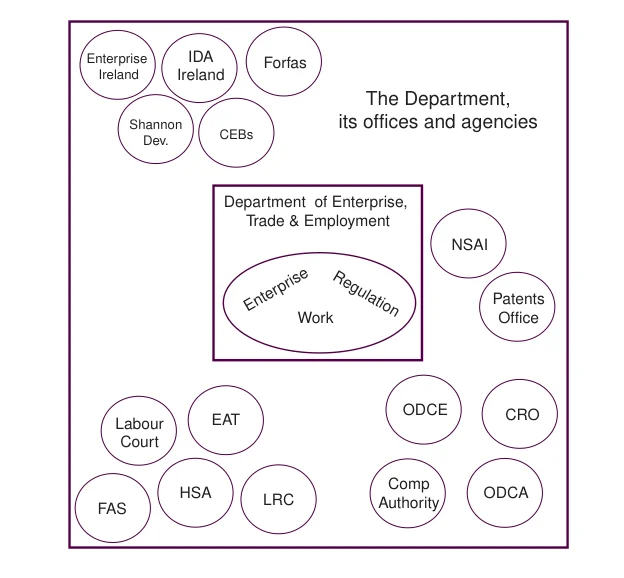
Figure from page 33
IDA Ireland
Enterprise
Forfas
Ireland
The Department, its offices and agencies
Shannon
CEBs Dev.
Department of Enterprise,
Trade & Employment
NSAI
Enterprise
Regulation
Patents
Work
Office
ODCE CRO
EAT
Labour
Court
Comp ODCA Authority
HSA
LRC
FAS
Over the previous strategy period, the structure of the Department has continued to evolve in the direction of greater separation between policy and executive functions. Significant developments in this respect include the establishment of the Office of the Director of Corporate Enforcement (ODCE), the formation of the Irish Financial Services Regulatory Authority (IFSRA) and the Irish Auditing and Accounting Supervisory Authority (IAASA). The Department also funds Skillnets, the organisation which runs the Training Networks Programme.
The establishment of IFSRA has significant structural implications for the Department, as a range of financial supervisory functions currently exercised by the central Department, the Registrar of Friendly Societies and the Director of Consumer Affairs have transferred to the new Authority.
A further important development planned for the coming strategy period and reflected in the Agreed Programme for Government is the full establishment of Science Foundation Ireland as a statutory agency of Forfás. It is expected that the legislation will be enacted during 2003.
In light of these developments, the management relationship between the Department and its agencies, and the creation of effective links and feedback mechanisms between policy and execution pose important challenges in the coming strategy period.
Over previous strategy periods, there has been significant reform of the Department’s industrial development agencies. Industrial performance during the 1990’s suggests that the creation of separate agencies with their own individual focus on the distinct tasks of indigenous development and the attraction of FDI has proved to be an effective strategy. The Department’s readiness to modify structures to meet evolving strategic needs has been positively commented on in the recent NESC strategy report.
The continuing evolution of the competitiveness challenge suggests that such flexibility and willingness to match structures to changing strategic needs should be maintained.
Pages 33–34 · View in original PDF