Stepping up efforts to improve access to finance for SMEs
Small and medium sized enterprises (SMEs) are important drivers of job creation, particularly younger firms and start-ups. SMEs in Ireland comprise 99.6% of all employer firms in 2011 and employ approximately 69% of the labour force. Access to finance for SMEs continues to be a challenge in the aftermath of Ireland’s economic and banking crisis, as shown in the data from the OECD Scoreboard on SME and Entrepreneurship Finance, which monitors SME and entrepreneurship conditions through 13 standardised indicators, most of them derived from supply-side data provided by financial institutions and other government agencies. The Scoreboard data (Figure 2) reflects the uncertain or weak recovery during 2011 and a reversal in 2012 for several countries, with Ireland among them. SME loans showed minimal growth between 2010 and 2011 and decreased by 6.4% in 2012. Indicators from the demand-side (national and regional surveys) provide a complementary view of the evolution in finance trends and needs. Surveys undertaken by the Department of Finance and the ECB highlight that the lack of demand for products and services played an important role in the reduced demand for credit by Irish SMEs (SME Credit Demand Survey, 2013). Recognising the importance and urgency of this issue, the 2013 APJ devotes significant attention to access to finance, and incorporates 24 separate actions in this regard.
The bursting of the property bubble exposed significant vulnerabilities in the banking system, which added to the context of the broader international financial crisis. Even excluding data from the property and construction sectors, which do not constitute the core SME sector in Ireland,
the data show that short term loans (new loans with a maturity of less than one year, for an amount lower than EUR 1 million and at a floating rate) decreased from EUR 19.4 billion in 2007 to EUR 3.6 billion in 2012. Interest rate spreads between small and large firm loans rose from 0.27 in 2007 to 1.67 in 2012. Payment delays for SMEs increased from 22 days in 2009 to 31 days in 2012, and bankruptcy numbers in 2012 (2 922 firms) were double the 2007 numbers (1 422 firms).
Year-on-year growth rates, percentages.
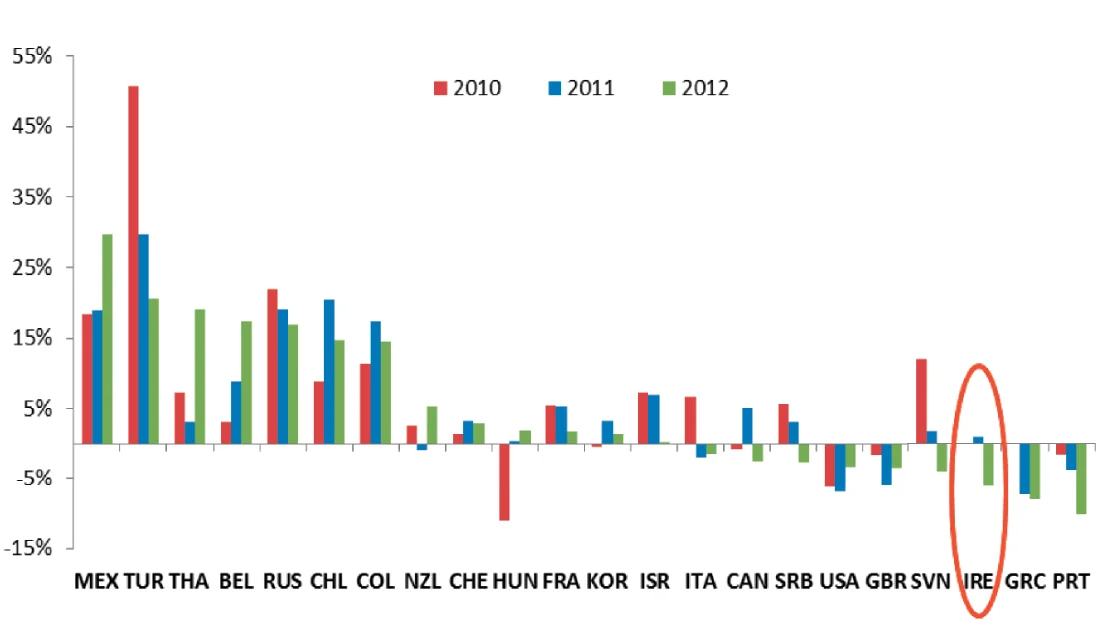
Figure 2. Trends in outstanding SME loans 2010-12
Source: OECD (2014).
For Ireland, data from the Central Bank of Ireland represents the stock of outstanding SME balances disaggregated to remove financial intermediation and property-related SME sectors. All maturities are covered in this indicator. Ireland’s business loans are not based on loan size but on firm size (companies with less than 250 employees).
Access to non-bank financing has also deteriorated in more recent years. Total venture capital, including funding by VC funds and business angels, increased over the 2007-2010 period but declined in 2011 and again in 2012. Contrary to trends in other countries, seed capital rose and was larger than either early stage or growth capital in 2011, although it declined significantly in 2012. Growth capital fell drastically between 2008 and 2009 and, while it has recovered strongly, it has yet to recover to its 2007 level. Given the strong recovery in 2012 in early stage and growth capital, total venture capital funding would have exceeded its 2010 peak were it not for the dramatic decline in seed capital.
To ease access to finance for SMEs and entrepreneurs, the government has developed several direct and indirect measures. Among the direct measures introduced, both debt (loans) and
equity instruments are offered through new schemes (Microenterprise Loan and Innovation Fund). The Credit Guarantee Scheme, introduced in October 2012, was independently evaluated in August 2013. However, not all instruments are suitable for all firms. Equity instruments tend to serve the needs of high growth firms, but are more expensive and difficult to monitor than standard loans.
In terms of indirect measures, the government has imposed lending targets for banks during the period 2011-13 (the monitoring of which is foreseen in APJ 2013). It has established a SME state bodies group to develop and ensure the implementation of initiatives to support SMEs access to credit, and a Credit Review Office in 2010 to re-consider SMEs rejected credit demands, for which extra human resources were foreseen in APJ 2013. It has also reformed the tax code to incentivise them to create jobs, among other objectives. The SME state Bodies Group has considered the effectiveness of the initiatives implemented to date when formulating actions to include in the APF 2014.
Venture capital raised by Irish SMEs, 2007-12
EUR million
2012 Stage 2007 2008 2009 2010 2011

Figure from page 21
135.6 Early 119.8 116.5 185.4 175.9 99.2

Figure from page 21
268.9 Total 225.9 242.9 288.1 310.2 274.4
Note: figures are reported by the SMEs and not by investors. Source: Irish Venture Capital Association.
Measures from the Action Plan for Jobs 2012 included measures intended to both improve understanding of the SME financing environment and ease access to capital for SMEs through direct measures (creating and augmenting the state support to equity funds), as well as indirect measures (rolling over the credit guarantee scheme for SME loans; improving SME financial knowledge before loan applications) that have similarly been applied in other OECD countries. Although the OECD Scoreboard on SME and Entrepreneurship Finance today does not permit a formal evaluation of the success of these measures, debt indicators show that SME business loans have not significantly increased since 2010, in a context of broader stringency for all business loans and reduced SME demand for credit.
Levels of venture and expansion capital invested have been maintained, thanks to state support. Nevertheless, a formal assessment of the costs and benefits of supporting SMEs through equity would be helpful, as equity instruments tend to be of higher cost than standard debt instruments, and are not necessarily suitable for the smaller segment of SMEs. A working group established in 2012 concluded that given the trends in private sector fund raising, a continuation of government support was deemed necessary to ensure availability of equity funds to Irish SMEs. Moreover, it is that the mobilisation of SME-dedicated funds established under the aegis of the National Pension Reserve Fund and the Ireland Strategic Investment Fund are both accelerated and made subject to appropriate oversight and reporting mechanisms going forward. No short or medium term targets for dispersal of funds were foreseen in APJ 2013, as the Irish authorities considered that targets for dispersals were not appropriate. Furthermore, as recommended in the OECD’s 2013 Economic Survey, more sustainable, market-based funding alternatives should be explored – such as SME loan securitisation (including covered bonds) and
mezzanine (hybrid debt/equity) financing instruments. The AJP 2014 contains commitments to develop alternative sources of finance for SMEs.
The 2013 APJ included tax modifications for SMEs (Finland has a similar scheme of promoting investments in part through tax incentives). It also included rigorous scrutiny of the SME credit environment and concerted efforts to communicate to smaller entrepreneurs the availability of state-supported SME funding options. However, it may be useful to extend the scope of this assessment in APJ 2014 to cover the evaluation of the spectrum of government interventions in this area to ascertain their impact on SMEs access to finance.
Pages 19–22 · View in original PDF