Enhancing horizontal and vertical governance
Effective and efficient public governance relies on robust co-ordination (i.e. joint or shared information) and collaboration (joint action and a structured relationship) across central government institutions, between central and local government, and between government and external stakeholders.
Deepening the whole-of-government approach
Whole-of-government approaches can improve national policy coherence, facilitate more effective use of resources, and capitalise on policy synergies and innovation that arise from multi-stakeholder engagement. These efforts should help to achieve integrated multi-sector policy outcomes successfully over time. The APJ recognises the importance of a whole-ofgovernment approach and relies on a co-ordination structure that involves key ministers and departments.
At the political level, an Economic Recovery and Jobs Cabinet Committee reviews progress on a monthly basis. The Committee is chaired by the Taoiseach and convened by the Minister for Jobs, Enterprise and Innovation. It includes the ministers for Finance; Public Expenditure and Reform; Education and Skills; Social Protection; Communication, Energy and Natural Resources; Transport, Tourism and Sport; Agriculture, Food and the Marine; as well as junior ministers for Small Business; Research and Innovation; and Training and Skills. The Committee also coordinates other relevant sector-based policies including Pathways to Work, thus facilitating synergies and co-ordination across the strategies aimed at supporting sustainable job creation.
At the administrative level, a Monitoring Committee is responsible for overseeing the implementation of the actions identified in the APJ. The Monitoring Committee is composed of the Department of the Taoiseach; the Office of the Tánaiste (Deputy Prime Minister); the Department of Jobs, Enterprise and Innovation; and the Department of Public Expenditure and Reform. It also includes Forfás – the policy advisory board for enterprise, trade, science, technology and innovation – which is in the process of being integrated into the Department of Jobs, Enterprise and Innovation. Since 2012, senior analysts from Forfás have been located in the Department of the Taoiseach to support monitoring and co-ordination of the APJ.
At the sector level, a number of task forces, groups and committees contribute to the steering and implementation of the APJ. Box 1 provides some examples of task forces, groups and Committees that support the implementation of deliverables under the APJ. The Government has also tasked representatives from business and private sector stakeholder groups with identifying opportunities for efficiency and synergy with the private sector in the implementation of the seven horizontal policy reforms (the Disruptive Reforms) introduced in the 2013 APJ.
Box 1. Action Plan for Jobs: examples of related task forces, groups and committees
xIndustry-Government Big Data Task Force, comprised of industry representatives and the
Department of Jobs, Enterprise and Innovation/Forfás, Department of Public Expenditure and Reform, Department of the Taoiseach, Science Foundation Ireland, Enterprise Ireland, and IDA Ireland.
xSmall and Medium Enterprises State Bodies Group, chaired by the Department of Finance
and comprising the Department of Jobs, Enterprise and Innovation, Department of Education and Skills, Forfás, Enterprise Ireland.
xPrioritisation Action Group, under the authority of the Cabinet Committee on Economic
Recovery and Jobs.
xHigh Level Group on Business Regulations.
xManufacturing Forum.
xConsultative Committee on the Green Economy.
xFood Harvest 2020 High Level Implementation Committee.
Source: Government of Ireland (2013), 2013 Action Plan for Jobs, http://www.djei.ie/publications/2013APJ.pdf
Cross-governmental co-ordination mechanisms to enhance multi-sector policy coherence in the pursuit of economic development outcomes are not uncommon in OECD countries. For example,
in Denmark, ministers meet on a weekly basis to assess proposals and initiatives with significant consequences for the economy and the budget. A Cabinet Committee on Economic Affairs is chaired by the Minister of Finance, with the Ministry of Finance serving as the secretariat. The Ministry of Finance also hosts preparatory meetings with permanent state secretaries of the participating ministries ahead of the weekly Cabinet Committee meeting. These preparatory meetings give line ministers an opportunity to discuss strategic policy solutions and gain an appreciation of their own proposals as part of an overall strategic approach to addressing the policy challenge on the agenda from a whole-of-government perspective. These mechanisms go beyond sheer information sharing and focus strongly on strategic policy co-ordination.
The APJ’s Monitoring Committee appears to focus mostly on the implementation of specific actions under the APJ, while playing a limited role in policy co-ordination. Delegation of sectorspecific responsibilities to relevant line departments helps ensure that sector-based policy development and implementation is led by the government institution with the best and most pertinent knowledge of the key issues. However, sector-specific responsibilities could benefit from better linkages with other sector policy activity through cross-sector policy steering led by the CoG. For example, the Economic Recovery and Jobs Committee could oversee strategysetting, policy execution and performance monitoring. Such an arrangement could improve overall coherence in implementing strategy to achieve integrated multi-sector policy outcomes. This could ensure, for example, robust CoG-led co-ordination between implementation of the APJ itself and that of such national strategies as Pathways to Work, the programme for publicsector reform, the ICT action plan, the energy-efficiency action plan, support for higher education, science and technology, research, development and innovation, and the local government reform strategy (discussed further below). A thematic Public Governance Review, focused specifically on job-creation and enterprise, could provide a richer diagnostic and a set of practical recommendations on strengthening horizontal strategic policy co-ordination and collaboration arrangements and making the work of the Cabinet Committee, the Senior Officials’ Group supporting it and the Monitoring Committee more effective, drawing on lessons from other OECD member countries.
Vertical co-ordination and the role of local government
Ireland has a highly centralised governance structure, which may explain in part the APJ’s current emphasis on central institutions. However, the local and regional dimension of job creation should not be underestimated. Inequality in GDP per capita between Ireland’s regions has increased over time. Even if regional variation in unemployment rates is relatively low compared to other EU member states, there are important differences in unemployment rates across the regions (Figure 1)8.
Given the regional variation in unemployment rates and the existence of local pockets of persistent unemployment, the Irish government has adopted a number of initiatives to incorporate this spatial dimension into its job creation efforts in general, and the APJs in particular. It is important that these efforts are sustained over time. Action could, for example, build on the evidence and analysis that is already planned for the APJ 2013, including the report
OECD (2011), “Ireland”, in OECD Regional Outlook 2011: Building Resilient Regions for Stronger Economies, OECD Publishing. http://dx.doi.org/10.1787/9789264120983-32-en
on economic development in rural areas up to 2025, the review of the Local Government Sectoral Strategy, and the review of actions and best practices identified by the County and City Managers’ Association.
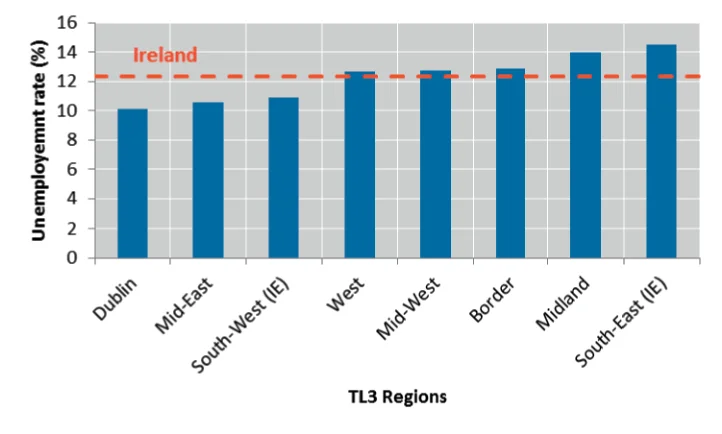
Figure 1. Unemployment rates (TL3 regions) - 2009
Source: OECD Regional database (last updated: October 2013).
Policy co-ordination and integration could be further strengthened through stronger local partnerships and governance structures. This could lead to more information sharing and the identification of common objectives and strategic initiatives to promote local economic development and growth. Better use of information and data at the sub-national level can help bring local partners together in assessing which labour market interventions are successful. The 2014 Action Plan for Jobs recognises the importance of this approach and includes a commitment to develop a framework for a Regional Enterprise Strategy, in order to integrate more effectively the efforts of key stakeholders to build enterprise based on regional competitive advantages. This is a positive step that could be enhanced further. The longstanding Rural Development Programme and the Local and Community Development Programme could also be reviewed to ensure their on-going effectiveness in contributing to job creation efforts at local level, and to ensure that synergies with other place-based employment policies are maximised.
Opportunities for synergies at the local level could be further maximised by developing placebased approaches to job creation that reflect the specific strengths and assets of each functional region, including through greater institutional involvement of local businesses, training and higher education institutions (Box 2), even if only to match skills to jobs. In this respect, local government reform strategies should be closely co-ordinated with implementation of the APJ.
To promote greater integration, the Government could consider injecting more flexibility into local governance networks with proven capacity to deliver so that they can have more influence on the implementation of mainstream programmes and policies. This would enable the employment and skills system to be more responsive to regional variations and local labour market contexts. In practice, this means giving local agencies more latitude in designing policies
and programmes, managing budgets, setting performance targets, deciding on eligibility, and influence on the outsourcing of services.
Box 2. Lessons from the United States
Local Workforce Investment Boards
In the United States, Local Workforce Investment Boards (LWIBs) have played a strong role in creating more integrated strategies to address employment and skills within broader economic development strategies since 1998. There are over 600 WIBs at the state and local level, and they are strongly business-led, being both chaired by business and having a majority of business members. Each WIB is responsible for providing employment and training services within a specific geographic area. The WIBs administer Workforce Investment Act services as designated by the governor, and within the regulations of the federal statute and US Department of Labour guidelines. There are also designated seats for representatives from labour unions and local educational institutions, with economic development officials sitting on the boards in many states. While the performance of these boards varies, in some areas they have developed strong integrated strategies bridging employment, skills and economic development.
OECD (2013), “Local Job Creation: How Employment and Training Agencies Can Help, United States”, OECD Local Economic and Employment Development (LEED) Working Papers, No. 2013/10, OECD Publishing, Paris.
Matching skills to jobs in the Chicago Tri-State Metropolitan area
The Tri-State Region’s various partnerships – both vertical (federal, state, and local agencies) and horizontal (educational institutions, business, non-profits and the workforce) – represent a system that is complex by necessity. For any co-ordination to be viable, the system requires, at a minimum, a common goal. A vision combined with objective performance indicators helps unite stakeholders behind that goal, and helps make tangible progress transparent.
“GO TO 2040” – the comprehensive regional plan launched in October 2010 by the Chicago Metropolitan Agency for Planning – represented a sound step towards establishing such a goal. Recognising existing skills mismatches and pockets of unemployment in the region, the plan’s recommended actions were organised into two areas. The first related to the improvement of education and workforce development, and the second to support for economic innovation.
The Milwaukee 7 – a regional partnership for economic development comprising seven counties in southeast Wisconsin – adopted a strategic framework in 2007 calling for greater coordination along three dimensions: assets, export markets and opportunity zones. The development of an experienced workforce to meet the region’s growing labour needs was among the principal opportunities identified. The group has released a series of annual reports including a performance scorecard that tracks a series of metrics related to the framework’s objectives.
Source: OECD (2012), OECD Territorial Reviews: The Chicago Tri-State Metropolitan Area, United States 2012, OECD Publishing, Paris.
The Regional Spatial and Economic Strategies (SES) and the Local Economic and Community Plans (LECP) as provided for under the Local Government Reform Action 2014 could be particularly effective co-ordination mechanisms as they better reflect functional economic areas. The preparation of the SES will be the principal function of the three new regional assemblies, which will be obliged to collaborate with a broad range of stakeholders in this process. The SES will co-ordinate relevant investment programmes of Government and agencies, taking into account the revised processes being put in place by the Department of Public Expenditure and
Reform, including the adoption of 3 year multi-annual envelopes for expenditure. Furthermore, through the SES, the regional assemblies will facilitate the development of an integrated approach to regional economic development taking into account the views of various stakeholders, including the enterprise and economic development agencies (e.g. Forfás, the IDA, and Enterprise Ireland), infrastructural agencies, higher education institutions and education and training boards, local authorities, key private and commercial semi-state companies, as well as other relevant Department and agencies, whose programmes are regionally significant. To be successful, the SES will need a high degree of commitment and buy-in from the parties involved.
More broadly, the reforms provide local authorities with a stronger mandate to be more proactive in supporting the emergence of strategic leadership in economic development. At the local authority level, the new Local Community Development Committees offer the prospect of improved collaboration between the key local players and, indeed, they are intended to become the prime co-ordination mechanism at this level on social issues. The new Strategic Policy Committees for economic development to be set up in all local authorities, and dedicated Directorates for Services to Economic Development in large urban areas, also offer the prospect of a more consistent and competent role being played by local government in identifying and working with key stakeholders to create sustainable private sector jobs and link available workers to employment opportunities needing their skills.
Pages 31–36 · View in original PDF