Goal 3: L E AD A WH O L E-O F-GOVE RNME NT AP P ROACH T O
Goal 3: L E AD A WH O L E-O F-GOVE RNME NT AP P ROACH T O P O SIT IO N IR EL AND AS A GL O BAL INNO V ATION L E AD ER, D R IVING AN INT E R NATIONALLY CO MPE TITIVE R E SE ARCH AND D E VEL OPME NT SY ST E M, CR E ATING AN INNO V AT IV E E NT E RPRISE BASE AND BUIL D ING A BE T T E R SO CIE TY
INNO VA TIO N 2020 Innovation 2020, Ireland’s national strategy for research and development, science and technology, sets a vision for Ireland to become a Global Innovation Leader.
In the 2020 European Innovation Scoreboard, Ireland is now at 9th place in the EU and 15th place in the 2020 Global Innovation Index. Key actions in 2020included:
Commencement of the consultation process for the development of the next national research and innovation strategy;
Appointment of a National Open Research coordinator, co-funded by this Department and the Department of Education;
Appointment of a researcher under the Science Foundation Ireland Public Service Research Fellowship to the Department to develop a standardised research classification system;
Continued success in Horizon 2020 - Irish researchers and innovators continue to perform well with €1.09bn in competitive funding won by the end of December 2020;
In June 2020, eight Irish start-ups and SMEs were awarded €31m in funding under the Horizon 2020 Accelerator Programme;
Ireland’s EuroHPC National Competence Centre was launched. Hosted by the Irish Centre for High-End Computing, it will afford training and infrastructure access in highperformance computing to Irish researchers and SMEs;
The acquisition of a Quantum Learning Machine in 2020 will enable ICHEC to pursue R&I activities in the emerging field of Quantum Computing;
An allocation of €9m was made through the Capital Equipment Programme – providing SMEs/industry with access to critical, leading-edge equipment and infrastructure through Technology Centres and Technology Gateways; and
The first tranche of Innovation Roadmaps was launched to develop an Innovation Roadmap for each of their clients that is consistent with their capabilities and ambition.
DIS RUP TIVE TEC H NO LO GIES INNO VA TIO N FUND The Disruptive Technologies Innovation Fund, (DTIF), is a €500m enterprise-focused, challenge-based, fund that encourages collaboration between and among SMEs, multinational companies and Irish research institutions. The aim of the fund is to encourage the enterprise sector to engage and invest in developing, deploying and commercialising industrial research. Announced in 2018 as one of four National Development Plan funds under Project Ireland 2040, the Department manages it in consultation with other
Government Departments and Agencies. Enterprise Ireland administers the DTIF on behalf of the Department.
The Fund is delivering on Pillar 1 of the Government’s Future Jobs Ireland framework – Embracing Innovation and Technological Change – by funding the development and deployment of disruptive innovative technologies on a commercial basis. It also aligns with the ambition of making Ireland a Global Innovation Leader by increasing public and private investment in RD&I due to its requirement for 50% co-funding from firms applying for DTIF funds.
The third Call of the Fund was announced in September 2020 and 62 applications were received by the closing date of 17 December 2020. These are checked for eligibility by Enterprise Ireland and then undergo evaluation by panels of international experts and successful projects were announced in Q1 2021.
In 2020 the Irish Government Economic and Evaluation Service conducted a Spending Review of the Fund, with the key findings summarised below:
There is a strong rationale for a publicly funded programme making significant investments in disruptive technologies. The funding provided through DTIF reduces risk for participating firms thereby helping to bring these technologies forward. If successful, the innovations emerging from DTIF offer Irish companies a route to compete in (and potentially disrupt) global markets. This would increase employment in those sectors and drive Irish exports and output.
DTIF is a distinct new programme among other RD&I measures to enterprise. A combination of the scale of funding available for projects, the focus on collaboration and commercialisation, in combination with its funding of disruptive innovation sets the fund apart from other RD&I measures available in Ireland.
The DTIF appears to be aligned well with a number of international initiatives, including in Germany and the EU, which recognise the importance of SME partnerships for innovation.
The programme is working towards achieving its stated objectives. It is funding significant innovations which could potentially capture global markets.
The innovations which DTIF is funding are high-risk, high-return - public funding is intended to help ensure that these technologies are brought forward.
By lowering the risk profile of the innovations, the fund is also encouraging private coinvestment along with DTIF funding.
In line with its objectives, it has maintained a focus on collaboration and building on previous publicly funded research.
It has secured strong involvement from SMEs within project consortia.
The scale of projects funded and the focus on collaboration has ensured that the DTIF is sufficiently different from other RD&I measures, thereby ensuring additionality.
The 43 successful projects under Calls 1 and 2 comprise of 159 partners from the enterprise and research sectors based at locations all around the country as illustrated in this map.
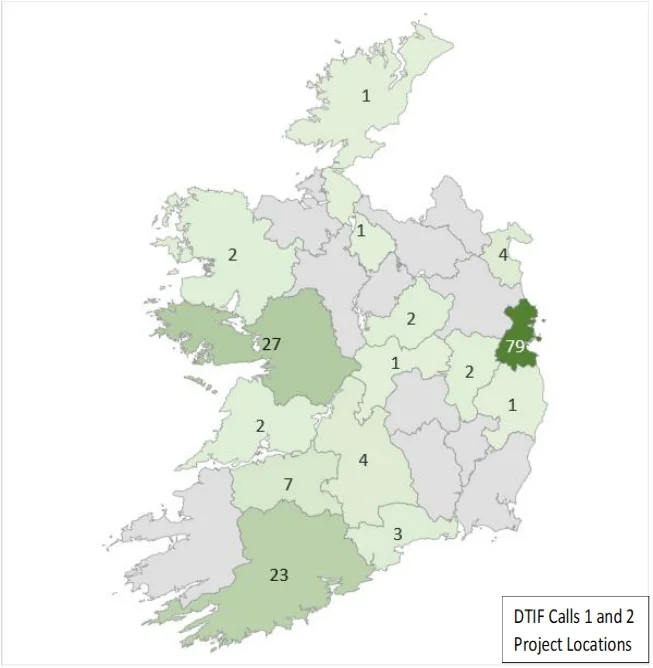
Figure from page 47
Locations of the 159 project partners that were allocated funding under Calls 1 and 2 of the Disruptive Technologies Innovation Fund
S C IENC E FO UNDA TIO N IRELA ND During 2020 Science Foundation Ireland (SFI) continued to play a key role in assisting the government’s vision for Ireland to become a Global Innovation Leader, as outlined in Ireland’s strategy for research and development, science and technology, Innovation 2020, as well as implementing a number of actions in the Future Jobs and other national strategies. With effect from 1 January 2021, SFI transferred to the remit of the Department of Further and Higher Education, Research, Innovation and Science.
Key areas of progress in 2020 included: Research and Innovation, in health, academia and industry, continues to have a significant role to play in the national and global response to COVID-19.
A key element of the SFI’s plan was the COVID-19 Rapid Response Research and Innovation Funding programme.
SFI assisted researchers across the system undertook a vast array of actions to assist and deal with the challenges that were faced as the country responded to the pandemic These included key research expertise, donations of equipment, essential supplies, staff for testing, modelling, 3D printing, etc. SFI also assisted the HSE by providing access to expertise from HEIs to inform the development of the HSE national COVID-19 app.
SFI has continued to deliver significant investments including: assisting Centres for Research Training and Centres for Doctoral Training to deliver the skills needed for the future of the economy; assistance to the network of world leading SFI Research Centres, new awards to assist excellent independent researchers to conduct discovery research; the introduction of dynamic funding models designed to address national and global challenges; and strategic partnerships to assist research projects of scale in strategically important areas.
SFI jointly hosted the National European Research Council Support and Information Forum with Enterprise Ireland and the Irish Research Council.
Programmes and Awards Highlights A number of significant SFI Strategic Partnerships were supported:
A €4.8m investment into a research partnership that investigates the immunology of COVID-19 was assisted.
SFI and Microsoft co-funded a €5m climate change project called Terrain-AI, led by researchers at Maynooth University.
An award was granted to the National Institute for Cellular Biotechnology (NICB) at DCU, to assist ACORN, led by Prof. John Crown and Dr Denis Collins which aims to advance cancer research skills in DCU and bring new findings to clinical trials that will benefit cancer patients in Ireland and globally.
The first awards were approved under the new SFI Frontiers for the Future programme, which assists important investment in high-risk, high reward research, assisting individual discovery research from early-career researchers through to well established leaders. An important gender initiative is also implemented as part of the programme.
As part of an overall Government plan to cultivate challenge-based funding in Ireland, SFI continued the roll out of new Challenges through the SFI Future Innovator Prize, with a focus on key issues such as AI for Societal Good, Zero Emissions, Plastics and Food.
Twelve awards were approved under the SFI Public Service Fellowship. These support researchers working across Government departments, in the Houses of Oireachtas
Library & Research Services, Food Safety Authority of Ireland, etc. helping to inform policy and improve services.
Professor Jens Walter was recruited at UCC, to lead a €3.7m research programme at APC Microbiome Ireland SFI Research Centre, through the SFI Research Professor Programme and will investigate the impact of a modern lifestyle on the gut microbiome and its relationship to increased chronic diseases.
SFI continued to assist the network of 16 SFI Research Centres, which have been at the core of transformational change in how we help research across the HEIs – with a drive to undertake excellent research with economic and societal impact. The 16 SFI Research Centres have been part of Ireland’s success at drawing down EU Horizon 2020 funding.
Careers, Education Support, Informal Learning
Science Week 2020 ran from 8-15 November 2020 and celebrated its 25th anniversary in 2020, moving to a virtual festival, with the theme Choosing our Future, focusing on how science can improve our lives for today and in the future. 13 Science Week Festivals, assisted under the SFI Discover Programme also took place virtually across the country in Cork, Cavan / Monaghan, Sligo, Galway, Limerick, Tipperary, Mayo, Wexford, Kilkenny, Kerry, south east and the midlands.
331 primary schools nationwide received an SFI Discover Primary Science and Maths Award. The programme aims to increase interest in science, technology, engineering and maths (STEM) among primary school students and teachers. The Awards recognise the achievements of children and teachers in the application of STEM in their curriculum.
ENTERP RIS E IRELA ND INNO VA TIO N INVES TMENT A ND A C TIVITY Enterprise Ireland provides RD&I measures for companies to develop new technologies and processes that will lead to job creation and increased exports. By the end of 2020 Ireland had drawn down more than €1bn in funding under the EU’s Horizon 2020 programme (2014- 2020). In June eight Irish start-ups and SMEs were awarded €31m in funding under the Horizon 2020 Accelerator Programme.
Strengthening existing in-company Research, Development and Innovation capacity In 2020, Enterprise Ireland approved 194 RD&I approvals over €50,000 to client companies. Enterprise Ireland rolled out a suite of webinars aimed at increasing awareness of RD&I funding and collaborative measures. In addition, they launched the first tranche of Innovation Roadmaps in line with their Strategy to develop an Innovation Roadmap for each of their clients that is consistent with their capabilities and ambition.
COVID-19 Products Scheme The COVID-19 outbreak has resulted in an urgent need across the EU and globally for medical and public health research and development, products and solutions. The COVID- 19 Products Scheme has been developed following the amendment of an EU Temporary State-Aid Framework, to provide grant aid to Enterprise Ireland and Údarás na Gaeltachta clients. IDA Ireland operates a similar scheme for their clients.
This scheme is composed of three measures:
Measure 1: COVID-19 relevant research and development activities by companies coupled with the creation of useful Intellectual Property.
Measure 2: The construction and upgrade of testing and upscaling infrastructures that are utilised to develop COVID-19 relevant products.
Measure 3: Increased production of products needed to respond to the COVID-19 outbreak. These outputs should be achieved as quickly as possible.
Driving increased collaboration between Industry and Academia During 2020, 936 collaborative projects between companies and Irish HEIs were assisted by Enterprise Ireland. This figure includes 477 small €5k Innovation Vouchers redeemed, 405 industry funded Technology Gateway Industry projects completed at Institutes of Technology across Ireland and 54 Innovation Partnerships approved. These projects provide companies with new commercial opportunities, cost savings or increases in their innovative capability.
Technology Centre Programme During 2020, 1,228 companies engaged with the network of Enterprise Ireland/IDA Ireland Technology Centres. While this more than double the number engaged in 2019, this includes companies newly engaged with the centres through their year-long series of webinars.
Independent economic analysis has found that Enterprise Ireland /IDA Ireland Technology Centres will achieve between a 6 to 20-fold return on the State’s investment. In addition, based on an analysis for Enterprise Ireland’s Annual Business Review Data, clients in Technology Centres, compared to RD&I performing clients that are not in Technology Centres, have higher Turnover, Export Sales , Domestic Sales, Full time Employees and RD&I Spend.
To scale up the operations of Enterprise Ireland/IDA Ireland Technology Centres, in 2020 additional five year investments were announced for the Microelectronic Circuits Centre Ireland (€10m) and the Dairy Processing Technology Centre (€14m).
Technology Gateway Programme The 2018-2022 Technology Gateway Programme funds 15 Gateways operating across the 11 Institutes of Technology. The Gateway network also comprises three Sectoral Clusters of Gateways namely: IoT Cluster (Internet of Things), EMD Ireland Cluster (Engineering , Materials and Design) and Irish Food Tech Cluster.
In 2020, €9m was spent on expanding the Capital Equipment Programme– providing SMEs/industry with access to critical, leading-edge equipment and infrastructure through Technology Centres and Technology Gateways, building on the €6m spent in 2019. Access to the new equipment will help companies in Ireland to innovate and adapt and remain competitive on a national and global level.
High Potential Start-ups 12 new High Potential Start-ups were created from research outputs from the Higher Education System in 2020.
KNO WLEDGE TRA NS FER IRELA ND Knowledge Transfer Ireland (KTI) helps business to benefit from access to Irish expertise and technology, by making it simple to connect and engage with this research base in Ireland.
In 2020, KTI began its series of ‘Unlocking Knowledge Transfer’ webinars every month with the aim of raising knowledge transfer awareness while taking an in-depth look at how it can benefit enterprise. The webinars covered issues such as: Harnessing the Value of Your IP; Accessing World Class RD&I through Ireland’s Technology Gateways; and Leveraging Artificial Intelligence Expertise. All of KTI’s past webinars are available through their website www.knowledgetransferireland.com. COVID-19 Non Exclusive Royalty-Free Licence In 2020 KTI announced the creation of a dedicated COVID-19 Non-Exclusive Royalty-Free (NERF) Licence. KTI worked with the Technology Transfer Offices in the Irish higher education sector nationwide to produce a simple two page agreement that is aimed at speeding up the dissemination of critical COVID-19 related intellectual property from Irish universities and institutes of technology to companies.
The NERF Licence is the result of a desire by HEIs nationwide to assist the search for, and the development of, new technologies to help bring the COVID-19 pandemic to an end. Under normal circumstances, IP is licenced through a process of negotiation between both parties under which royalties and exclusivity of use are clearly detailed and agreed. The COVID-19 NERF provides cutting edge IP free of charge to organisations engaged in critical research and development activities for the sole purposes of diagnosing, preventing, containing, treating and/or minimising the impact of the virus.
The COVID-19 NERF Licence will remain in place until such time as the World Health Organisation declares the current COVID-19 pandemic to have ended.
In response to COVID-19, in 2020 the KTI Impact Awards included an award for the ‘COVID- 19 Response Award’ recognising innovative activities in the Higher Education Institutions that rose to the various challenges presented by the pandemic and that required the skills of the Technology Transfer Office to assist delivery.
H E AL T H INNO VAT IO N H UB IR E LAND Health Innovation Hub Ireland (HIHI) is a joint initiative of this Department and the Department of Health. The aim of the initiative is to drive collaboration between the health service and the enterprise sector leading to the development and commercialisation of new healthcare technologies, products and services.
In February 2020, HIHI’s call for COVID-19 related products generated 197 submissions over 11 weeks, many of which proved to be valuable solutions which were fed into the HSE or directly to healthcare facilities and nursing homes.
In July the results of HIHI’s annual national call for innovations addressing any healthcare need and a focussed call on Supporting the Self -Management of Chronic Disease (cardiovascular, respiratory and diabetes) were announced. Of the 48 applicants, 23 were selected to pitch their product and 15 were selected for pilot and validation studies.
EU FRA MEWO RK P RO GRA MME FO R RES EA RC H & INNO VA TIO N - H O RIZ O N 2020 Ireland continued its excellent performance in Horizon 2020, the EU Framework Programme for Research and Innovation. Ireland based researchers and innovators have won €1.09bn in competitive, EU funding from the programme up to the end of 2020. Secondary or higher education accounted for €614.4m of the total. Private for profit companies (excluding education) won €383.4m with €266.4m of this going to SMEs. Enterprise Ireland leads the Irish Horizon 2020 support network.
Negotiations on the 9th Framework Programme for Research and Innovation Horizon Europe regulation and budget concluded in December 2020. The final agreed budget for Horizon Europe is €95.5bn with a €5bn boost from Next Generation EU. The first calls for Horizon Europe are expected to launch in April 2021.
INTERNA TIO NA L RES EA RC H O RGA NIS A TIONS The Department continued to strengthen Ireland’s participation in international research collaborations and 2020 saw the first Irish student participating in the new Irish Research Council European Southern Observatory (ESO) Studentship Programme.ESO is the foremost intergovernmental astronomy organisation in Europe and the world’s most productive astronomical observatory.
In 2020, the Irish Centre for High-End Computing launched its Academic Flagship and SME Accelerator programmes, following its designation as Ireland’s national EuroHPC Competence Centre.
Quantum Computing is a rapidly-emerging area of technological development that is of significant interest to the Department. The acquisition of a Quantum Learning Platform in 2020, hosted by the Irish Centre for High-End Computing, will facilitate application development, research and innovation, training and education in the field of Quantum Computing, contributing to Ireland’s smart economy.
Ireland will also participate in the European Open Science Cloud (EOSC) Association, which was formally established late in 2020. The goal of EOSC is to provide a trusted virtual environment for researchers to store, manage, analyse and re-use data for research, innovation and educational purposes. This will help give the EU a global lead in research data management. It will also facilitate open science and innovation by offering every European researcher the possibility to access and reuse all publicly funded research data in Europe across disciplines and borders.
US - IRELA ND R& D P A RTNERS H IP The US-Ireland R&D Partnership is a tri-jurisdictional alliance which was officially launched in 2006. Its aim is to promote collaborative innovative research projects which create value above and beyond individual efforts. The Partnership steering group met on 10 March 2020 in the US State Department in Washington DC and via video link from the InterTradeIreland offices in Newry.
Since the March 2020 annual meeting, seven additional projects have been approved, one in Nanotechnology, three in Centre to Centre, two in Health and one under the Energy and sustainability priority area. A total of 65 projects are approved to date, representing $126m/£89m/€106m. The number of projects funded under each priority area are: 16 Nanotechnology, 14 Health, 11 Energy & Sustainability, nine Sensors, seven Centre to Centre, five Agriculture, and three Telecommunications. The portfolio continues to perform well with National Institutes of Health applications achieving a success rate of 17.1%, National Institute of Food and Agriculture applications 18.5% and National Science Foundation applications showing a particularly healthy success rate of 32.2%.
At the March meeting, it was commented that the US-Ireland R&D partnership model is now used as a model for collaborations with other countries. The updated terms of reference were approved by all departments and an amendment to the Memorandum of Understanding to include the new cybersecurity priority area had been signed by partners in December 2019. The Department for the Economy in Northern Ireland is currently undertaking a review which will consider, among other matters, how the impact of research and the wider US-Ireland partnership is best measured. This will be a key consideration for the partnership – how best to measure both quantitative and qualitative impacts that will add value to the partnership in terms of promotion and wider public engagement. USDA are leading a tripartite review of the agriculture pilot which should be completed in 2021.
Work has commenced on a second US-Ireland R&D Partnership video case study. In relation to the newest priority area, Cybersecurity, the first transatlantic collaborative webinar took place on 2 December 2020. This was the first webinar of the series of meetings to promote the new Cybersecurity theme and to facilitate formation of new collaborations.
EU S P A C E P O LIC Y DEVELO P MENTS In December 2020, the European Council and the European Parliament reached agreement on the regulation establishing the EU space programme for 2021-2027, paving the way for the €13.2bn space programme to start work in 2021.
European Space Agency (ESA) contracts were secured by 20 companies up to end Q3 2020. Six of these companies were first-time ESA contractors demonstrating the progression of Irish industry in this developing sector. The total value of industry contracts placed by ESA in Ireland up to end Q3 2020 was €5.15m. A further €1.25m in contracts were secured by the Irish research community, bringing the total value of ESA contracts placed in Ireland in 2020 up to Q3 to €6.4m. Additionally, five new start-ups were approved for the Irish ESA Business IncubationCentres (BICs) in 2020. The ESA BIC works with entrepreneurs to turn space-connected business ideas into commercial start-ups companies. In 2020, Ireland invested €19.8m in its membership of ESA.
TY NDA LL NA TIO NA L INS TITUTE Tyndall National Institute (Tyndall) is Ireland’s largest dedicated research centre, specialising in Information and Communications Technology hardware and systems. Tyndall received a total of €9m from the Department in 2020.
In January 2020, Tyndall launched their new strategic plan Tyndall 2025 laying out their ambition to significantly scale the Institute, doubling both the physical space as well as their
research capacity. Tyndall 2025 seeks to ensure that Tyndall will stay at the forefront of new technologies and build on its successful industry engagement model while enabling it to respond to evolving ICT-related technology opportunities in a fast changing and competitive environment. Responsibility for Tyndall moved to the Department of Further and Higher Education, Research, Innovation and Science along with other academic led research with effect from 1 January 2021.
INTELLEC TUA L P RO P ERTY The EU Commission launched its Intellectual Property (IP) Action Plan Roadmap in 2020. This was developed around five pillars;
Update the IP protection system which includes the evaluation of the industrial 1. designs legislation and to make IP protection more effective in the supplementary protection certificate system;
Promote strategic use of IP by businesses, and in particular to make the IP system 2. more effective for SMES;
Facilitate IP valorisation and licensing; 3.
Reduce IP infringement through enhancing the effectiveness of initiatives to combat 4. counterfeiting and piracy; and
Improve global fair play. 5.
C O P Y RIGHT Post Enactment Report for the Copyright and Other Intellectual Property Law Provisions Act, 2019 (No. 19 of 2019) The Copyright and Other Intellectual Property Law Provisions Act, 2019 (‘the 2019 Act’) was signed into law by the President on 26 June 2019. In accordance with Dáil Standing Order 164A (adopted in 2016), twelve months following the enactment of a Bill, the Government or Minister of State responsible for the implementation of an Act is required to produce a report on the functioning of the Act and submit the report to the Parliamentary Library of the Houses of the Oireachtas.
A post-enactment report for the 2019 Act was prepared by the Department and laid in the Parliamentary Library of the Houses of the Oireachtas on 18June 2020. Certification of Copyright Licensing Scheme for the use of copyright protected material by educational establishments In July 2020, the Tánaiste certified four new copyright licensing schemes for the Primary, Post-primary, Higher Education and Further Education sectors that are applicable for the academic year 2020/21 onwards. The new schemes, operated by the Irish Copyright Licensing Agency, allow schools and other educational establishments to make use of copyright protected works (including print and digital works) for educational purposes.
Amendments to the District Court Rules for Intellectual Property to facilitate access of intellectual property claims to those courts
The 2019 Act contained amendments to the legislation governing the Circuit Court and District Court that provide for easier and lower-cost access to the courts system for Intellectual Property infringement claims. In 2020, as a direct result of these provisions, the Courts Service/Department of Justice, with the assistance of this Department, oversaw the signing into law of the District Court (Intellectual Property) Rules 2020 (S.I. No. 284 of 2020) which facilitate the expansion of intellectual property infringement claims to that court. This now reduces the cost of pursuing intellectual property infringement claims in instances where monetary awards sought are within the jurisdiction of the District Court.
Directive (EU) 2019/790 of the European Parliament and of the Council on copyright and related rights in the Digital Single Market and amending Directives 96/9/EC and 2001/29/EC The EU Directive on Copyright in the Digital Single Market was negotiated and agreed under the Digital Single Market strategy between September 2016 and May 2019. The intention of the Directive is to craft a modern copyright legislation to respond to the needs of all European citizens in an increasingly digitalised society. This Directive allow for wider access to and use of copyright protected works benefitting the creative sectors, press publishers, researchers, educators, cultural heritage institutions, and citizens. It provides a framework for the creation of modern European copyright legislation to take account of technological developments in the digital age while continuing to ensure that creators are remunerated for their creative efforts. Following the publication of the Directive, the Department carried out a series of public consultations seeking the views of all interested stakeholders on the transposition of the Directive into Irish law. Work on the transposition continued throughout 2020 with the Department carrying out a detailed analysis of the large number of submissions received to the consultation process. The Department intends to transpose the Directive by the deadline of 7 June 2021.
S EC O NDA RY LEGIS LA TIO N IMP LEMENTED IN TH E A REA O F INTELLEC TUA L P RO P ERTY 1. S.I. No. 275 of 2020 Copyright and Related Rights (Certification of Licensing Scheme for Primary Schools) (The Irish Copyright Licensing Agency Limited) Order 2020. Published in ‘Iris Oifigiúil’ of 4 August 2020.
-
S.I. No. 276 of 2020 Copyright and Related Rights (Certification of Licensing Scheme for Post-Primary Schools) (The Irish Copyright Licensing Agency Limited) Order 2020. Published in ‘Iris Oifigiúil’ of 4 August 2020.
-
S.I. No. 277 of 2020 Copyright and Related Rights (Certification of Licensing Scheme for Higher Education Institutions) (The Irish Copyright Licensing Agency Limited) Order 2020. Published in ‘Iris Oifigiúil’ of 4 August 2020.
-
S.I. No. 278 of 2020 Copyright and Related Rights (Certification of Licensing Scheme for Further Education Providers) (The Irish Copyright Licensing Agency Limited) Order 2020. Published in ‘Iris Oifigiúil’ of 4 August 2020.
The above Orders, certified by the Tánaiste pursuant to section 173 of the Copyright and Related Rights Act 2000, provide for new copyright licensing schemes for the Primary, Postprimary, Higher Education and Further Education sectors. The new licensing schemes were required as a result of the provisions contained in section 15 of the Copyright and Other Intellectual Property Law Provisions Act 2019. The licensing schemes enable educational establishments to make use of copyright protected works for educational purposes. The licensing schemes are operated by the Irish Copyright Licensing Agency Limited and are applicable for the 2020/21 academic year onwards.
S TA NDA RDIS A TIO N Due to COVID-19 restrictions worldwide Standards meetings migrated to on-line platforms, which had a positive impact of making meetings accessible to Committee Members who may not have the time or the resources to attend international meetings.
Artificial Intelligence (AI) – NSAI were appointed to lead a Government of Ireland Top Team on AI standards. The team was established to realise opportunities presented by technological changes and the move to a low carbon economy. It forms part of the overall national AI Strategy which aims to ensure our research centres, businesses and the public sector exploit AI technologies to secure greater levels of productivity and wellbeing.
European Standards+Innovation Award - NSAI blockchain committee member took home the European Standards+Innovation Award at the 2020 CEN and CENELEC Standards+Innovation Awards, Fiona Delaney, Technical Committee member and founder of Origin Chain Networks was awarded for her contributions to European and international blockchain Standards. Ms Delaney submitted a unique agri-food application of blockchain called Universal Farm Compliance to the ‘Blockchain and distributed ledger technologies’ Standards Committee. The case will allow blockchain to be used creatively worldwide and puts Origin chain networks, NSAI and Ireland on the map for Innovation.
Contributing to Standards – The importance and benefit of participating in standards development was formally recognised by Engineers Ireland during 2020 through acknowledging Standards Committee Participation for Continuing Professional Development purposes.
Pages 45–56 · View in original PDF