Goal 2:L E AD A WH O L E O F GO V E RNME NT AP P ROACH T O
Goal 2:L E AD A WH O L E O F GO V E RNME NT AP P ROACH T O D E V E L OP ING T H E MO ST CO MP ETITIV E E NV IRONMENT F O R INV E ST ME NT, P R ODUCTIVITY AND SUST AINABLE J O BS
INDUS TRY 4. 0 S TRA TEGY Ireland’s Industry 4.0 Strategy 2020-2025 was published in December 2019. The vision underpinning the strategy is that, by 2025, Ireland will be a competitive, innovation-driven manufacturing hub at the frontier of the fourth industrial revolution, and at the forefront of Industry 4.0 development and adoption.
The Strategy has five goals and 18 strategic actions and the strategic actions are structured around six themes. The Strategy recognises that Ireland is well positioned to pursue opportunities arising from Industry 4.0, and that all firms – large and small, foreign and indigenous - should have the opportunity to engage in Industry 4.0. It also recognises that one of the key policy challenges is to encourage the diffusion and adoption of the new technologies by all firms, particularly those with low absorptive capacity.
In 2020, work continued on the establishment of two key drivers of the Strategy:
The establishment of ‘Future Manufacturing Ireland’ (FMI) – this new coordination mechanism will ensure coherence and optimal delivery of Research, Development and Innovation (RD&I) measures across publicly funded research centres of scale. FMI will ensure maximum alignment of activities across the Research and Development centres and avoid unnecessary duplication and fragmentation of effort, providing a coordinated approach to meet the needs of the Irish manufacturing industry.
The establishment of an Industry 4.0 Stakeholder Forum to oversee the implementation of the Strategy and to provide advice, guidance and inform future policy development. The Forum members will include representatives of the manufacturing value chain, Industry 4.0 experts, Higher Education Institutions, industry bodies, relevant state bodies and the FMI Project Manager.
REMO TE WO RK GUIDA NC E A ND S TRA TEGY Following the findings of the December 2019 Remote Work in Ireland report, the Department focussed on providing guidance to employers and employees on the topic of Remote Work. An Interdepartmental Group (IDG) on Remote Work was formed to deliver guidance on Remote Work.
In July 2020, the Department launched the ‘Remote Work Guidance’ webpage. This webpage brought together the information, guidance and legislation relevant to remote working from across Government Departments and Agencies. In the same month, a public consultation was launched, following which, the webpage was updated to address the feedback received and to include an employer checklist. The checklist provides employers a quick way to navigate the adoption of remote working arrangements in an easy-to-use format for businesses.
In September, the Department commenced the development of a National Remote Work Strategy, steered by the IDG on Remote Work. The Strategy was published in early January 2021 and its vision is to make remote working a permanent feature of the Irish workplace in a way that maximises the economic, social and environmental benefits. It includes 15 actions to be taken to progress remote work in Ireland.
DIS RUP TIVE TEC H NO LO GIES INNO VA TIO N FUND During 2020, Disruptive Technologies Innovation Fund (DTIF) projects continued to deliver on ambitions set out in Future Jobs Ireland 2019. There are 74 SMEs engaging in RD&I through the Fund, collaborating with multinational companies and research institutions on large-scale industrial research projects. These projects are at the forefront of technological change in areas such as gene therapies, artificial intelligence and carbon reduction. This work will help not only to increase productivity across these companies but also to attract new talent to these sectors in Ireland. See more about DTIF under Goal 3.
DELIVERING S KILLS FO R A GRO WING EC O NO MY The Department provides the secretariat for the Expert Group on Future Skills Needs (EGFSN) and initiated and published the following reports in 2019 and 2020.
Building Future Skills: The Demand for Skills in Ireland’s Built Environment Sector to 2030 The study focussed on the Future Skills Needs across Ireland’s Built Environment Sector i.e. activities related to Construction, Engineering, Architecture and Utilities. Framed by national strategies such as Rebuilding Ireland: Action Plan for Housing and Homelessness, Project Ireland 2040, and the built environment elements of the Climate Action Plan, the study was completed in Q2 and approved by the National Skills Council prior to its publication at the end of September 2020.
Management capacity and practices of Irish SME managers A study to examine management capacity and practice in Ireland was carried out by TU Dublin for the EGFSN and with the assistance of the European Commission, between October 2019 and June 2020. The project report was published in October 2020. An implementation group was established following the publication of the report and will convene for an initial period of two years with a view to extending its term to five years. The implementation group will include members from the Department of Enterprise, Trade and Employment, the Department of Further and Higher Education, Research, Innovation and Science, ISME, SFA, Chambers Ireland, Enterprise Ireland, LEOs, Solas and the Higher Education Authority.
Together for Design - a new design skills study In 2019 the EGFSN commenced a new design skills study, Together for Design. The objective of this report was to build on the foundations provided by the EGFSN’s 2017 Winning by Design report to understand the enterprise demand for digital, product and strategic design skills and to measure the provision of educational courses ad dressing these skillsets. The report identifies recommendations to help drive forward skills supply in this area. Together for Design was published Q2 of 2020. The report’s recommendations are currently being progressed by an implementation group.
Skills to Enable the Low Carbon Economy to 2030 In late 2020, the EGFSN also initiated a study on Skills to Enable the Low Carbon Economy to 2030. This study will seek to determine the demand for, and nature of, the skills required to deliver on key elements of Ireland’s Climate Action Plan to Tackle Climate Breakdown over the years to 2030. The study, which will involve comprehensive engagement with enterprises across the low carbon economy and will be guided by a steering group composed of the key public and private sector stakeholders, is scheduled to be completed in May 2021. It will be published following its approval by both the Expert Group on Future Skills Needs and National Skills Council.
LO W P A Y C O MMIS S IO N Following the transfer of functions from the Department of Social Protection, the Department assumed responsibility for the Low Pay Commission which has the principal function of examining and making recommendations to the Tánaiste on the appropriate level of the national minimum wage and related matters. As part of this agenda the Department is representing Ireland in the negotiations on the draft EU Directive on Adequate Minimum Wages, which is expected to be finalised in 2021. The Low Pay Commission’s current work programme includes two major pieces of research on the transition to a Living Wage and the design of a Universal Basic Income pilot.
C O MP ETITIVENES S A ND P RO DUC TIVITY Research, analysis and the secretariat role for the National Competitiveness and Productivity Council (NCPC) is undertaken by the Department. In accordance with the European Council recommendation on the establishment of National Productivity Boards by euro area countries, in March 2018, the Government mandated the National Competitiveness Council as the body responsible for analysing developments and policies in the field of productivity and competitiveness in Ireland. This underpins the decision to rename the Council as the National Competitiveness and Productivity Council in November 2020.
The Council reports to the Taoiseach and the Government, through the Minister for Enterprise, Trade and Employment on key competitiveness issues facing the Irish economy and offers recommendations on policy actions required to enhance Ireland’s competitive position.
The Department places a high priority on ensuring that the key enterprise competitiveness issues are identified and prioritised for action across the government system. Ireland is currently ranked 12th according to the Institute for Management Development’s World Competitiveness Ranking 2020 report.
The NCPC published the following reports during 2020:
Ireland’s Competitiveness Scorecard 2020 Ireland’s Competitiveness Challenge 2020 Competitiveness Bulletins 2020
EC O NO MIC INFRA S TRUC TURE During 2020 the Department engaged across Government on key issues and priorities for business users across infrastructure areas drawing on analysis carried out focussing on the competitiveness of Ireland’s business environment.
The Department engaged with Irish Water and the Commission f or Regulation of Utilities on the delivery of water services for non-domestic users, worked with the relevant policy makers in the Department of the Environment, Climate and Communications regarding the competitiveness implications of energy infrastructure on policy areas such as the development of the Renewable Energy Support Scheme, a micro-generation scheme and the development of a policy framework to encourage the uptake of Corporate Power Purchase Agreements by large energy users.
The Department is represented by the Secretary General on the Project Ireland 2040 Delivery Board. The Department works closely with the Department of Public Expenditure and Reform’s National Investment Office as well as across other relevant Departments to provide input on the infrastructure needs of enterprise, to maintain a competitive and attractive business environment, as part of achieving our national population, ‘place-making’ and employment ambitions.
In parallel, the Department engaged on an ongoing basis across the public and private sectors to advocate for policy measures to improve the availability and quality of economic infrastructure to assist enterprise development and maintain the competitiveness of our business environment.
EVA LUA TIO N A C TIVITY The Department carried out a number of evaluations in 2020 including a review of the Department’s capital expenditure over the period 2006 to 2018. This exercise examined the Department’s expenditure across a number of areas including theme, agency, policy instrument and beneficiary. The paper provided some initial insights in the area of policy alignment which are being further explored. An early evaluation of the Disruptive Technologies Innovation Fund was also carried out through the Spending Review process. The paper found that the programme is working towards its stated objectives and made a number of recommendations around continued monitoring. A review of Enterprise Ireland’s Research, Development and Innovation programme was carried out and will be published in 2021.
TA XA TIO N The Department had ongoing engagement across Government with regard to the wage subsidy schemes created in response to the COVID-19 pandemic and delivered via the Revenue Commissioners. The Department’s engagement helped to shape the schemes to ensure that they met the needs of enterprise and assisted employment insofar as possible.
The Department liaised widely with enterprise representative groups and worked closely with the Department’s development Agencies to develop a joint agency Pre-Budget Submission. The primary purpose of the submission was to ensure that Budget 2021 continued to assist enterprise and that the views and needs of enterprise were taken into consideration.
C LIMA TE A C TIO N Climate Action is a core element of the Department’s enterprise and innovation policies and in our Agencies’ programmes and activities. The Department recognises that enterprises have important roles to play to develop and adopt innovative technologies, products and services that increase efficiencies, reduce waste and deliver sustainable development as countries across the world transition to low carbon economies.
Pillar 5 of Future Jobs Ireland 2019 recognises the importance of climate action, complements the all-of-Government Climate Action Plan and outlines three ambitions and actions in transitioning to a low carbon economy:
to become a leader in adopting and developing standards in the low carbon economy; 1.
to realise the opportunities for economic activity and job creation; and 2.
to leverage Ireland’s natural resources, enterprise strengths and innovative capacity to 3. be a global leader in the circular and bio-economy.
Four of the projects funded under Calls 1 and 2 of the Disruptive Technologies Innovation Fund address the theme of Energy, Climate Action & Sustainability. These projects include a cooperative energy trading system; an advanced environmental decision support system to address issues such as coastal pollution and flooding; a zero-emission, refrigerant-free heat pump and a sustainable bio-renewable energy from wastewater anaerobic digester for the food and drink sector. Further details on the Disruptive Technologies Innovation Fund are under Goal 3.
The Department actively engaged with the Government’s Climate Action Plan 2019, its governance processes and has monitored progress and provided input into the development of the economy-wide Long-Term Strategy outlining Ireland’s net-zero 2050 target. It committed to further Departmental and cross agency climate actions for the interim period to the development of Climate Action Plan 2021 and work commenced on the contributions from the Department to Climate Action Plan 2021.
The Department participated in discussions with the European Commission on the enterprise aspects of the Commissions reference scenario which will form the basis of Ireland’s national effort-sharing target following the increase in EU ambition to reduce greenhouse gases by 55% by 2030.
RES EA RC H A ND P UBLIC A TIO NS Climate Research was undertaken into technologies that could be adopted in specific sub -sectors of the manufacturing sector to reduce emissions and in the context of the development of sectoral targets, analysis was conducted to quantify CO2 abatement if investment in these technologies occurred over the period to 2030. It progressed the Department’s actions from the Climate Action Plan 2019 regarding those applying to the food/drinks and cement sectors and inputted to the quarterly published progress reports on the Climate Action Plan on actions including those undertaken by IDA Ireland, Enterprise Ireland, Science Foundation Ireland and NSAI. Throughout the year the Department provided analysis and
policy input into matters relating to climate action policy and ensured consideration of competitiveness impacts in policy options. Focus on Sectors 2020 Focus on Sectors 2020 was published in August and is a series of sectoral reports that present concise overviews of 16 key sectors of the economy, encompassing both exporting and locally trading activities. While a number of the sectors fall within the remit of this Department and its Agencies, broader sectoral development responsibility spans a range of government departments. The reports draw on existing Departmental research and a review of recent national and international analysis undertaken in response to the pandemic. They include inputs from across several government departments, enterprise Agencies and industry representative organisations and outline some initial indications of the impact of COVID-19 on these sectors.
The sectors covered in the reports are: Aerospace & Aviation; Agri-Food & Beverages; Audiovisual; Biopharmachem; Construction; Energy, Sustainability & Natural Resources; Engineered Products & Sub-Supply; Global Business Services & Business Process Outsourcing; International Education Services; International Financial Services & Fintech; Marine & Maritime; Medical Technologies; Retail; Technology; Tourism & Hospitality; and Transport & Logistics.
EU DIGITA L EC O NO MY P O LIC Y In line with the Department’s goal of developing a competitive environment to boost investment, improve productivity and create and sustain jobs, work on delivering the digital transformation agenda continued throughout 2020. The Department continued to lead a whole-of-Government activity and cross Government coordination of the Digital Single Market (DSM) agenda at national and EU levels.
Ireland improved its performance in the EU Digital Economy and Society Index (DESI) Report for 2020 compared with 2019, now ranked in 6th place. Over the last five years, Ireland has made continuous improvements in these rankings and is now the fastest growing Member State in the EU.
One of the key successes last year was the delivery of the Platform to Business Regulation by the Department which was signed into law in July 2020 via S.I. No. 256/2020 - European Union (Promoting Fairness and Transparency for Business Users of Online Intermediation Services) Regulations 2020.
This aims at creating a fair, transparent and predictable business environment for businesses when using online platforms to trade. The Regulation had direct effect in EU Member States from 12 July 2020 and was signed into law by the Tánaiste by way of S.I. No. 256/2020 - European Union (Promoting Fairness and Transparency for Business Users of Online Intermediation Services) Regulations 2020. The Competition and Consumer Protection Commission has been designated as the Irish enforcement body for the Regulations and will investigate and tackle any structural non-compliance with the provisions of the Regulations.
The Department prepared a national submission to the EU’s public consultation on the Digital Services Act package, then one combined package, in September 2020, which was based on an extensive cross-Government collaboration of relevant departments and a wider national stakeholder consultation.
In June 2020 the Department prepared a comprehensive national submission to the EU’s Public Consultation on the EU White Paper on Artificial Intelligence that was based on extensive cross- Government consultation.
Completing the Digital Single Market is a priority for Ireland and the Department continues to work with the European Commission, European Parliament and other Member States in delivering outcomes which are pro-trade, pro-enterprise and pro-innovation. Proposals have been formulated for DSM 2.0 and the key areas that are to be focused on as part of the future development of the digital economy are: Platforms and the Digital Services Act; Artificial Intelligence; and Better use of data.
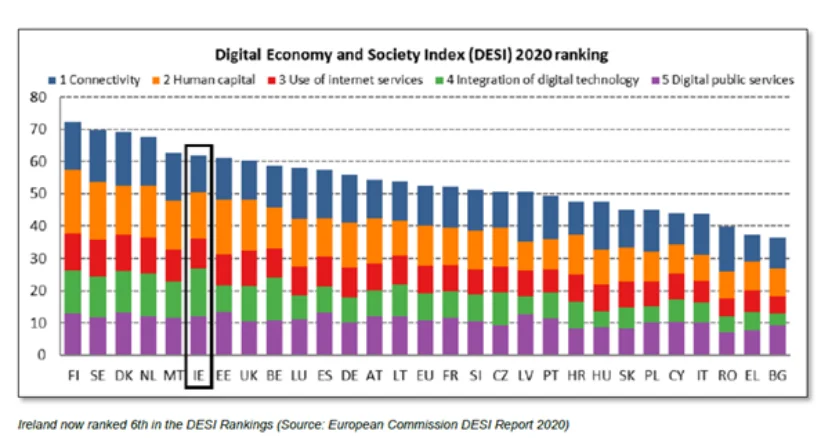
Figure from page 42
NA TIO NA L A RTIFIC IA L INTELLIGENC E S TRA TEGY Work commenced on the development of the national Artificial Intelligence (AI) Strategy which will be launched in mid 2021. The Strategy will outline a vision for Ireland to be an international leader in using AI to the benefit of our population, through a people-centred and ethical approach to AI development, adoption and use.
NA TIO NA L P LA N O N C O RP O RA TE S O C IA L RES P O NSIBILITY The Corporate Social Responsibility (CSR) Stakeholder Forum was established in 2014 to drive the implementation of the first National Plan and was renewed for the second national plan.
The CSR Stakeholder Forum is a business led voluntary Body with representatives from business, civil society and Government. The primary goal of the Forum is to raise awareness of CSR and grow CSR activity within business in Ireland, working in partnership with business, civil society and Government to deliver on the actions of the National Plan, Towards Responsible Business, Ireland’s second National Plan on Corporate Social Responsibility 2017-2020.
Some of the key achievements by the CSR Stakeholder Forum included;
Development of CSRhub - CSR Hub as a dedicated national CSR resource, assisted by an active social media present to highlight good CSR practice;
establishment of a flagship CSR Annual CEO/Leaders’ Breakfast event;
promoting CSR peer learning amongst businesses through SME outreach events; establishment of a dedicated ‘Public Sector CSR Network’ – a peer learning network for public sector organisations to develop their CSR strategies;
establishment of the CSR virtual online network – for CSR practitioners and organisations interested in developing their CSR strategies;
an increase in the number of CSR Case Studies profiled on the CSRhub.ie website. Case studies are an integral element of the work of the Forum as they provide a strong educational resource for businesses and organisations of all sizes. Case studies are available to download from CSRhub - CSR Hub and are accessible to all;
growing a panel of active CSR ambassadors within the business community; and highlighting opportunities for the private and public sector to partner on impactful initiatives that align with public policy.
The Department continued to liaise with the CSR Stakeholder Forum throughout 2020 and had started the consultation process on a new iteration of the CSR National Plan. However, due to the prioritisation for COVID-19 and Brexit the initiative was paused in 2020.
S US TA INA BLE DEVELO P MENT GO A LS The Department of the Environment, Climate and Communications’ ‘Sustainable Development Goals National Implementation Plan 2018-2020’’ provides for a whole-ofgovernment approach to implementing the Sustainable Development Goals (SDG) 6.
The Department has lead role and stakeholder responsibility for the implementation of a number of targets under the plan under Goal 8 (Good jobs and economic growth), Goal 9 (Innovation and infrastructure) alongside the new Department for Further and Higher Education, Research, Innovation and Science and Goal 12 (Sustainable consumption and production).
The Department continued to progress work on targets under the SDGs in 2020 through implementation of its policies including Future Jobs 2019 and Enterprise 2025 Renewed, which sets an ambition for Ireland to be the best place to succeed in business delivering
6 In 2015, 193 United Nations Member States, including Ireland, adopted the Sustainable Development Goals. The 17 goals cover the social, economic and environmental requirements for a sustainable future.
sustainable employment and higher standards of living for all. A particular action on this front in 2020 was the consultation on remote working which informed the National Remote Working Strategy.
The Department also continued to promote the environmentally sound management of chemicals through its chairing of an interdepartmental and interagency steering group on Chemicals to coordinate national policy responses to chemicals-related issues.
Pages 36–44 · View in original PDF