transformation

Figure from page 20
Strategic Goal 5:
Smart Specialisation will increase the regional uptake of new advanced technologies to
increase the reach of the twin green and digital transformation throughout Irish
enterprise.
Summary
Through successive innovation and enterprise strategies and policies, the uptake of digital technologies by SMEs in Ireland is relatively advanced compared to other EU and OECD countries. Furthermore, a recent Uisce Éireann survey found nine in ten SMEs are seeking to retain or bolster investments toward sustainability in the next 12 months, which is a consistent trend since 2022.
However, challenges remain in increasing the reach of the twin digital and green transition. Investment in collaborative R&D is fundamental to the identification and widespread application/uptake of new and improved digital and green technologies. Accordingly, Strategic Goal 5 aims to further drive industry-academic collaboration to support an internationally competitive enterprise base while also encouraging new green and digital technology adoption in Irish businesses. EI’s Technology Gateway network; the new European Digital Innovation Hubs (EDIHs) and Digital Manufacturing Ireland (DMI) are key initiatives in support of this Goal.
Technology Gateways promoting research collaboration and the uptake of new technologies
EI’s Technology Gateway Network focuses on key technology areas aligned to industry needs in areas such as polymers, photonics, coatings, industrial design, mechatronics, biotechnology, pharmaceuticals, wireless technologies and precision engineering. The 17 Gateways are dispersed regionally, operating through the Technological Universities.
Figure 2 Regional Locations of EI’s 17 Technology Gateways
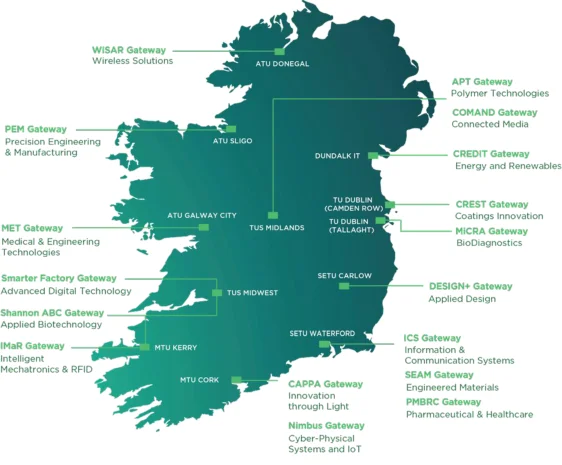
Figure from page 20
Each Gateway works in conjunction with industry to aid the research and development of innovative products and services through a dedicated team of full-time researchers and engineers. The Gateways act as a bridge between research groups in a host institution and local companies, targeting industry sectors relevant to the core capabilities of the nominated research group.
Technology Gateways enable interaction between the companies and the host, help the companies articulate their technical issues which need to be resolved, source State or EU funding where appropriate, and ensure projects are delivered successfully. Furthermore, a company in one region can work with a research group in another by utilising their local Technology Gateway as the access point. Notably, 86% of companies using the Gateways are located outside Dublin with 73% of them SMEs.
The Technology Gateways are playing an important part in supporting and enabling businesses to engage with the twin green and digital transition. For example:
The Smarter Factory Technology Gateway at the Technological University of the Shannon serves as a centre of excellence for Industry 4.0/5.0, focusing on driving digital and green transformation to support innovative enterprises and shape the future of manufacturing.
The CREDIT Gateway applies emerging technologies, expertise and specialist knowledge across the energy and renewables sector to help innovative businesses and companies succeed in the introduction of new and improved processes, products and services.
The WiSAR Gateway, based in Atlantic Technological University Donegal, provides solutions to Irish industry for the Internet of Things (IoT) using expertise in RF, wireless, embedded systems and related software.
EDIHs increasing the reach of digital transformation
Introduced as part of the European Commission’s Digital Europe Programme, to shape digital transformation over the 2021-2027 programming period, EDIHs serve as one-stop shops with research performing organisations (RPOs) at the core, providing access to technical expertise and experimentation, as well as innovation services, and the training and skills development necessary for successful digital transformation. The EDIH network now established across Europe has created opportunities for regions to confront industrial challenges linked to the digital transition.
Ireland’s four EDIHs are now operational, guided at the national level by Enterprise Ireland:
CeADAR, led by Ireland’s EI/IDA Technology Centre in Applied Data Analytics and Machine Intelligence based in UCD, is focused on supporting AI transformation in SMEs and public service organisations.
Data2Sustain, led by Atlantic Technological University Sligo, aims to increase the transformation capacity of SMEs in the NWR with a focus on circular economy, operations and sustainability areas.
ENTIRE, led by Tyndall National Institute Cork, is helping SMEs and start-ups become more competitive in their business/production processes using digital technologies such as Internet of Things and sensors.
FactoryxChange, led by the EI-funded Irish Manufacturing Research in Mullingar, is focused on supporting factories embrace ecological, digital and societal challenges.
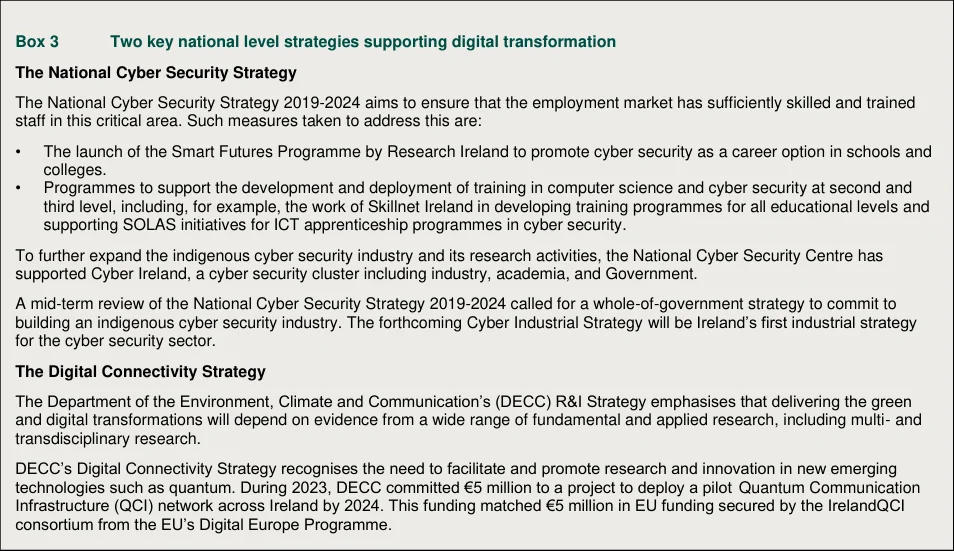
Figure from page 22
Box 3 Two key national level strategies supporting digital transformation
The National Cyber Security Strategy
The National Cyber Security Strategy 2019-2024 aims to ensure that the employment market has sufficiently skilled and trained staff in this critical area. Such measures taken to address this are:
• The launch of the Smart Futures Programme by Research Ireland to promote cyber security as a career option in schools and colleges. • Programmes to support the development and deployment of training in computer science and cyber security at second and third level, including, for example, the work of Skillnet Ireland in developing training programmes for all educational levels and supporting SOLAS initiatives for ICT apprenticeship programmes in cyber security.
To further expand the indigenous cyber security industry and its research activities, the National Cyber Security Centre has supported Cyber Ireland, a cyber security cluster including industry, academia, and Government.
A mid-term review of the National Cyber Security Strategy 2019-2024 called for a whole-of-government strategy to commit to building an indigenous cyber security industry. The forthcoming Cyber Industrial Strategy will be Ireland’s first industrial strategy for the cyber security sector.
The Digital Connectivity Strategy
The Department of the Environment, Climate and Communication’s (DECC) R&I Strategy emphasises that delivering the green and digital transformations will depend on evidence from a wide range of fundamental and applied research, including multi- and transdisciplinary research.
DECC’s Digital Connectivity Strategy recognises the need to facilitate and promote research and innovation in new emerging technologies such as quantum. During 2023, DECC committed €5 million to a project to deploy a pilotQuantum Communication Infrastructure (QCI) network across Ireland by 2024. This funding matched €5 million in EU funding secured by the IrelandQCI consortium from the EU’s Digital Europe Programme.
DMI supporting digitalisation and upskilling of Ireland’s manufacturing sector
DMI, the new national centre of excellence to aid digital transformation in manufacturing, was officially opened by the then Minister for Enterprise, Trade and Employment, Simon Coveney TD, at the IDA Ireland National Technology Park in Limerick in March 2023.
Backed by €40 million in IDA Ireland investment, DMI is designed to support Irish-based manufacturers in accelerating their adoption of digital technologies and drive economic competitiveness. Industry-led, and resourced to solve manufacturing industry challenges, it will be a leader for world-class digital and smart manufacturing, instrumental in ensuring the future resilience and competitiveness of Irish-based manufacturing.
DMI will develop a pipeline of digitalisation projects for the manufacturing sector and is on track to engage 400 companies across Ireland, to commence digitalising with awareness and advisory assistance. This Centre will work with existing manufacturing centres such as Irish Manufacturing Research (IMR) to ensure a collaborative and cohesive manufacturing ecosystem for Irish companies to engage with, upskill staff and develop new Industry 5.0 technologies.
Assisting the green transition through the EU Just Transition Fund
The EU Just Transition Fund (EU JTF), created under the 2021-2027 EU programming round, helps communities across Europe meet the challenges posed by the transition to a zero-carbon economy, supporting them to meet the challenges of the green transition while assisting in the transition to a climate-neutral economy.
In Ireland, the EU JTF is focused on the wider Midlands region. Counties Laois, Westmeath, Offaly, Longford and Roscommon, along with the municipal districts of Ballinasloe in Galway, Carrick-on-Suir and Thurles in Tipperary, Athy and Clane in Kildare, are covered by the EU JTF.
Administered by EMRA, up to €169 million is available to the region, complementing the ERDF priorities of developing smarter, more competitive, greener and more energy efficient regions. Projects under the EU JTF include the Lisheen BioScaleUP, a platform for the collaboration between RPOs through the BiOrbic Bioeconomy Research Centre, SMEs, and large industry for biorefinery and biomanufacturing; and the Mount Lucas Circular Bioeconomy Aquaculture Demonstration Initiative (Circular IMTA). Other EU JTF projects come under the Local and Regional Economic Strategies Support Scheme (LRESSS) which spans several sectors, such as the circular economy, peat replacement for horticulture/bioeconomy, innovation in energy and resource efficiency, retrofitting, training, and upskilling, infrastructure development and scientific research.
Pages 20–23 · View in original PDF