Introduction
Ireland’s National Smart Specialisation Strategy for Innovation 2022-2027
Smart Specialisation is a place-based innovation policy concept promoted by the European Commission. Applied in practice, it aims to boost innovation-driven sustainable regional growth models by harnessing local sectoral strengths and emerging areas of opportunity, and by fostering collaboration between businesses, research institutions, public authorities and civil society to realise their potential.
As a strategy, Smart Specialisation can also provide a roadmap to address important challenges at a regional level, while emphasising the importance of research and development, skills and entrepreneurship.
The European Commission included the development of a Smart Specialisation Strategy as an essential requirement for member state drawdown of European Regional Development Fund (ERDF) under Programme Objective 1, A Smarter Europe – innovative and smart economic transformation.
The Smart Specialisation methodology advocated by the European Commission is characterised by the identification of strategic areas for intervention supported by an analysis of geographical strengths and potential of an economy, as well as through an Entrepreneurial Discovery Process (EDP) which means facilitating broad and locally based stakeholder consultation.
To guide the development of Ireland’s Smart Specialisation Strategy, a number of key policy priorities were taken into consideration which also provided a frame of reference for the public consultation and stakeholder engagement undertaken:
- Digitalisation and digital transformation;
- Green transformation for enterprise;
- Innovation diffusion;
- International collaboration on research, development and innovation (RD&I);
- Improving the national or regional enterprise research and innovation (R&I) system.
The Department of Enterprise, Trade and Employment (DETE) published Ireland’s National Smart Specialisation Strategy for Innovation 2022 to 2027 in July 2022. The Strategy was informed by a twostage EDP consultation process, comprising engagement with regional stakeholders through DETE’s Regional Enterprise Plans (REPs) framework and further supported by an open public consultation process to garner perspectives about regional sectoral strengths and opportunities in Ireland.
Regional sectoral strengths and emerging areas of opportunity
Stakeholder consultations for the Strategy highlighted existing and emerging sectoral areas of strength across Ireland’s three NUTS2 regions (see Table 1) and also identified subsectors and niches within these areas considered to offer potential for innovation driven growth.
This analysis forms a critical component of Ireland’s Smart Specialisation Strategy and reflects where stakeholders felt that investment should be focused through the ERDF.
Table 1 Regional sectoral strengths and emerging areas
| Northern and Western Region | Eastern and Midland Region | Southern Region | |||
| Sectoral strengths and emerging areas of opportunity | |||||
| Advanced Manufacturing and Engineering | Advanced Manufacturing | Advanced Manufacturing | |||
| AgriFood and AgriTech | Audiovisual | Automotive/Aerospace | |||
| Audiovisual/Creative | Biopharma/Life Sciences | Design | |||
| ICT and ICT Services | Engineering | Financial Services | |||
| Life Sciences, MedTech and Medical Devices | Financial Services/FinTech | Food/AgriTech | |||
| Marine and Blue Economy | Food/AgriTech | ICT | |||
| Renewable energy, Climate Change mitigation and sustainability | ICT | Marine/Maritime | |||
| Pharma/MedTech | |||||
| Renewable Energy |
High-level strategic goals and deliverables to support smart specialisation
To support the identified regional strengths and opportunities, eight high-level strategic goals were identified in Ireland’s Smart Specialisation Strategy (see Table 2).
In line with the priorities for the Strategy set out above, the eight Strategic Goals address the need to drive innovation and new opportunities for growth at a sectoral level; meet the challenges of the twin green and digital transitions across all sectors; improve innovation diffusion; strengthen the regional enterprise R&I system; and encourage more international regional collaboration on RD&I.
This Progress Report sets out how Ireland has advanced initiatives across each of these high-level Strategic Goals.
Table 2 Ireland’s Smart Specialisation Strategy for Innovation 2022-2027 – High-level
Strategic Goals
| High-Level Strategic Goals | ||
| 1 | Smart Specialisation Strategy for Ireland will link national and regional enterprise and innovation policy, connecting the statutory RSESs, Regional Enterprise Plans, Impact 2030: Ireland’s Research and Innovation Strategy, and will bring greater policy coherence at multiple levels of governance. | |
| 2 | Smart Specialisation will support the adoption of the European Regional Development Fund in Ireland by supporting Policy Objective 1, A Smarter Europe. | |
| 3 | Smart Specialisation will improve research and innovation capacity in Ireland’s regions. | |
| 4 | Smart Specialisation will encourage more regionally dispersed RD&I, strengthen the enterprise base and identify emerging areas of opportunity. | |
| 5 | Smart Specialisation will increase the regional uptake of new advanced technologies to increase the reach of the twin green and digital transformation throughout Irish enterprise. | |
| 6 | Smart Specialisation will drive the development of skills needed for enhancing innovation activity across the economy. | |
| 7 | Smart Specialisation will encourage the maximising of sectoral strengths through clustering and the scaling of Ireland’s existing areas of research excellence. | |
| 8 | Smart Specialisation will lead to a greater visibility and coherence of the innovation system in Ireland’s regions both nationally and in Europe. |
Strategy implementation and metrics
Implementation of Smart Specialisation requires co-ordination between regional, national and EU institutional actors, and among regional administration and territorial actors. As part of the development of the Strategy, a multi-level oversight structure was set out (see Figure 1) and this is now in operation.
A Smart Specialisation National Implementation Group was established to oversee the delivery of the Strategy’s national and regional priorities in December 2022. The Group, chaired by DETE, comprises representatives of the Departments of Further and Higher Education, Research, Innovation and Science (DFHERIS); Public Expenditure, NDP Delivery and Reform (DPENDPR); and the Environment, Climate and Communications (DECC). The Group further includes the three Regional Assemblies; Enterprise Ireland (EI); IDA Ireland; and Taighde Éireann-Research Ireland.
The Group meets every six months with updates from all the above bodies which regularly consult with local enterprises, elected officials, academics and members of the public. This, in turn, ensures a continuous and wide-ranging feedback loop for the Strategy.
Representatives of the three Regional Assemblies sit on both the Smart Specialisation Strategy National Implementation Group and the Steering Committees for the REPs. This further strengthens the feedback loop and ongoing entrepreneurial discovery so that the Strategy remains relevant and informed from the bottom-up.
Figure 1 Smart Specialisation Strategy multi-level oversight and ongoing ‘bottom-up’ entrepreneurial discovery
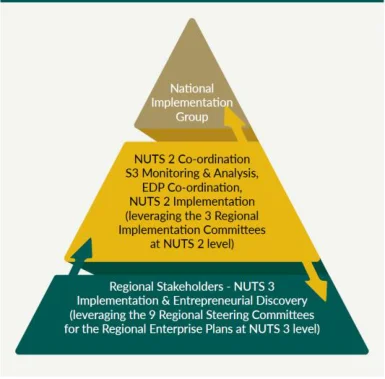
Figure from page 9
Identification of metrics to monitor impact of the Strategy
The National Implementation Group has agreed a set of indicators which will be monitored on an ongoing basis to track progress in quantitative terms. These indicators are set out in Appendix 3. DETE has worked with the three Regional Assemblies and the All-Island Research Observatory (AIRO) at Maynooth University to reflect and monitor these indicators through the inclusion of a new smart specialisation dashboard on the Regional Development Monitor (RDM), a data mapping and visualisation platform (see more details in Chapter 8).
Overall, latest data shows that in 2023 Irish performance was driven by the Eastern and Midland Region (EMR), with the Southern Region (SR) and Northern and Western Region (NWR) following behind.
Table 3 Regional Innovation Scoreboard 2023 1
| Region | Regional Innovation Scoreboard | Rank in Europe | ||||||
| Northern and Western | 104.5 | 90 | ||||||
| Southern | 105.4 | 86 | ||||||
| Eastern and Midland | 124.0 | 42 |
Within regions, the NWR has a relative concentration of trademark applications compared to other regions in Ireland, while international scientific co-publications are highest in the EMR. Furthermore, across all three regions, Ireland has drawn down over €781 million from Horizon Europe, showing that we are engaging with partners across Europe.
1https://ec.europa.eu/assets/rtd/ris/2023/ec_rtd_ris-regional-profiles-ireland.pdf
Pages 6–9 · View in original PDF