connections
Strategic Goal 8:
Smart Specialisation will lead to a greater visibility and coherence of the innovation
system in Ireland’s regions both nationally and in Europe.
Summary
Under this Strategic Goal, the Smart Specialisation Strategy placed an emphasis on establishing the oversight structures at national and regional level, as well as a monitoring approach, for the Strategy. The agreed metrics and oversight structures now in place are described earlier in the Introduction to this report.
DETE has also worked closely with DFHERIS to reflect the objectives of Ireland’s Smart Specialisation Strategy in the national innovation policy, Impact 2030. DFHERIS is represented on the National Implementation Group for the Strategy.
There has been ongoing engagement with the European Commission in relation to Smart Specialisation as also envisaged under this Strategic Goal, especially in the area of international regional collaboration (e.g. Regional Innovation Valleys).
This Chapter details key initiatives that have been progressed under this Goal, such as effective monitoring of Smart Specialisation impact through the Regional Development Monitor (RDM); and international regional collaboration on innovation through Regional Innovation Valley (RIV) designation for Ireland’s regions. The Chapter also details a range of international collaborative relationships on innovation involving Ireland and its regions, including through Horizon Europe.
Smart Specialisation monitoring through data visualisation
Smart Specialisation Strategy monitoring is an EU requirement under the ERDF programming period 2021-2027 and is considered a strategic management tool to assist policymakers to assess the completion of Strategic Goals while identifying those elements to be further assessed in evaluation exercises.
It is recognised by the European Commission’s Smart Specialisation Strategy Community of Practice that to develop a good monitoring system which provides a clear picture of policy implementation, it is necessary to involve stakeholders to get their views on the evolution of priority areas. It also recognises open data platforms offer the potential to revolutionise Smart Specialisation Strategy monitoring.
In December 2023, following engagement with the Smart Specialisation Strategy National Implementation Group, the Regional Assemblies agreed to extend the scope of the RDM with the addition of a new Smart Specialisation dashboard. During 2023, DETE worked with the three Regional Assemblies and the All-Island Research Observatory (AIRO) to incorporate the 11 agreed Smart Specialisation Strategy impact indicators into the RDM data visualisation platform.
The RDM is a collaborative project between the three Regional Assemblies, the All-Island Research Observatory (AIRO) at Maynooth University and spatial infrastructure partners the Ordnance Survey Ireland (OSI) via the GeoHive platform.
The RDM visualisation platform accesses and presents administrative and other data in an interactive visual format which offers a more accessible way to investigate and monitor changing patterns in regional development performance across a range of indicators. The indicators contained in the existing monitor have been informed by a range of development bodies who are seeking a robust evidence base for policy and monitoring the impact of policy interventions. It is anticipated that the newly developed RDM Smart Specialisation ‘dashboard’ will be launched in Q4 2024 alongside this Progress Report.
Figure 2 Regional Development Monitor Sample
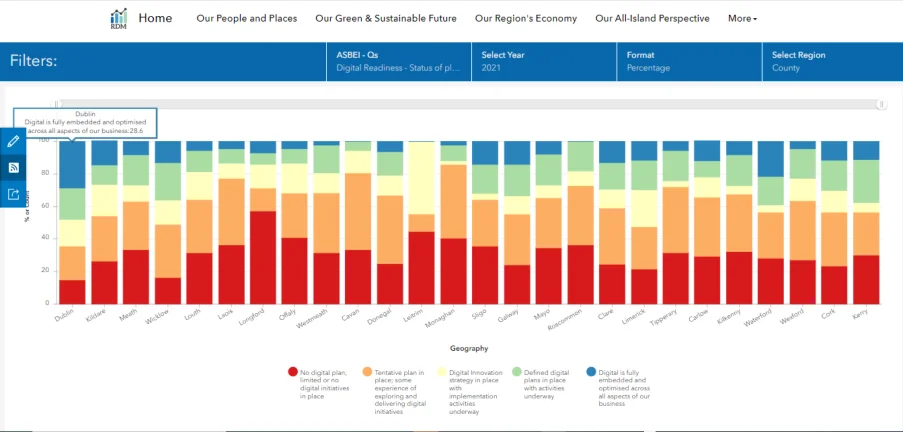
Figure 2
RIV status for Ireland’s three NUTS 2 regions
The European Commission’s RIVs initiative is one of 25 actions of the New European Innovation Agenda (NEIA). It aims to harness the full innovation potential across Europe, connecting less and more innovative regions and addressing social challenges through cutting edge technology.
Designated regions identify their competitive advantages to bridge the innovation divide by building on strategic areas of regional strength and specialisation, as defined in their Smart Specialisation strategies, in support of five identified challenges, namely, food security, renewable energy, circular economy, digital transition, and healthcare. In June 2024, all three of Ireland’s NUTS 2 regions were designated as RIVs following an Expression of Interest process, making them part of a network of 149 similarly designated regions across Europe.
Figure 3 Regional Innovation Valleys network
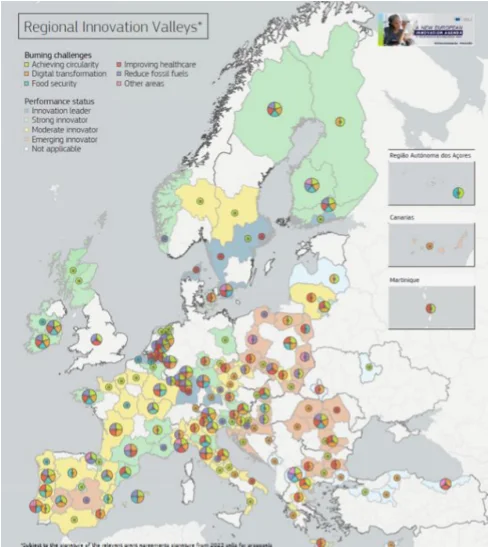
Figure from page 31
The creation of the new RIV network seeks to mobilise:
New regional partners – to complement European innovation investments including Horizon Europe European Innovation Ecosystems (EIE) and Interregional Innovation Investments (I3) instruments;
Innovators – to bring their ideas to the market, enabling the link with the private sector and other R&I actors;
Innovation ecosystems actors across EU territories – to participate in novel approaches and technology to the EU twin green and digital transitions; and
European counterparts in existing innovation clusters – to establish connections with and help develop new clusters.
A key component of the RIV initiative is its matchmaking process, which plays a vital role in connecting various stakeholders within each region’s innovation ecosystem.
Further information on RIVs is available at: Flagship 3: Accelerating and strengthening innovation in European Innovation Ecosystems across the EU and addressing the innovation divide - European Commission (europa.eu)
The RIV initiative is reflected in national enterprise policy and its progress will be tracked under the Enterprise Policy White Paper implementation – “activating international collaborative opportunities on regional enterprise innovation through EU initiatives such as Regional Innovation Valleys.”
The Smart Specialisation Strategy National Implementation Group and the Regional Assemblies will also be encouraging Irish regional participation in competitive calls for international collaborative projects in research and innovation, arising from this process.
Interregional Innovation Investments (I3) instrument
The European Commission funded Interregional Innovation Investments (I3) Instrument encourages the development of joint projects in shared Smart Specialisation priority areas. I3 funds interregional innovation investments projects focused on the twin Green and Digital transitions and in Smart Manufacturing. The overall objective of the programme is to promote innovation, innovation diffusion, and the reinforcement of EU and regional value chains, by linking regional ecosystems in shared Smart Specialisation areas vital to accelerate market uptake of research results and stimulate innovation.
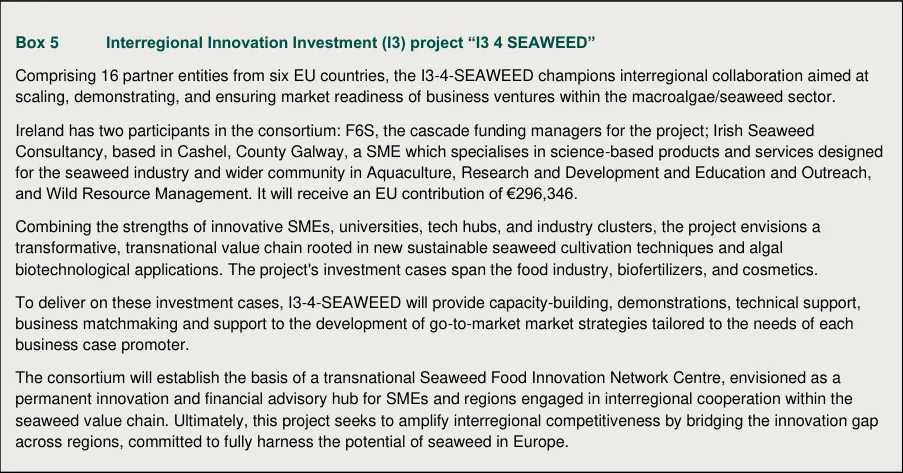
Figure from page 32
Box 5 Interregional Innovation Investment (I3) project “I3 4 SEAWEED”
Comprising 16 partner entities from six EU countries, the I3-4-SEAWEED champions interregional collaboration aimed at scaling, demonstrating, and ensuring market readiness of business ventures within the macroalgae/seaweed sector.
Ireland has two participants in the consortium: F6S, the cascade funding managers for the project; Irish Seaweed Consultancy, based in Cashel, County Galway, a SME which specialises in science-based products and services designed for the seaweed industry and wider community in Aquaculture, Research and Development and Education and Outreach, and Wild Resource Management. It will receive an EU contribution of €296,346.
Combining the strengths of innovative SMEs, universities, tech hubs, and industry clusters, the project envisions a transformative, transnational value chain rooted in new sustainable seaweed cultivation techniques and algal biotechnological applications. The project’s investment cases span the food industry, biofertilizers, and cosmetics.
To deliver on these investment cases, I3-4-SEAWEED will provide capacity-building, demonstrations, technical support, business matchmaking and support to the development of go-to-market market strategies tailored to the needs of each business case promoter.
The consortium will establish the basis of a transnational Seaweed Food Innovation Network Centre, envisioned as a permanent innovation and financial advisory hub for SMEs and regions engaged in interregional cooperation within the seaweed value chain. Ultimately, this project seeks to amplify interregional competitiveness by bridging the innovation gap across regions, committed to fully harness the potential of seaweed in Europe.
Financed from the ERDF, I3 supports interregional innovation projects in their commercialisation and scale-up phases, giving them the tools to overcome regulatory and other barriers to bring their projects to investment level. The total number of funded projects under I3 now stands at 44 out of a total 131 applications. Projects involving Irish entities include ‘Baltic MUPPETS’, ‘INNO4CFIs’, ‘DigiONE I3’ [Trinity St James’s Cancer Institute] and ‘I3 4 SEAWEED’ (see Box 5).
Supporting international RD&I engagement through Horizon Europe
Horizon Europe is an important source of investment in research and innovation for the Irish enterprise sector, for both indigenous SMEs and multinationals. The Framework Programme also plays a critical role in boosting research capabilities and outcomes in Ireland’s third level academic sector. It stimulates research activity and innovation which feeds the pipeline of ideas and talent on which the Irish enterprise sector relies for its growth, development, and renewal through commercialisation and start-up potential. At a Horizon Europe programmatic level, Ireland is performing particularly well under Pillar 1: Research Excellence, and also under the EIC. Pillar 2 clusters on Digital, Industry, Climate, Food and Health are also generating a significant level of Irish
engagement and investment in Irish-based collaborative research. To date, Irish SMEs account for 28.5% of Ireland’s participations in Horizon Europe, totalling €199 million in investment from the programme.
EI also provides supports to ensure that Irish enterprises and researchers can best compete in Horizon Calls. These ensure that Ireland is well placed to deliver funding and projects under Horizon Europe. To date, the results of these efforts have been very strong.
Ireland’s engagement with Horizon Europe is led by DFHERIS and is strongly supported by a network of National Contact Points (NCPs), facilitated and overseen by EI. DECC also supports Ireland’s participation in two Horizon Europe Missions related to the twin green and digital transitions; Climate- Neutral and Smart Cities, and Adaptation to Climate Change.
Other regional projects promoting inter-regional collaborations across EU Member States
ORIGINN is an Interreg Europe co-funded project under the ERDF’s PO1 which aims to support economic and social transformation in rural areas through industrial innovation with a particular focus on the AgriFood sector. The partnership comprises seven regional and local actors from Ireland, Spain, Sweden, Romania, Slovakia, Italy and Estonia. Irish participation in the project is administered by EMRA as the Irish partner.
Through active participation in ORIGINN, EMRA seeks the transfer of good practices from its ORIGINN partners and their stakeholders to counter rural depopulation through entrepreneurial and innovative activity in the AgriFood sector. The project assists in transferring good practice to reinforce the growth of the sector through collaboration, innovation and clustering to support scalable, sustainable and profitable food businesses. The four thematic semesters of the project focus on digitalisation; the green economy; social innovation; and commercial innovation.
In the SR, the TALENT4S3 Project – Retention and Attraction of Talent for a Better Deployment of Smart Specialisation Strategies (Smarter Europe) – is an Interreg Europe-funded initiative aimed at improving talent attraction and retention policies in the SR. Its goal is to ensure the necessary talent for the effective development of Smart Specialisation Strategies, particularly those addressing the brain drain issue by focusing on the competitive advantages of specific territories, along with encouraging the adoption of effective strategies in co-designing policy instruments responsive to local demands and conditions.
The National Smart Specialisation Implementation Group will continue to promote regional engagement with international RD&I initiatives, including further leveraging established connections with international organisations and partnerships (see Appendix 3 for a list of international RD&I organisations with Irish involvement).
Pages 29–33 · View in original PDF