6 Skills for innovation
Strategic Goal 6:
Smart Specialisation will drive the development of skills needed for enhancing
innovation activity across the economy
Summary
The European Commission 2024 Country Report for Ireland highlighted how expertise in R&D is cited as the second highest skills shortage for SMEs. The OECD has recommended that to more effectively leverage skills to drive innovation and strengthen firm performance, Ireland should better utilise its research talent and public R&I system to drive innovation within firms. The OECD also emphasised that better leveraging of skills will be central to supporting economic growth, promoting resilience to global megatrends, and ensuring Ireland can achieve its aims of digital leadership and a just transition.
Strategic Goal 6 aims to enhance skills development and innovation activity across the regions through new and improved supports informed by existing international and national best practice. Key initiatives have been progressed, including the Research Ireland ARC Hub Programme; the Innovators’ Initiative; and the establishment of Taighde Éireann-Research Ireland.
Exploring the commercial potential of academic research through the Research Ireland ARC Hub Programme
The Research Ireland ARC Hub Programme, which is co-funded under the ERDF, aims to drive regional development through a network of three Hubs, each working to optimise the translation of academic research to create new products, processes and services and to train and develop entrepreneurial scientists and engineers who are primed from an early stage to exploit the commercial potential of their research endeavours.
A 2023 competitive call for proposals closed in September 2023 and Research Ireland approved funding for an ARC Hub for ICT, hosted by Technological University Dublin, and an ARC Hub for Therapeutics, hosted by Trinity College Dublin.
The Research Ireland ARC Hub for Therapeutics will be jointly led by Trinity College Dublin, University College Dublin and the Royal College of Surgeons in Ireland in partnership with research bodies in the Southern and Eastern and Midland (SEM) Regions and the NWR to develop a globally recognised ecosystem for therapeutic innovation within the thematic area of Biopharma/Life Sciences, an identified key sectoral strength for the EMR under Ireland’s Smart Specialisation Strategy. The Hub aims to address several current challenges in the translation of state-funded research to commercial outputs, including lack of national cohesion, funding gaps, and lack of commercial expertise in the HEIs.
The Research Ireland ARC Hub for ICT led by Technological University Dublin in partnership with research bodies across the regions will enhance digital transformation by providing critical support for translating ideas into market-ready products and services across digital education and online communication; healthcare and medical applications; digital infrastructure; sustainable and environmental management; and data security, privacy and governance. By specialising in translational research supports, providing funding for projects with strong impact potential and tailored entrepreneurial training supports, the Hub aims to foster ICT entrepreneurship capability.
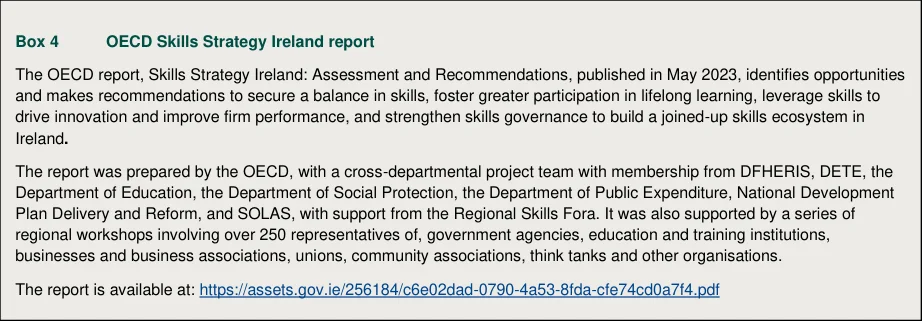
Figure from page 25
Box 4 OECD Skills Strategy Ireland report
The OECD report, Skills Strategy Ireland: Assessment and Recommendations, published in May 2023, identifies opportunities and makes recommendations to secure a balance in skills, foster greater participation in lifelong learning, leverage skills to drive innovation and improve firm performance, and strengthen skills governance to build a joined-up skills ecosystem in Ireland.
The report was prepared by the OECD, with a cross-departmental project team with membership from DFHERIS, DETE, the Department of Education, the Department of Social Protection, the Department of Public Expenditure, National Development Plan Delivery and Reform, and SOLAS, with support from the Regional Skills Fora. It was also supported by a series of regional workshops involving over 250 representatives of, government agencies, education and training institutions, businesses and business associations, unions, community associations, think tanks and other organisations.
The report is available at: https://assets.gov.ie/256184/c6e02dad-0790-4a53-8fda-cfe74cd0a7f4.pdf
A second call was launched in Q3 2024, with the aim of establishing a third ARC Hub in the NWR. The deadline for submission of full proposals was 23 September 2024 with a panel review in late January 2025 and a funding decision in April 2025.
Creating high-skilled innovators through EI’s Innovators’ Initiative
Supported under the ERDF, the Innovators’ Initiative develops a series of immersive, needs-led innovation training programmes which will create cohorts of highly skilled innovators who can identify unmet market needs within specific sectors of growth.
Each of the four education and training programmes under EI’s Innovators’ Initiative will receive €7 million in funding over a seven-year period. On completion of a programme, the participants can return to their respective sectors, bringing back their new skills and training. Alternatively, they can access further funding and training through EI’s Commercialisation Fund with the aim of forming a high potential start-up (HPSU), directly contributing to job creation.
The four successful programmes under the Innovators’ Initiative are:
BioInnovate, (MedTech) hosted by University of Galway.
AgTechFood & Agriculture Sustainable Technology Innovation Programme (FAST-IP), hosted by University College Dublin and supported by Teagasc.
Cyber-Innovate, (cyber security) hosted by the Munster Technological University Cork.
DigiBio, (digital health) hosted by Dundalk Institute of Technology, in association with the Royal College of Surgeons, Tyndall Institute, Dublin City University and Trinity College Dublin.
Supporting skills development through Taighde Éireann-Research Ireland
In August 2024, the Minister for Further and Higher Education, Research, Innovation and Science, Patrick O’Donovan TD, announced the establishment of a new R&D funding agency Taighde Éireann- Research Ireland, which amalgamated two national research funding bodies, Science Foundation Ireland and the Irish Research Council.
The establishment of Taighde Éireann-Research Ireland is a key element in the reform of Ireland’s R&I system as set out in Impact 2030, which aims to maximise its impact on national priorities and enhance its capacity to address, in particular, climate change and the digital transition. This includes
increasing EU research funding and collaborations while applying innovation to make Irish businesses more competitive.
Skills and skills development is key to the agenda of the new Agency. One of its core functions is to promote the engagement, retention and development of the skills and capacity of researchers of an excellent standard in the national system of R&I in co-operation with the HEA, EI and other bodies. The new Agency will build on the strengths of programmes, such as Research Centres, the Centres for Research Training and the Industry RD&I Fellowship Programme, to facilitate skills development through researcher and knowledge exchange between academia and industry, informed by the recently published OECD Ireland Skills Strategy Report’s evidence around demand for research talent. The new Agency will also promote R&I which supports the development and competitiveness of regional enterprise and employment in collaboration with EI and other bodies.
Supporting research talent for industry through EI
Two new pilot initiatives were launched by EI during 2024, aimed at identifying and funnelling research talent to industry, with a focus on SMEs:
The Work Ready Graduate Programme equips graduates with practical, industry-relevant skills, including digital competencies and industry placement. It uses the Technology Centres as sectorally aligned hubs to house the graduate cohorts, so that graduates are focussing on specific areas of industry-led research and capability, closing the gap for potential transfer to industry.
Pages 24–26 · View in original PDF