2 Enabling “A Smarter Europe”
Strategic Goal 2:
Smart Specialisation will support the adoption of the European Regional Development
Fund in Ireland by supporting Policy Objective 1 ‘A Smarter Europe’
Summary
Smart Specialisation is fundamental to developing more competitive regions, one of the key strategic outcomes under PO1 of the ERDF. The policy objective focuses on innovative and smart economic transformation by enhancing research and innovation capacities and the uptake of advanced technologies, as well as enhancing growth and competitiveness of SMEs. The European Commission made drawdown of funds under PO1 of the ERDF contingent on Member States having a Smart Specialisation Strategy in place and further supported by a range of fulfilment criteria.
Strategic Goal 2 has been achieved through the publication of Ireland’s Smart Specialisation Strategy; European Commission confirmation that Ireland had satisfied all fulfilment criteria for the Strategy; and the subsequent approval by the Commission of Ireland’s ERDF regional funding programmes.
European Commission approval of Ireland’s Smart Specialisation Strategy
Following approval by the European Commission in May 2022, DETE published Ireland’s National Smart Specialisation Strategy for Innovation 2022-2027 on 11 July 2022.
Tied to this, Ireland was also required to carry out a self-assessment of seven fulfilment criteria associated with Smart Specialisation that demonstrated ‘good governance of national or regional smart specialisation strategy’ as set out in the European Commission’s Cohesion Policy legislative package (see Appendix 4). On 16 August 2022, the European Commission approved Ireland’s selfassessment that the seven fulfilment criteria had successfully been met.
Launch of Ireland’s two ERDF regional programmes underpinned by Smart Specialisation
Following their formal approval by the European Commission as part of Ireland’s overall Cohesion package of funding, in November 2022, the then Minister for Public Expenditure and Reform, Michael McGrath, together with the Southern Regional Assembly (SRA), Northern and Western Regional Assembly (NWRA) and the Eastern and Midland Regional Assembly (EMRA), launched Ireland’s two ERDF Programmes for the period 2021-2027 for €853 million, of which €396 million is financed by the EU. The ERDF comprises of two regional operational programmes as follows:
Managed by the NWRA, the Northern and Western Regional Programme is a €217 million cofunded programme of investment, supported by €130 million of EU funding and €87 million of national funding provided by the Exchequer. The Southern, Eastern and Midland Regional Programme, managed by the SRA, with significant collaboration from the EMRA, is a €663 million co-funded programme of investment, supported by €265 million of EU funding and €398 million of national funding.
Both programmes make a significant commitment to addressing ERDF PO 1 and Smart Specialisation through committing investment in building RD&I capacity within the public research institutions in the regions, as well as by strengthening regional innovation ecosystems.
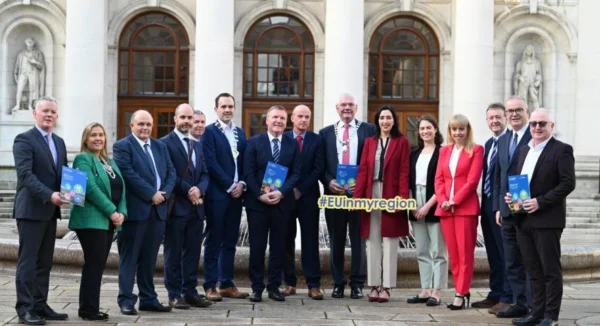
Figure from page 14
Pictured at the launch of Ireland’s two ERDF Programmes for the period 2021-2027 in November 2022 were the then Minister for Public Expenditure and Reform, Michael McGrath, together with the Southern Regional Assembly, Northern and Western Regional Assembly and the Eastern and Midland Regional Assembly
ERDF co-funded schemes under PO 1 – A Smarter Europe
A total of €445.6 million has been allocated to deliver six schemes under PO 1 of Ireland’s ERDF package, across the NWR and the SR and EMR. These schemes are most closely aligned with our Smart Specialisation Strategy and are being delivered by Enterprise Ireland (EI); Taighde Éireann- Research Ireland; and the Higher Education Authority (HEA).
Four of the schemes have been developed and launched by Enterprise Ireland:
Technology Gateways – to support regionally dispersed academic-industry collaboration synchronised with industry needs through the Technological Universities. Knowledge Transfer (KT) Boost - provides technology transfer specialists to help with commercialisation and collaboration opportunities between research and enterprise Innovators’ Initiative - develops and delivers immersive needs-led innovation training programmes to create innovation leaders and entrepreneurs in high-growth potential sectors with a view to creating more deep-tech start-ups. Smart Regions Enterprise Innovation Scheme (SREIS) – supports the development of innovative services through local infrastructure, innovation clusters, services to SMEs and early-stage feasibility and priming research.
Research Ireland is overseeing ARC (Accelerating Research to Commercialisation) Hubs, which establishes three regional smart hubs for research, training, innovation, commercialisation.
The HEA is supporting capacity of the new Technological Universities to drive and support regional research, capacity building and innovation through the TU RISE programme.
Calls for proposals have been launched for all six schemes. As of 31 May 2024, operations have been selected and grants awarded under four of the six schemes amounting to 43% of the total programme allocation under PO1. Selection of operations and grant awards are imminent under the remaining two schemes. The managing authorities and intermediate bodies ensure all selected operations are consistent with the Ireland’s Smart Specialisation Strategy.
Pages 13–14 · View in original PDF