3.4 RECOMMENDATIONS TO THE MINISTER
3.4 RECOMMENDATIONS TO THE MINISTER
3.4.1 Presentations of Recommendations to Minister
Volunteers from each group presented Minister Ryan with two recommendations from each of the four topics (see Box 3).
Box 3: Summary of Recommendations to Minister Ryan
TOPIC DECC THEME RECOMMENDATION
- Encourage cycling (e.g. bike to school Transport option, public bike share scheme, bike lanes safer) 2. Improve public transport: • Make it affordable, accessible and reliable. • Put on more buses when YP are travelling, and reduce overcrowding.
Transport
- More affordable electric cars – reduce the cost and have more charging points 4. Agriculture – sustainable agriculture is an issue, we need to focus on farmers often face blame, We recommend education is offered to farmers. To lower methane gas and CO2 emissions in agriculture.
Government Policy and Goals
Transport
Agriculture
Just Transition Circular economy
- Mandatory standard of eco labelling in food and clothes products. We propose legislation standard mandatory labelling like washing machines for example. Micro plastics in washing. European eco label – you have to apply for it. Allow consumers to vote with their wallet. It is a practical step we could take. 6. *Improve the affordability of transition to making better choices for low income families (e.g. fuel choices, transport etc) Make sustainable transport more affordable (e.g. make e cars an affordable option for people who live in poverty).
Transport
- Support the vote for 16 year olds 8. Community engagement platforms. Introduce a platform for bottom-up engagement and suggestions Accessible to all sites, to promote greater active citizenship. Have consultations in workplaces as well as schools.
Community Engagement
Community, Engagement & Climate Literacy
*This group ran out of time so did not have a formal vote. They agreed that eco-labelling should be main recommendation. Recommendation 6 reflects the dominant messages from discussions and was mentioned briefly in the recommendation to Minister Ryan.
3.4.2 Discussion with Minister Eamon Ryan
Minister Ryan addressed the delegates. He talked about the current uncertainty in the world referencing the war in Ukraine and the recent Intergovernmental Panel on Climate Change (IPCC) report. He also talked briefly about the recent experiences of the lockdown which provided people with a greater sense of our local place. The Minister then turned to the National Climate Plan, saying it will be updated every year and which will provide an opportunity for delegates’ ideas to be fed into the plan.
Minister Ryan thanked the delegates for their recommendations and spent some time discussing the recommendations with the delegates.
Community Engagement Platforms – How might these work? • The volunteer explained their rationale for this suggestion: • Public consultations are not accessible for all. They are online and people don’t hear what happens. • There should be a system where you get an email with updates on policies. You very rarely hear back from consultations. • Often public consultations are given to schools, maybe have them at workplaces as well. • In the climate action plan when consulting with young people ensure the hard to reach are not left behind. If they are involved they are more likely to be engaged.
Community Engagement. What’s the best example where communities come together? • The volunteer suggested having youth and community projects come together as part of the climate action, so the hard to reach are given a space to have their input and are not left behind. • The group are recommending multi-generational community involvement on different issues is important. The older might need to be reached in different ways if communities were working together to achieve a goal.
Transport: Any good examples on the transport issue? • One delegate described their personal experience of overcrowding on the school bus, and suggested providing more buses at times when people are travelling to school and work would make it more efficient. • Another described the inefficiency and cost of poorly planned transport in the city. • Cycle to school schemes are really beneficial. People want to cycle to school and bikes can be really expensive.
Just transition: Eco label • EU working on the environmental footprint of products. It would be good to have labels to show water use etc. to see what has been involved in the production of the product. • The delegate described how there is zero regulation on sustainable fashion. There is a lot of green washing in fashion. A government watchdog or agency that can check manufacturing of the companies – enforcing the eco label and help set standards. • Reduce landfill
Minister Ryan asked delegates their views on ongoing change, did they think they might go back to how they were pre-Covid? One delegate hoped that their generation would continue to adopt changes they had made to reduce emissions.
We have improved our carbon emissions as a result of Covid. It opened our eyes. A lot more people are more educated by social media, especially the 14 up age group. It opened our eyes to the dangers
if we don’t change. On a night out we organised a bus rather than us all getting a taxi. Small things like that make a difference. Young people don’t want to regress, we will get there if we work together.
• This delegate felt that Covid experience has transformed rural Ireland, particular the way people work.
Rather than a mass commute. There is a demand for small hubs where people can communicate and
work effectively. Smaller towns are working well, and it has helped to reduce congestion in Galway.
• Another delegate was less positive.
’ I feel my school isn’t learning from Covid, we’re kind of regressing, going back to old normal.
We moved from busy to quiet – to having space to learn and think and reflect.
I don’t think we learnt much as we’re trying to get back to old bustling.
Some felt there wasn’t the same level of engagement during the lockdown.
With Covid – it has not been publicised as much as before Covid.
Another felt that schools had hindered the climate protests.
If anyone wasn’t in school we would get a detention. Schools took away students’ voices.
Support has grown but schools are sort of taking voices away. You need support on a government level to back up young people. To a certain extent it’s not about education
anymore it’s about teaching us to sit in line.
One young person described how their school had compromised and allowed some involvement in the climate protests.
My school met in the middle, we got a 6th year delegation (to go out to protest)
Young people in schools are getting involved in climate change.
It may not be in the media as much anymore.
Delegates discussed the role of schools to educate people about climate. One described engaging conversations in personal and social education (PSE). Delegates noted the importance of having climate education within an exam subject.
When it’s in PSE it’s not taken as seriously as other exam subjects. When it’s put in geography.
Another delegate felt that communities do care and want to do what they can but they need more education.
They want to do what they can, whether it is writing or podcasts, they want to be listened to, they want the government to listen to them. Everyone wants to see action, farmers, people in power want to make sure that …
The issue of eco-anxiety was raised. To address this, delegates felt that people need to know that the Government is doing something about climate change.
Need more talk, words, make it easy to read, use less academic vocabulary…. access to those documents, you don’t know how to find them, the government should make an app to find out what
the government is doing on different issues. It would be useful in gathering everyday opinions.
3.4.3 Close of Event The event was closed by one of the Youth Advisory Group who thanked everyone and asked delegates to complete the evaluation form (See Appendix 6).
The establishment of the National Youth Assembly on Climate is a significant milestone in the delivery of the NDCA and the beginning of a yearlong programme of engagement
activities involving people from across the country on climate action.
Today young delegates embraced this challenge, gave of their time to shape our future,
and will play a key role in defining how we make the transition to a cleaner,
healthier and more sustainable future. Minister Ryan (Press Release)

Figure from page 50
APPENDICES
Appendix 1: Membership of Project Group
Name Organisation Role on day
Eileen Leahy DCEDIY Facilitator/Presenter
Rob Mooney DECC Observer/Presenter
Brenda Durkan DECC Observer
Justina Corcoran DECC Observer
Renagh Hayden National Participation Office Facilitator
Suzanne Byrne National Participation Office Facilitator
Mark O Dwyer National Participation Office Facilitator
Stephaine Cook National Participation Office Facilitator
Alexis Carey National Participation Office Facilitator
Gavin Byrne Foróige Facilitator
Mary Glacken Foróige Co-Facilitator
Siobhan Hennessy Foróige Co-facilitator
Andy Neary Foróige Co-facilitator
Deirdre Fullerton Insights Health and Social Research Report writer/Note taker
Maria Herron Independent Consultant Note taker
Sheena McGrellis Independent Consultant Note taker
Maisie Cooper Independent Consultant Note taker
Appendix 2: Counties and Youth based organisations represented at the Assembly
Counties Organisations
Carlow
Candle Community Trust
Clare
Carlow Regional Youth Service
Cork
Catholic Guides of Ireland
Donegal
Climate Assembly Ireland
Dublin
Cloyne Diosiean Youth Service
Galway
Cork City Comhairle na nÓg
Kerry
Cork Comhairle na nÓg
Kildare
Crosscare
Laois
EcoUnesco
Leitrim
EEU An Taisce
Longford
Eurodirect Letterkenny
Mayo
Foróige
Meath
Fridays for Future
Monaghan
Irish Girl Guides
Offaly
Kerry Comhairle na nÓg
Tipperary
Kildare Comhairle na nÓg
Waterford
Localise Youth Volunteering
Wicklow
Longford Comhairle na nÓg
Love Leitrim
Mayo Comhairle na nÓg
Monaghan Comhairle na nÓg
Offaly Comhairle na nÓg
Ogras
Scouting Ireland
Spunout
Tipperary Comhairle na nÓg
YMCA
Youthwork Ireland Laois
Appendix 3a: Preparation for the National Youth Assembly on Climate & Questions for the Minister
To prepare the delegates and build their capacity and knowledge ahead of the Assembly, in February 2022, the DCEDIY and National Participation Office hosted a preparation session with all the invited delegates. This event was co-designed by the Youth Advisory Group (YAG). The YAG had three meetings with the National Participation Office and DECC to design and test the methodologies, to plan the preparation session (e.g. guest speakers etc.). The preparation session was hosted online on Saturday 19th February 2022. It was attended by 26 of the Youth Assembly permanent delegates and five guest delegates. The function of the meeting was to build capacity and knowledge on the topic and to prepare the delegates for the Climate Assembly, to meet the other delegates, to hear from the different Government Departments (DECC and DCEDIY), and to hear from invited experts on climate. Three members of the Youth Advisory Group welcomed the delegates, introduced speakers, and closed the event.
The speakers included Eileen Leahy (Assistant Principal Officer DCEDIY) who outlined that the role of the DCEDIY (and of the National Participation Office) to ensure that young people’s voices are heard and are given due weight.
Dr Robert Mooney, Assistant Principal Officer with the Department of the Environment, Climate and Communications also addressed the group and highlighted the importance of the Youth Assembly and its role in feeding into the Climate Action plan.
Climate Change … … The Evidence
• Intergovernmental Panel on Climate Change (IPCC) Sixth Assessment Report sets out the most up-to-date physical science basis for our understanding of climate change. • The current changes in the planet’s climate are transforming the world. • Each of the last four decades has been warmer than any since 1850. Global average temperatures increased by more than 1°C since pre-industrial times. • • Evidence of human influence in warming our climate system is beyond dispute. Without urgent action, global warming is likely to be more than 2°C above pre- • industrial levels by 2060, and 5°C above pre-industrial levels by the end of the century.
The NDCA Engagement Activities
National activities • Youth Climate Assembly • National Climate Stakeholder Forum • Climate Conversations: Public Consultation on Climate Action • Climate Conference, Climate Lecture Series & Support Workshops
Local Activities • Local Climate Conversations • Network and capacity building between organisations • National Climate Conversation on Local Action
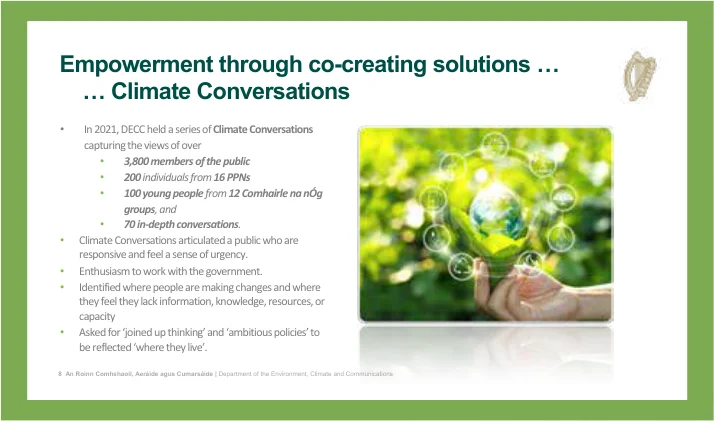
Figure from page 53
Empowerment through co-creating solutions … … Climate Conversations
• In 2021, DECC held a series of Climate Conversations capturing the views of over
• 3,800 members of the public • 200 individuals from 16 PPNs • 100 young people from 12 Comhairle na nÓg groups, and • 70in-depth conversations. • Climate Conversations articulated a public who are responsive and feel a sense of urgency. • Enthusiasm to work with the government. • Identified where people are making changes and where they feel they lack information, knowledge, resources, or capacity • Asked for ‘joined up thinking’ and ‘ambitious policies’ to be reflected ‘where they live’.
8 An Roinn Comhshaoil, Aeráide agus Cumarsáide | Department of the Environment, Climate and Communications
Four guest speakers made short presentations.
Emeritus Professor John Sweeney from Maynooth University. He has taught courses in Climatology, Biogeography, Geomorphology and Environmental Resource Management. He has served as the President of the Irish Meteorological Society and the Geographical Society of Ireland. His presentation provided the delegates with some facts about climate emergency before posing some questions and suggesting areas for action.
Some facts • Everyone produces a ton of CO2 per month • The main source of the problem with climate are the developed northern countries. • Many of the victims of the impact of climate change will come from developing countries. • People dependent on water • People living on Islands (lower sea levels) • These people will become refugees • Ireland is a mirror of the Global situation • Continue to see rising temperatures • Rainfall changes in the West Ireland • Problems with rainfall in East Ireland • Driving to school 170kg of greenhouse gas • Impact of fossil fuels on wildlife • Curlews in bogs
Some questions • Why are the projected reductions only 4.8% per year? • Why is Ireland subsiding fossil fuel? €2 billion per year • When will we stop using fossil gas to generate electricity?
Possible Actions • Plan our landscapes to take CO2 out of the air • Stop ‘GreenWashing’ • GET ACTIVE AND MAKE NOISE
Dr Cara Augustenborg, Assistant Prof in Landscape Studies and Environmental Policy in UCD, is an environmental scientist and media personality. She is a member of Ireland’s Climate Change Advisory Council and a member of the President of Ireland’s Council of State. She is also a former chairperson of both Friends of the Earth Europe and Friends of the Earth Ireland.
Dr Augustenborg recorded her presentation: https://www.youtube.com/watch?v=uuhnuxwLMdk • Phase out subsidies for fossil fuel industries (use tax payers money for climate action rather than causes of climate change) • Offer grants to change how companies operate and assist homes and industries. Rather than telling companies to change, offer financial support using tax payers money that has previously been used on fossil fuels • Money used for fossil fuels could be used to develop sustainable transport e.g. a cycle to school scheme like the cycle to work scheme, ensure it would be available large scale (accessible for rural and urban areas) • Invest in more cycle lanes and improve transport to reduce the heavy reliance on cars as a mode of transport • Develop high speed-rail (make it as efficient as cars) • Make public transport as time and cost efficient as cars • Introduce regulations that ensure clothing that says they are sustainable, really are sustainable (similar to food sustainability labelling) • An independent government run organisation should be introduced that ensures the sustainable labelling on clothing is trustworthy
Finlay Thomson is a transition year student, a climate activist and musician from North West Donegal. He is an active member of Foróige’s eCollective and has helped to bring to life two seasons of their podcast series – Future-Proof Living. He contributed to Madam De Temmerman’s report on “Inaction on climate change: a violation of children’s rights” and also presented at the first ever “Network meeting of Contact Parliamentarians for a healthy environment” meeting which was held online.
Treasa Cadogan is the UN Youth Delegate for Ireland. She is currently a fellow with One Young World. Treasa co-founded the UCC Fighting World Hunger Chapter, an initiative to raise awareness and create action around access to affordable, nutritious food on campus. In 2020, Treasa was awarded the Climate Ambassador Outstanding Achievement Award for her contribution to Climate Action in Ireland.
Finlay and Treasa gave inspirational presentations which emphasised the importance of hearing from young people and encouraged delegates to use their voice to make change. Finlay cautioned that change takes time but starts at the individual level. Treasa provided examples of different types of decision makers to influence • Local development cooperatives (e.g. agricultural co-ops) • Local councillors • County councillors • TDs etc.
She talked about the importance of using opportunities to build up skills (e.g. CNÓG, National Youth Council of Ireland, Foróige) to bring your ideas and encouraged change for future generations. She talked about the Next Generation Commissioner in Wales.
Appendix 3b: Planning Recommendations Session
Figure from page 55
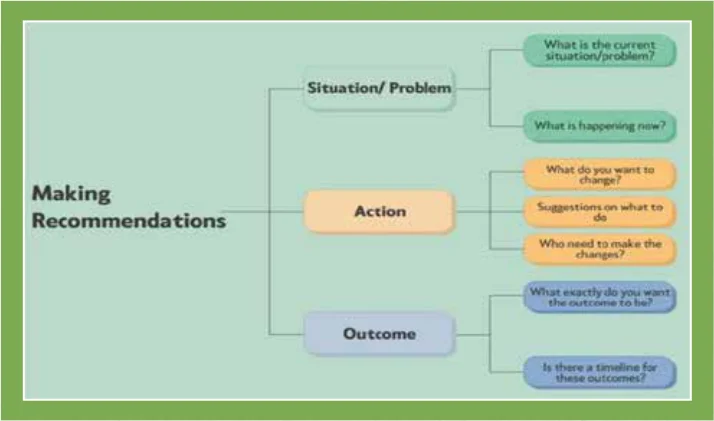
Figure from page 55
Appendix 3c: Questions Posed to the DECC after the Preparation session.
Climate Literacy Is there a plan in place to incorporate climate literacy into schools? Can environmental issues/climate be added into the leaving certificate? Shannon Airport Given the US Military emits a similar amount C02 to many developed nations such as Denmark and Portugal, what is the government plan to end the use of Shannon airport as a place for the US Military to refuel their planes?
Shipping and Aviation Does the government plan to include shipping and aviation emissions in climate targets and emissions tracking? What is the government’s plan to decarbonise aviation? Will Eamon Ryan support the bill to ban LNG (Liquified Natural Gas) terminals in Ireland? Fuel Poverty What is the government plan to replace fossil fuel subsidies for those in fuel poverty with green fuel alternatives? Does government have any plans/ideas for making climate action more cost inclusive for poorer communities? How does the government plan on catering to all communities in Ireland e.g. poorer communities rural Ireland built up areas because their needs are so different? Money will be the overwhelming deciding factor in Climate Action. The sustainable, and ecological option will be far more expensive than the current option. The same subsides that were once applied to fossil fuels need to be applied to all sorts of ecological necessities. The people with the least will be hit hardest in all countries. Organic, local products should be continued to be promoted.
Subsidies for Fossil Fuels Why are you promising to reduce carbon emissions but still using taxpayers money to subsidies fossil fuels?
Reducing Carbon Emissions What measures have been put in place to reduce carbon emissions in public transport?
Climate Change Events What are the events happening/ topics discussed relating to climate change in the near future?
Labelling of sustainable products Why is there no regulations for companies labelling products with sustainable? Does the government plan on preventing major companies unsustainably “passing on” their climate responsibilities onto individuals? Is or will clothes and WEEE electrical waste be included under the waste sector of emissions - to include emissions from fast fashion etc?
Rural/Just transition What is the minister doing to ensure rural areas are not left behind with initiatives? Lack of links/services?
Biodiversity Biodiversity is a key aspect that should be included in the climate action plan constantly. Will biodiversity and biodiversity goals be brought into the plan more often e.g. banning hare coursing, setting up wildlife corridors around Ireland, protecting endangered species etc? What are the goals being made in National Development Plans to increase biodiversity?
Sustainable Development Goals (SDGs) What is being done by the Irish government in connection to the SDGs set out by the UN, individually as a country? Is reaching the 17 sustainable goals realistic in the next 8 years. If yes then what plans have the gov got in mind. If no should there be a “fine” for not reaching these goals by 2030
Climate Action Plan and Policy Will timing of goals be brought forward - net zero by 2050 is too late Policies as a whole take quite a while to implement however with regards to Covid, policies were implemented as fast as possible due to the direct urgency. How come this type of action is not implemented with regards to climate? It has been proven that the excuse of time does not apply anymore if we effectively use our time and resources so how come we are focusing our time and efforts elsewhere when we can tackle this issue quicker and more effectively? Are there clear steps in the climate action plan which show how the reduction of 1.5 degrees will be met? How do you go about you making the decisions for the climate action plan? What are the steps?
Greenwashing What measures are going to be implemented to prohibit and prevent greenwashing?
Eco-anxiety Eco-anxiety-will the policy consider the impact of eco-anxiety on young people? Young people engaging in environmental youth work organisations are experience eco anxiety, by being overwhelmed from the individualistic responsibility on them, will a programme for tackling eco anxiety through engaging with nature and biodiversity for wellbeing be drafted alongside the climate action plan?
Alternative energy Why does Ireland not use more ocean wave power when we are an island and this could be a largely effective renewable source of energy?
Agriculture All actions that are taken in response to the Climate Emergency should take into account how they will be implemented. Namely (from the Rural Perspective) as bogs and peat production are being shut down, coal and peat supplies are still needed, and they are forced to be imported from other countries, causing even more pollution with transport. The same applies with the agri-industry; from conversations with Teagasc and the Galway Grasslands association, the current agri-food industry in Ireland is very efficient, compared to other nations. As we try to reduce the emission from the sector, we should not annihilate a per-established and efficient system. New innovations are being developed, and more should be done to work with agri innovators and improve literacy among small farmers in what they can do to help the cause. When dealing with the Agri Food industry, worse case scenario would be cutting down the herd rapidly, while importing food from less efficient systems that will be more polluting overall. People will still need to be fed. Action must be quick, but it must be measured and efficient.
Retrofitting Getting solar panels for homes doesn’t require planning permission, yet it is required for schools. The reduced costs for schools from heating oil, and the reduced emissions from burning this fuel create a win - win scenario or the environment and schools. How can we go about getting rid of this barrier, and when can we expect it to be gone?
30
Marine Legislation How far out is the legislation for marine protected areas from being introduced and implemented?
31
Links Climate Action Plan 2021: gov.ie - Climate Action Plan 2021 (www.gov.ie)
Climate Action Plan 2021 Annex of Actions: gov.ie - Climate Action Plan 2021 (www.gov.ie)
Programme for Government: Our Shared Future: gov.ie - Programme for Government: Our Shared Future (www.gov.ie)
The National Dialogue on Climate Action: gov.ie - National Dialogue on Climate Action (NDCA) (www.gov.ie)
Biofuel Obligation Scheme: gov.ie - Biofuels Obligation Scheme (www.gov.ie)
EU Emissions Trading Scheme: EU Emissions Trading System (EU ETS) (europa.eu)
ReFuel EU Aviation: ReFuelEU Aviation | European Economic and Social Committee (europa.eu)
Fuel EU aritime: FuelEU Maritime | European Economic and Social Committee (europa.eu)
Alternative Fuel Infrastructure Regulation: AFIR - zero 2050 (cero2050.es)
International Maritime Organization: International Maritime Organization (imo.org)
The International Civil Aviation Organization: Home (icao.int)
The National Economic and Social Council: Home | The National Economic and Social Council - Ireland (nesc.ie)
Corporate Sustainability Reporting: Corporate sustainability reporting | European Commission (europa.eu)
UN 2030 Agenda for Sustainable Development: 21252030 Agenda for Sustainable Development web.pdf (un.org)
Climate Action and Low Carbon Development (Amendment) Act 2021: gov.ie - Climate Action and Low Carbon Development (Amendment) Bill 2021 (www.gov.ie)
National Planning Framework: Ireland 2040 Our Plan – National Planning Framework (npf.ie)
The European Green Deal: A European Green Deal | European Commission (europa.eu)
Offshore Renewable Energy Development Plan: gov.ie - Offshore Renewable Energy Development Plan (OREDP) (www.gov.ie)
Maritime Area Planning Act: Maritime Area Planning Act 2021 – No. 50 of 2021 – Houses of the Oireachtas
The National Residential Retrofit Plan: gov.ie - National Retrofit Plan (www.gov.ie)
Figure from page 58
Appendix 3: Programme
Figure from page 59
THE NATIONAL YOUTH ASSEMBLY ON CLIMATE
Date: Wednesday 2 March 2022
Time: 11am – 3.05pm
Young People to Log on at 10.50am
11am Welcome and Housekeeping
11.10am Roderic O’Gorman, Minister for Children, Equality, Disability, Integration and Youth
11.20am Icebreaker Session
11.30am Open Space Activity - Climate
11.45am Identifying Priority Areas
12.15am LUNCH - 30 minutes
12.45am World Cafe - Discussions on Priority Areas
1.30pm Preparing Recommendations
1.55pm Comfort Break - 5 minutes
2.00pm Address to the Assembly by Eamon Ryan Minister for Environment, Climate and Communications and Minister for Transport
Recommendations on 4 themes presented to Minister Ryan by Rapporteurs and conversation
Minister Ryan’s closing remarks
3.00pm Youth Participation in 2022 and closing remarks
Appendix 4: What are the main priority areas in climate action for young people in Ireland (Screenshots of Padlets)
Appendix 4a: Room 1
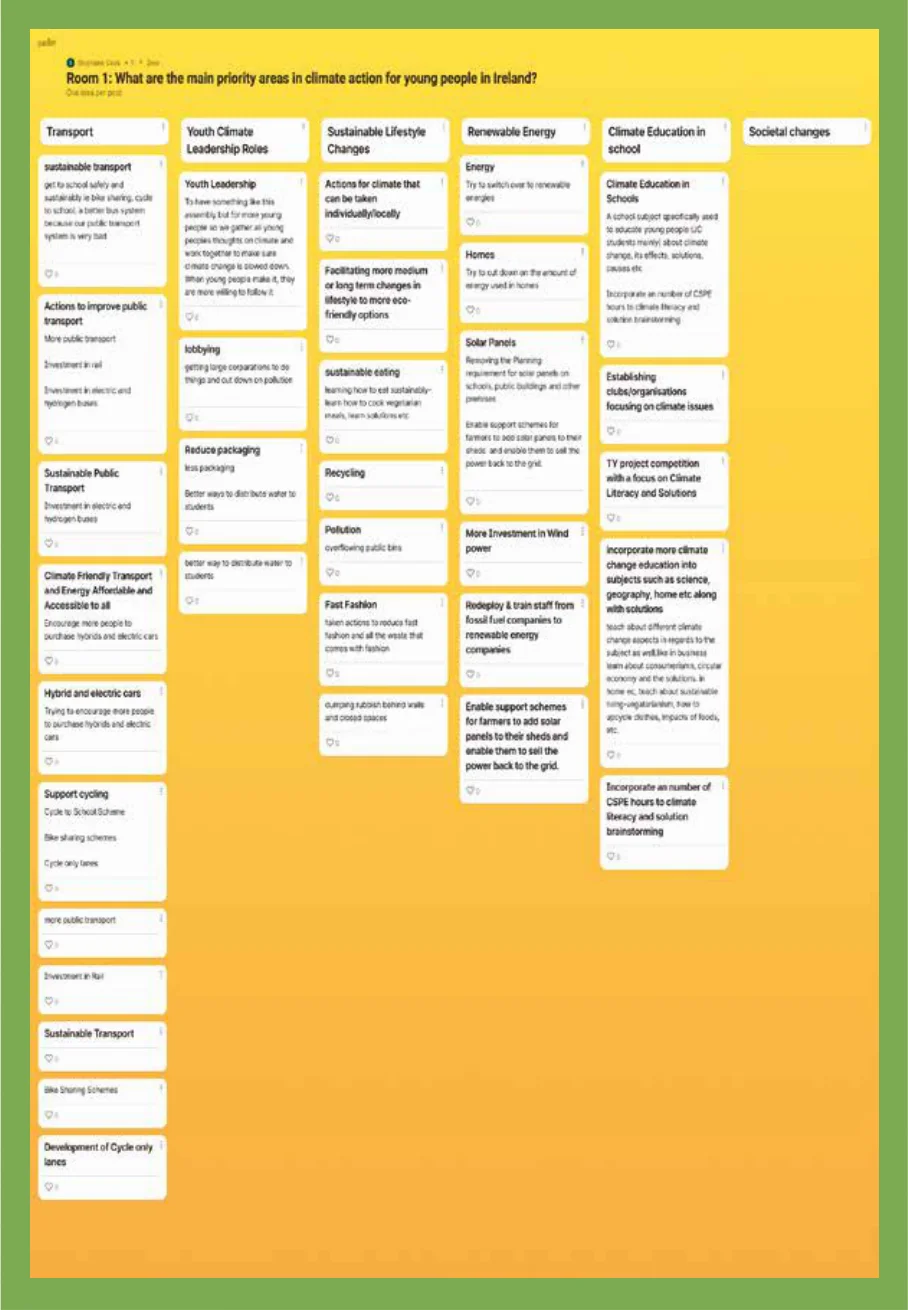
Figure from page 60
Appendix 4b: Room 2
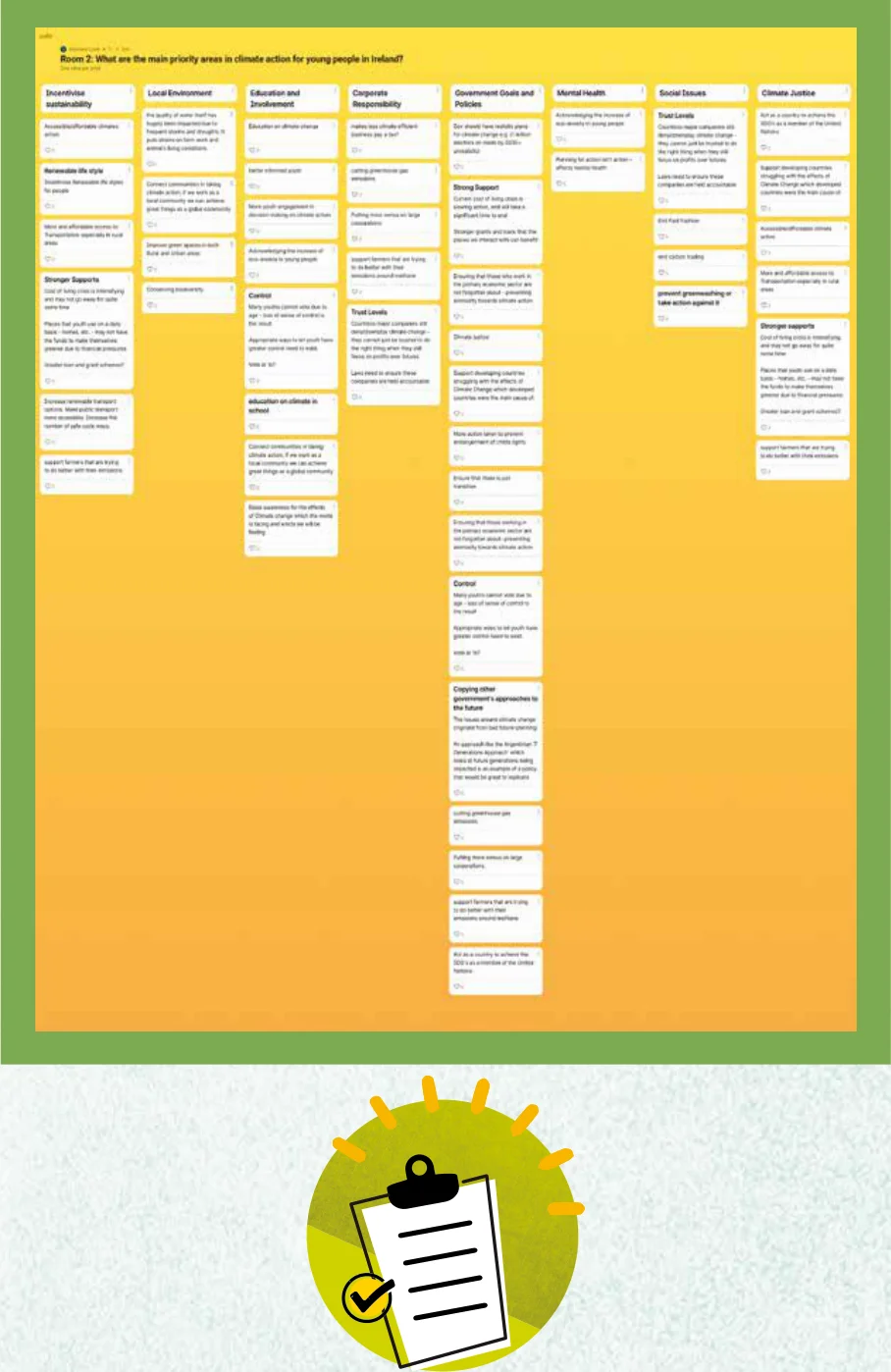
Figure from page 61
Appendix 4b: Room 3
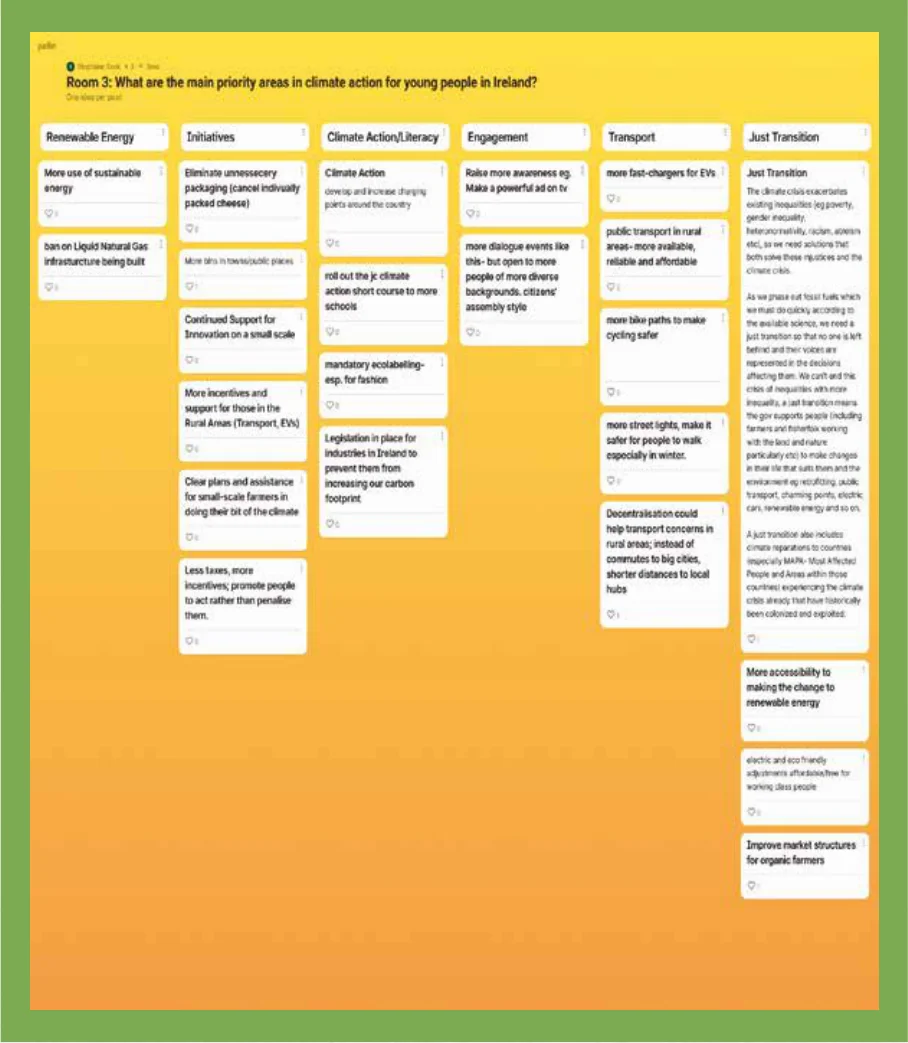
Figure from page 62
Appendix 4b: Room 4
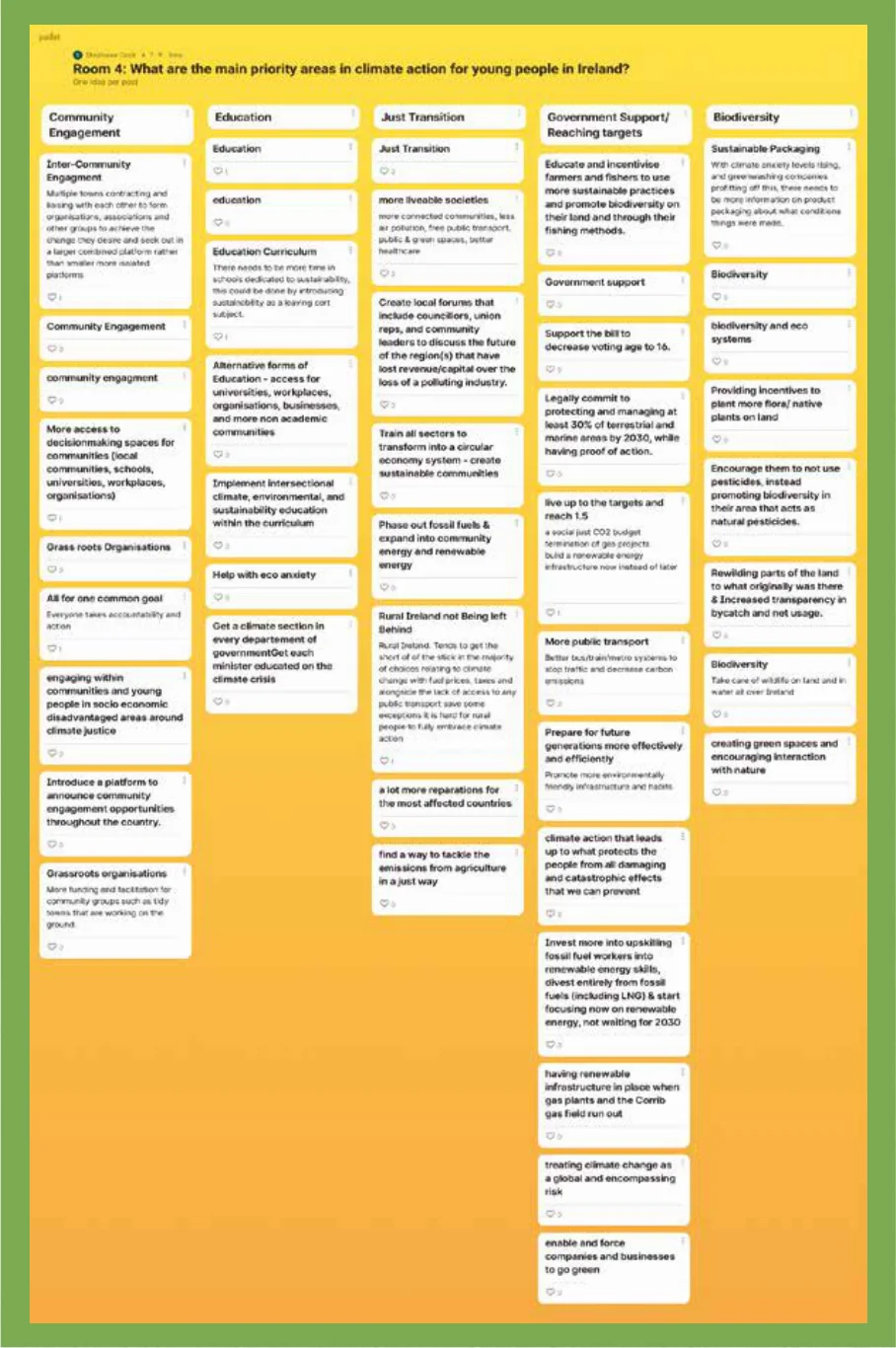
Figure from page 63
Appendix 5: Summary of Discussion of the Four Topics
Table 5(a) In depth discussion on Transport
Topic 1: Transport Sub-topic Detail
What makes transport so important?
• Transport is responsible for high emissions (2nd or 3rd worst environmental offender in the country). • Pollution from traffic
High emissions
Poor public transport
• Cost of public transport in Ireland. • Inefficient public transport • Inefficient – not connected /lack of direct routes/ not enough at peak times • Unreliable – cancelled at last minute • Unappealing - overcrowded, poor social etiquette, littering • Easiest option not always the best for the environment • Poor access to public transport in rural Ireland
• Cycling can be expensive • Barriers to cycling • Lack of safety (in urban and rural areas) • Cost of bicycles • Lack of bike racks (bikes are easily stolen or vandalised)
Barriers to cycling
- Barriers to adopting sustainable transport options
- Electric cars are expensive
- Not enough charging points
- (High cost of public transport
High cost of sustainable options
Wi-Fi Broadband
• Poor connectivity – not reliable broadband to work from home
• Focus on sustainable public transport-not just electric cars but also electric public buses. Investment needed in Electric/hydrogen rail. No green washing this needs to be done right • Address the barriers to using public transport • Provide more bus routes. • Plan public transport to match need e.g. school/college starting times (e.g., change timetables/more buses) • Have more logical systems of public transport. Connect the suburbs without the need to travel to the centre of towns/cities.
Improve public transport
What can be done to solve this? Action)
• Improve cycling infra-structure (e.g safe bike lanes in urban and rural areas • Introduce incentives e.g. cycle to school scheme Bike sharing schemes throughout Ireland (not just Dublin) which are close to bus/train stations More bike racks in schools and public places.
Promote cycling
Topic 1: Transport Sub-topic Detail
What can be done to solve this? Action)
- Have grants for electric cars
- Have more charging points
Support sustainable transport
Wi-Fi – Broadband
Improve broadband/internet • Faster / reliable broadband - efficient
What difference will this make? (Outcome)
• Will reduce emissions
Using sustainable transport options
Promotion of public transport
• Young people use public transport now. If this is properly improved, they will be encouraged to keep using public transport in the future rather than getting more cars on the road • If people use public transport, fewer private cars on roads will lower emissions • Air quality will be improved.
Health benefits of walking, cycling, and having affordable interconnected public transport-people in cities can go for a hike/get into nature
Cycling Interconnected bus systems
Wifi/ broadband
Reduce the need to commute to work – reduce traffic – emissions.
Figure from page 65
Table 5(b) Summary of Topic 2: Government Goals and Policy
Topic 4: Government Goals and Policy
Sub-topic Detail
What makes Government Policy and Goals so important?
People leading the way but Government has the power
• Governments has most power to make changes. • People are doing a lot – getting on top of initiatives, government are lacking, responsibility falls on them the most • There is only so much that individuals can do • We will be more affected by what the government doesn’t do – rather than what they do. It will affect us for the next 50 years. • If it is going to be expensive, so it is important to know how the government will react to this crisis
• Solar panels • Plastic bag ban • Introducing scheme to reimburse home owners for some costs of retro fitting their homes
Examples of what government has done
Climate anxiety • It affects how we think about our own futures • Acknowledge the increase of eco-anxiety in young people • Justice for all - animals, nature, everyone
Importance of youth voice
• Many young people cannot vote due to age – there is a loss of control as a result • Appropriate ways to let youth have a greater control need to exist.
What can be done to solve this? Action)
• Mental health/eco-anxiety – we are told the science, then you see [government focusing on] actions by 2050 – you see it is not connecting, it is going to affect our future • Establish a climate section in every department of the government and educate the ministers on the climate crisis
Inform public on Government use of income from Taxes All gov depts to take action
• Policy on single use plastics • Introduce use of symbols on packaging to provide consumers with information (e.g. carbon footprint rating) • Add solar planning without need for planning permission (Planning and Development Solar Planning Amendment 21)
Specific actions
- Act on goals
- Act on a short and long term goal strategy
Deliver on goals
• Support large corporations to follow regulations set by Government and to go green • Sanction organisations e.g. climate court for pollution
Carrot and stick approach to large corporations
Legislate for the vote at 16
• Give more young people the opportunity to vote to have a say on their future
Topic 4: Government Goals and Policy
Sub-topic Detail
What difference will this make? (outcome)
Informing and involving the public
• This will inform and involve the public in decision making at Government level. It will empower the public • Government to have an app so people can access their climate related policies etc. in a user friendly language and in one space
Open up public consultations
• Open up consultations to workplaces
Figure from page 67
Table 5(c): Summary of in-depth discussions on Topic 3: Just Transition
Topic 3: Just Transition
Sub-topic Detail
Why Just Transition is important?
Main source of emissions
• Agriculture and transport
Need for alternative employment for fossil fuel sector workers
• When people move to renewable energy options important to find transition for people who will lose their jobs from closure of fossil fuel sector
Individual responsibility not as effective
• We used to focus on individual responsibility. Now we need more. Government is sugar coating and avoiding the topic
Greenwashing • Corporations are keen on being green because it attracts business • 81% of consumers don’t trust companies
• Corporations are taking advantage of Ireland’s tax laws and are causing harm to the environment • Tech/fashion industries are causing harm to the environment • Corporations based in global North are benefitting from exploitation. • A lot of goods produced in Asia but are imported to Ireland. Who is responsible for the harm caused? • Government overlooks carbon emissions because these companies bring investment • Big corps have the resources to move away from fossil fuels already. • Unfair that ordinary people take the blame for emissions
Large companies responsible for large volume of carbon emissions
Agriculture contributes to high volume emissions
• Farmers need to be supported to make transitions to sustainable farming.
Energy is becoming more expensive for farmers
• Farmers need planning permission to install solar panels
The expense of being climate conscious
• Sustainable choices and products can be more expensive • It is unfair to make fossil fuel more expensive when not everyone can afford to switch. • People in lower income households [need more support than] retro fitting, electric cars – eg oil and gas are very expensive, but alternatives are expensive too • Need to bring ordinary people / rural people along. Make life easier to adapt to sustainable living
Limited access to sustainable shopping/ products
• Not many eco shops
Topic 3: Just Transition
Sub-topic Detail
What can be done to solve this?
Gov. to support sustainable actions
• Government to incentivise renewable sustainable actions. • Gov. offer incentives e.g., make electric cars more affordable, tax cuts • Empower consumers to ‘vote with their wallets’ by choosing green • Retrofitting older buildings – make grants and loans more accessible • Subsidies for more sustainable transport (electric vehicles / public transport) • Have allowance/adjustments in taxes depending on use of sustainable sources (reduced tax for sustainable) • Tax breaks for greener practices
Government to support people with lower incomes
• People in lower income households need more support than retro fitting, electric cars – e.g. oil and gas are very expensive, but alternatives are expensive too
Support fossil fuel sector workers during the move to renewable energy
• Find alternative employment for people who will lose their jobs
Support farmers
• Help farmers to transition to climate friendly approaches • Grants to farmers who want to swap to more sustainable farming (e.g. peat farmers) • Educate farmers on renewable methods e.g. how to use wind energy • Remove the requirement for planning permission to put up solar panels • Market restructuring. More organic farming pilot schemes
Corporate accountability
• If companies harm the environment they should be charged Carbon caps and quotas to prevent over-pollution. Certain quota untaxed similar to PAYE. Any emissions above quota taxed. • Make them [corporations] use sustainable energy • Carbon tax for corporations/climate reparations for global south • Use the money to help climate justice and action e.g. electric vehicles for low income families • Don’t allow companies to trade their quotas • Rebalance corporate tax system. Delicate balance. Don’t want to push too hard that investors are put off.
Greenwashing Reducing harm caused by Fashion industry
• Enforce eco-labelling in food and fashion
Support poor countries
• Support poorer countries who are feeling the effects now
Topic 3: Just Transition
Sub-topic Detail
What difference this will make
Supporting low income people to make transitions
• More low income people make the transition to sustainable energy • Fewer emissions
Actions to support farmers
• Enable them to go green
Action to support people employed in the peat industry
• More just transition to sustainable energy
• Large industry more likely to move to sustainable energy • Income from tax and fines to be re-directed to supporting sustainable transitions.
Tax & fine large industry
Table 5(d): In depth discussion on Topic 4: Community Engagement
Topic 2: Community Engagement
Sub-topic Detail
What makes this so important?
Climate change impacts on everyone
• Climate change is dangerous and impacts on all our lives
Importance of community (start local)
• People want to be part of a community. This makes it more enjoyable and less daunting. • People need to be given a sense of control • It takes a community to work together to bring about change • If there are no communities, it’s hard to get involved.
People need to be informed People are informed about consultations (see Topic 4)
• YP feel marginalised • Not enough places for young people to hang out and discuss topics generally (and are not adult led)
Topic 2: Community Engagement
Sub-topic Detail
What can be done to solve this?
Include climate change in school
• Have climate action as a subject
Inform people and raise awareness
• Raise awareness of the importance of climate – include this in climate education in schools • Raise awareness of the available opportunities to get involved via schools/teachers etc • Signpost available groups • Have groups (e.g. environmental councils in local communities)
Provide spaces for engagement
• Create community spaces for interaction and engagement. • Provide funding to youth organisations (not sport organisations) and more opportunities / activities in rural areas. • Opportunities for the different generations to inform each other • Use of different media to reach different generations • Universal approaches • Projects to get community involved e.g. something similar to Tidy Towns.
Projects to bring communities together
Support and advise groups
• Provide guidance on setting up climate action groups
Create accessible (online) platforms
• Create online platforms so people can access and influence decision
Topic 2: Community Engagement
Sub-topic Detail
What difference this will make?
Informed and engaged community
- People will be more informed – and empowered
- People will be more engaged
Appendix 6: Delegates’ evaluation of Space, Voice, Audience, and Influence (completed by 20 young people)
1 2 3 4
Detail
| I felt comfortable giving my opinions | ||||
|---|---|---|---|---|
| I got the chance to give my opinions | 5 | 3 | ||
| I know who wants to hear our opinions | 2 | 2 | 9 | |
| I think what we said today will be taken seriously |
Space
Voice
Audience
Influence
Open Comments
The best thing about today was:
Meeting Minister Ryan • Networking with like minded members and getting to speak to Minister Eamonn Ryan • The difference between this event and others, was I feel that our ideas were really listened to by government change makers. I really enjoyed meeting the ministers and having conversations with them • Having a chance to meet Minister Ryan • Speaking to Minister Eamon Ryan • The conversation at the end in the main room where everyone gave their opinions and recommendations and Minister Ryan had the chance to feedback • Get to give our recommendations to the minister
Expressing our opinions & hearing different viewpoints • Everyone was given a chance to speak, no favouritism was shown towards any candidate. • Hearing different perspectives • Getting to learn and hear from other young people with different experiences to mine (e.g. rural, BIPOC, etc) and the climate solutions they suggested. • Brainstorming ideas with passionate young people and having a chance to speak with Minister Ryan • The pool of information from all the delegates and the opportunity to hear new voices and collaborate. There was also great room for innovation to take place which allowed for creative ideas and thoughts • The large amount of people who gave their input. • Seeing other teens and hearing what they have to say • I enjoyed listening to some of other delegates as they seemed to know a lot of information regarding the climate crisis and it was nice to hear what other people think. • Getting a chance to share our opinions with others our age and hear our opinions. • Talking to other like-minded people and engaging with the minister. • The best bit about the day was getting to voice our ideas and hear others.
Open Comments
The best thing about today was:
The approach • The world cafe because we got to cover a lot of topics in a short time • The discussion in the breakout room. • The groupwork • Doing the words (the Mentimeter exercise)
Having our views recorded Having the note takers so all our opinions were being heard and getting to meet the ministers
One thing you’d change from today’s event
Timing • The fact we ran over time, not that I was in a rush to leave or anything but I just found my focus really slipping • How the recommendations were discussed in the breakout rooms • More time with group provided to finalise recommendations there was too little time to come up with the recommendations and evaluate things, maybe extending future assemblies by around 30 minutes • I would have liked if more people could have shared their opinions be that may have been due to lack of time. • Have more time when discussing our ideas to fix certain issues • Give it more time • I would change the timing. It was too rushed. I would make sure that people had the chance to speak up and there was more focus on making it comfortable to speak up • I would maybe have a bit more time for icebreakers • Seems a bit rushed when it comes to group sessions. • in my breakout room it felt very rushed and it seemed to lack a lot of structure in terms of creating the proposals. this was disappointing for me because I felt like we could have made much better use out of the little time we had.
In-person meetings • Have the meetings in person rather than over zoom. • Having the meeting in person. • It’s not something that I would necessarily change about yesterday’s Assembly but I was wondering if there will be any meetings that will take place in real life rather than over a zoom call.
More information/preparation • More information about different climate initiatives for people to educate themselves would have been a good idea. Information beforehand about the Assembly methods so people could prepare (recommendations were rushed). A formal write up of the recommendations would have been a good idea. More diverse participants in term of age and ethnicity.
More young people/wider representation • I think more young people e.g. 100-150 should’ve been included and it should have been open call for anyone to join (the only reason it should’ve gone through a nomination process would’ve been to ensure diversity and that different groups are strongly represented in numbers) • I would also have had more representation as I felt everyone around me was around the 16 years old and there were only a few younger and older.
More recommendations • I would’ve chosen to give more recommendations than just two per group.
Nothing/It worked well • Nothing. Really well organised like the idea of the break out rooms and world café definitely the best virtual experience I have been a part of so far ! • I was very happy with today • I think working in smaller groups really worked well on zoom as we got to know each other better and had a better chance to talk. When meetings are in person however, I feel that it would be important for some time to be spent getting to know all of the members.

Figure from page 74
NOTES

Figure from page 75
REVISED: JUNE 2022
Prepared by Deirdre Fullerton (Insights Health and Social Research)

Figure from page 76
REPORT OF THE NATIONAL YOUTH ASSEMBLY ON CLIMATE
MARCH 2022
Pages 46–76 · View in original PDF