3.3 RECOMMENDATION DEVELOPMENT
3.3 RECOMMENDATION DEVELOPMENT
Box 5: Recommendation Development

Figure from page 26
ACTIVITY 4: In the fourth activity, delegates in each room developed two recommendations focusing on the Situation, possible Actions, and Outcomes. (see Appendix 2b)
In the third activity, the World Café, the delegates continued to work in their breakout room to discuss each of the four prioritised topics:
• Topic 1: Transport
• Topic 2: Community Engagement
• Topic 3: Just Transition
• Topic 4: Government Goals and Policy
Each facilitator was assigned one topic to explore in more depth spending 15 minutes with the first breakout room, and 10 minutes with each of the remaining rooms. All the breakout rooms had a second facilitator and note taker who remained in the room for all four discussions.
When entering the room, the facilitator asked the group to consider three questions on the topic.
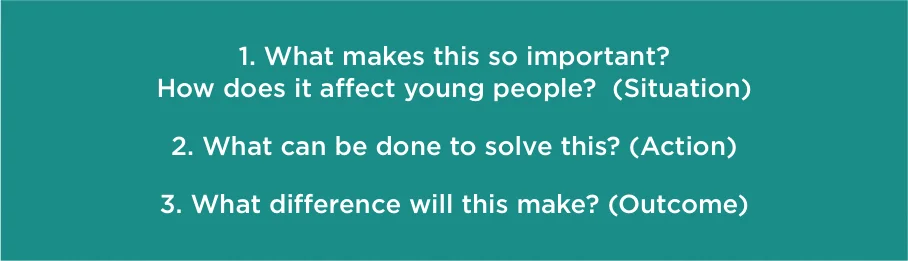
Figure from page 26
-
What makes this so important? How does it affect young people? (Situation)
-
What can be done to solve this? (Action)
-
What difference will this make? (Outcome)
The facilitators reminded delegates to be clear about their suggestions for change, as only one group will be making recommendations about the topic.
The note takers in each room recorded the deliberations from each of the four topics. The report writer combined the messages from each breakout room in table format (see Appendix 5). The messages from the topic were sorted by Situation, Action and Outcome. To provide greater clarity the report writer also grouped the messages by sub-theme to capture similar messages.
It is important to note that some of the messages are repeated across the different topics.
3.3.1Topic 1: Transport
Summary of Topic 1: Transport
WHY IS TRANSPORT IMPORTANT?
High emissions • Focus on the emissions rates for transport.
Public Transport The need for regular and reliable public transport: • Public transport used daily by young people – but it is unreliable and inefficient: • Buses cancelled at the last minute/infrastructure doesn’t make sense, not interconnected or logical (need ‘interconnected suburbs’) • Need to add more buses etc at school start and end times/More school buses • Public transport = Lack of routes and/or lack of direct routes/expensive • Easiest option not most sustainable • Taking a lift from parents is the easiest option • It is unappealing • Public transport can be scary and frightening. There is poor social etiquette (people not adhering to Covid-mask wearing rules to antisocial behaviour). • They (buses/trains) are also very dirty with litter.
Cycling Barriers to cycling (as an alternative to cars) • Many barriers to cycling e.g. cost of cycling, lack of infra-structure, safety concerns.
Sustainable Transport • Need to focus on sustainable public transport-not just electric cars but also electric public buses. Investment needed in electric/hydrogen rail. No green washing, this needs to be done right. • Electric cars - expensive
WHAT ACTIONS MIGHT BE TAKEN?
Public Transport • It needs efficient planning and reliable services • Make it more appealing • The rules on buses need to be enforced regarding (adhering to Covid-mask wearing rules to antisocial behaviour). • They (buses/trains) need to be clean and free from litter.
Cycling • Address the barriers to cycling • Introduce incentives e.g. cycle to school scheme (similar to cycle to work scheme) • Bike sharing schemes throughout the country (not just Dublin centric). Should be near bus stops/trains. • Improve cycling infra-structure • Bike lanes need to be made safer (urban and rural issue). • Bike racks important (bikes are easily stolen or vandalised) in schools and within the community.
Sustainable Transport • More incentives to move to sustainable transport (e.g. electric cars) • More sustainable public transport options
Other suggestions • Car free Sundays should be introduced • Smart villages & hubs can help but need for internet/broadband to work throughout the country
What difference will it make? • Improved public transport • Reduce emissions from private car use • Young people use public transport now. If this is properly improved, young people will have the option to keep using public transport in the future rather than getting more cars on the road
Cycling • Air quality will be improved. Health benefits of walking, cycling, and having affordable interconnected public transport-people in cities can go for a hike/get into nature
WHAT MAKES ‘TRANSPORT’ IMPORTANT? The facilitators asked focused questions to gain a better understanding of role played by transport on the climate, what actions might be taken to improve the situation, and the possible impact of such actions (See Appendix 5a for further detail).
For the ‘Transport’ topic the delegates discussed five sub-topics6:
•HIGH EMISSIONS
•POOR PUBLIC TRANSPORT
•BARRIERS TO CYCLING
•HIGH COST OF SUSTAINABLE OPTIONS
•WI-FI/BROADBAND
Figure from page 28
6 The report writer grouped the main messages into themes.
HIGH EMISSIONS/POLLUTION The high emissions from transport in Ireland was discussed in one of the rooms.
Focus on the emissions rates for transport (2nd or 3rd worst environmental offender in the country). If you’re cycling in Dublin you really get the air pollution and it’s also
very dangerous. Cars and buses burn a lot of fossil fuels – this is why it is one of the main topics. Burning diesel instead of car-pooling and using public transport
The need for regular and reliable public transport The delegates were concerned about the environmental impact of relying on private cars (often no e-cars) rather than sustainable public transport. Public transport was described as ‘inefficient and unreliable,’ resulting in parents opting for the easiest option rather than the sustainable option.
Easiest option is not the most sustainable
Regular and reliable public transport was considered essential for participation in activities across the lifespan (i.e., not just for children and young people). It is needed to access education (school and colleges), training, work, healthcare, social and economic activities.
The problem is access to public transport. Where I live it’s not existent. If there were more buses going around the countryside it might occur to people to
use them rather than taking the car.
One of the groups discussed the tendency for public transport to be planned towards town/city centres rather than being planned logically to connect suburbs, which means short journeys (as the crow flies) often take longer and cost more as they require two or three buses.
I used to get 66 bus to college and since they changed the route it is harder,
I have to get two buses. There’s no direct route now, it’s worse
One delegate described the lack of appeal of public transport due to the overcrowding and lack of etiquette.
Need rules on buses that are actually enforced regarding social etiquette (not following Covid guidance to antisocial behaviour). Public transport can be scary
and frightening. They are also very dirty with litter (buses and trains).
The high cost of public transport in Ireland was also discussed.
The cost of transport – it should be free for most of my money
goes on transport to get to college
BARRIERS TO CYCLING Delegates described several barriers to cycle use. The lack of infra-structure to support cycle use, including the lack of safety in both urban and rural settings, was discussed. In one room delegates discussed the lack of bike racks in schools and in the community to secure, the often expensive, bicycles. This group also discussed the changeable weather in Ireland.
- Cycling can be expensive
- Cycling can be unsafe
- Not enough bike racks
NEED TO FOCUS ON SUSTAINABLE TRANSPORT In addition to the limitations of public transport, delegates discussed the barriers to adopting sustainable options such as electric cars for personal use.
- High cost of electric cars
- Not enough charging points
Not enough charging points. What happens if you live in an apartment
or a house without a driveway? How could you charge then?
LACK OF CONNECTIVITY (BROADBAND) In one group, delegates discussed the impact of commuting on the climate. This group felt if connectivity (broadband) improved this would help to reduce the need for people to commute for work.
WHAT ACTIONS MIGHT BE TAKEN?
The suggestions for actions included: • Addressing the barriers to public transport • Address the barriers to cycling • Supporting sustainable transport • Other actions
Address the barriers to using public transport Across all four breakout rooms the delegates put forward several suggestions to address the difficulties in transport and connectivity. These included:
• Improve public transport • More regular buses (plan timetables to match school/college starting times). • Have more logical systems of public transport. Connect the suburbs without the need to travel to the centre of towns/cities. • Add more buses etc at school start and end times. Reduce the cost of public transport.
We need bus timetables that make sense In the countryside if you need a car you should have one
– and eventually replace it with an electric. But the infrastructure should be as good as possible
To make free public transport an urgent goal.
Address the barriers to cycling • Infrastructure required to make cycling viable e.g. safe bike lanes: urban and rural issue. • Introduce incentives e.g. cycle to school scheme (similar to cycle to work scheme).
Bike sharing schemes throughout the country (not just Dublin). They should be near bus stops. If it is sunny, it will nudge people to hop on a
bike rather than use the bus. More bike racks in schools and public spaces.
Support sustainable transport • More sustainable public transport options. • More green forms of public transport. • Electric cars need to be cheaper. • Have more charging points
It’s so important to build tram routes. Give people good options.
We need to think about inequality and different wage levels. Electric cars need to be cheaper. All cars electric policy by 2030
‘wishful thinking’ and ‘unrealistic’ Without proper grants. Not enough charging points. What happens if you live in an apartment
or a house without a driveway? How could you charge then?
Other actions • Improve connectivity (e.g. broadband) to reduce need to travel to work • Allow more remote working (which would also take pressure off rural roads) • Car free Sundays should be introduced • Work towards car free cities/Sundays
We need to work towards car free cities. If you’re cycling in Dublin
you really get the air pollution and it’s also very dangerous.
In the countryside if you need a car you should have one – and eventually replace it with an electric. But the infrastructure should be as good as possible Car fee Sundays . That happens in other EU cities,
on a Sunday you need to access cities by buses
What difference will this make?
Delegates put forward a number of possible outcomes of their suggested actions which included: • An increase in the use of public transport • Increased uptake of sustainable cars (e-cars) and sustainable public transport which will lower emissions • Increase uptake of cycling with the added health benefits for individual and benefits for environment.
Young people use public transport now. If this is properly improved, young people will have the option to keep using public transport in the future
rather than getting more cars on the road.

Figure from page 32
Pages 26–32 · View in original PDF