3.3.2 TOPIC 2: GOVERNMENT GOALS AND POLICY
3.3.2 TOPIC 2: GOVERNMENT GOALS AND POLICY
Summary of Topic 2: Government Goals and Policy
WHY THIS IS IMPORTANT • Government has the power to translate our ideas into actions • We need to cut our emissions fast • The government has policies – they really need to stick to them - need for accountability • We need to stick to 1.5 degree rise in temperature
• Government has had some successes e.g. plastic bags, retrofitting support but more action is needed. • Young people are concerned about the climate, and need to be involved and informed on Government’s plans • Young people need to have a voice – the Government needs to reduce the voting age.
WHAT NEEDS TO HAPPEN? • Accessible information on what is happening. • Bring in vote at 16 – to involve more young people • Establish a climate section in every department of the government and educate the ministers on the climate crisis • Mandate about packaging in shops, food products, clothes – symbol representing the carbon footprint. • Policies to help businesses go green. • Focus on need to support agriculture and develop policies and incentives to ensure a Just Transition for farmers. • Alternative energy sources: • Phasing out fossil fuels. • Explore Hydro-electricity potential.
WHAT DIFFERENCE WILL THIS MAKE?* • Informing and involving the public in decision making at Government level will empower the public • If the government develop an app/website where people can access their climate related policies etc. in a user-friendly language and in one space they will be more informed. • Opening up public consultations to public spaces and workplaces will reach more people.
- Not all outcomes for each of the suggestions were discussed
Why is ‘Government Goals and Policy’ important? Delegates’ responses to why the Government Goals and Policy is important were grouped under four subthemes: • The Government has the power • Government action to date • To support transition to sustainable options • The need to address climate anxiety • The importance of youth voice
The Government has the power Delegates described the central role played by Government in translating their ideas into action. Some felt that whilst individuals doing action to be more climate aware, there is only some much that can be achieved without concerted action by Government.
Government has most power to make changes. I think as much as people put forward ideas, government plays
a key role in putting our ideas and proposals into practice. If it is going to be expensive, so it is important to know how the government will react.
People are doing a lot – getting on top of initiatives, government are lacking,
responsibility falls on them the most of this crisis
One group stressed that it was not what actions the Government make, but also the lack of action that will impact on their future.
We will be more affected by what the government doesn’t do – rather than what they do. It will affect us for the next 50 years.
Some delegates identified specific actions required by the Government. These covered exiting fossil fuels, and the importance of sticking to targets set by the scientists
Exit fossil fuels early. The new IPCC report said that by 2030 we have to half our emissions.
We need to do it even earlier, we have to put renewable energy into place year by year. To have emission targets in place, and that they fit the ones that are given by the IPCC scientists.
That we meet the scientists targets that they give us.
I think the biggest thing should be that they commit to what they sign up to. It’s like they put it on the back burner. You can’t do a massive change overnight…
they should be working more to move towards it (2030 goals).
If it’s extended it’s just going to make it worse Gov should have realistic plans for climate change e.g.
(1 million electrics on roads by 2030= unrealistic)
Government action to date The delegates described some of the actions that Government has already taken and the benefits of these policies. These included the plastic bag ban, the support for solar panels, and the introduction of the scheme to support retrofitting homes.
The need to support transition to sustainable transport Echoing the discussion within the Transport theme, delegates discussed the challenges facing lowincome families to make the transition to more sustainable transport.
Low-income families can barely afford to run a normal car
let alone purchase an electric car.
Whilst the Government has introduced some action to help with the transition, delegates felt more action is required for people with lower incomes.
Current electric car grants are still not affordable for too many people.
The need to support farmers/agriculture Acknowledging that agriculture contributes to high volume of emissions, delegates felt that farmers needed support.
Farmers are very unsupported around [becoming climate conscious] but agriculture is harshly blamed for mass production of methane gases.
Delegates discussed how the cost of energy impacts on farmers which adds to the urgency to address some of the barriers they face to transitioning to more sustainable energy sources (i.e. install solar panels). They also need support to make the transition to sustainable farming.
Farmers need to apply for planning permission to install solar panels Support farmers that are trying to do better with their emissions around methane
Farmers don’t like it if their opinions/needs are not taken into consideration
Climate anxiety In one of the groups the delegates discussed people’s concern about the climate and increasing ‘ecoanxiety’. This group felt that Government action is needed to ensure people feel included and kept informed on what the Government’s plans.
Eco anxiety. Not just naming it – but if the government had a plan to tackle eco anxiety, if groups had a way of addressing it. I think it is something that will impact young people
Youth Voice One group discussed young people’s role in informing Government Goals and Policies, and how reducing the voting age will provide them with a greater opportunity to have their voice heard.
This (consultation) shows we are fluent enough in consultations etc,
and it should be reflected in voting as well Most of those who care about climate action are young people.
What action might be taken? Delegates suggestions actions for Government Goals and Policy captured 6 themes • Action within Government • Support for people on low incomes • Education and support for farmers • Take action with large industry/companies • Inform and involve the public • Support vote for 16-year-olds
Action within Government Suggestions of actions for the Government included having someone in each Government Department to take responsibility for climate actions.
I looked at a list of ministries in government and it is a topic for every ministry.
Have one minister in each ministry to educate on climate change.
To push it forward and educate.
More generally, suggestions of actions included the Government setting and acting on specific goals (short and long term).
Develop renewable energy plans now. Reaching the goals – you may also need to set short term goals,
that the government has to reach every 6 months or every year.
In project planning you have to set small goals along the way
Climate action plan needs to include 1.5 degree goal.
Support for people on low incomes Delegates felt that people who have lower incomes to move away from fossil fuels. They suggested that ‘strong grants to support electric vehicles should be considered’ and more charging points should be made available.
Make purchase of electric cars more affordable
Support for agriculture and farmers Delegates also discussed the impact of transitioning to sustainable energy for people living in rural areas who tend to be more dependent on fossil fuels for heat and transport. This would be acting on the UN Sustainable Development Goal Life on Land to support sustainable farming.
Suggested actions to support farmers included: • Educate farmers on renewable methods e.g. how to use wind energy • Help farmers to transition to climate friendly approaches • Grants to farmers who want to swap to more sustainable farming (e.g. peat farmers) • Remove the requirement for planning permission to put up solar panels • Market restructuring. More organic farming pilot schemes.
Support around involvement and education to the farming community on methane gas
to make informed decisions around the cattle and sheep they decide to own. Support the farmers who might not know much about climate change and how they are
affecting the climate
One group suggested taking away the subsidy from fossil fuels.
Put it in plans now. Some gas plants will be shut by 2023, Corrib gas is running out,
we need to put renewable energy plants in place now. Take the subsidy away.
Enable local communities to have their own renewable energy.
Bring knowledge to the right places.
Suggestions also included actions to encourage farmers and large companies to become ‘greener and sustainable’.
Enable them (big companies/corporations) to go green.
Sometimes it is difficult for them to stay competitive. And for the government to have some standards and go green. To go green means to use renewable energy, to look at where they get their resources from.
Putting in place standards of sustainability in place and human rights Incentivise farmers and fishermen to use more sustainable practices and promote
biodiversity on their land and through their fishing methods.
Take action with large industry/companies
Some of the suggestions of Government actions focused on supporting people in general to make better choices, but also the action to regulate large corporations and industry.
I feel very strongly about corporations doing their bit, the governments have put everything in place for the corporations, they now need to regulate them
At a corporate level, delegates’ suggestions centred actions to make large industry use sustainable energy, and sanctions if they harm the environment (e.g. carbon caps and quota). In addition to sanctions for pollution in Ireland, delegates discussed the need for tax or reparations for the global south.
Legislation in place for industries in Ireland to prevent them from increasing our
carbon footprint. Laws need to ensure these companies are held accountable
Informing and involving the public Delegates felt that the public need to be more engaged in Government actions and policies.
Remove bureaucracy around renewable energy. enable people to put renewable energy
in place by giving people the knowledge, make it more accessible.
Suggestions of ways the Government might inform and involve the public include:
• Introducing a platform to announce community engagement opportunities throughout the country. The platform will consist of consultations, updates on policies etc. • Include a system that people can sign up to be kept informed on Government policies and consultations (and what happens in response to the consultations) • Create local forums that include community representatives, counsellors, so communities have a direct link to national decision making that makes them feel they have a direct link. In agriculture, farmers have ways (to connect), they need to have a direct link to decision making. • In the action plan when consulting with young people, ensure the hard to reach are not left behind.
If they engage with the process they are more like to be engaged.
Support Vote for 16 year olds Delegates also suggested that as young people are likely to most impacted by climate action, they need to be involved and a greater say in what happens. One way of doing this is to lower the vote to 16 to give them a voice on issues important to them.
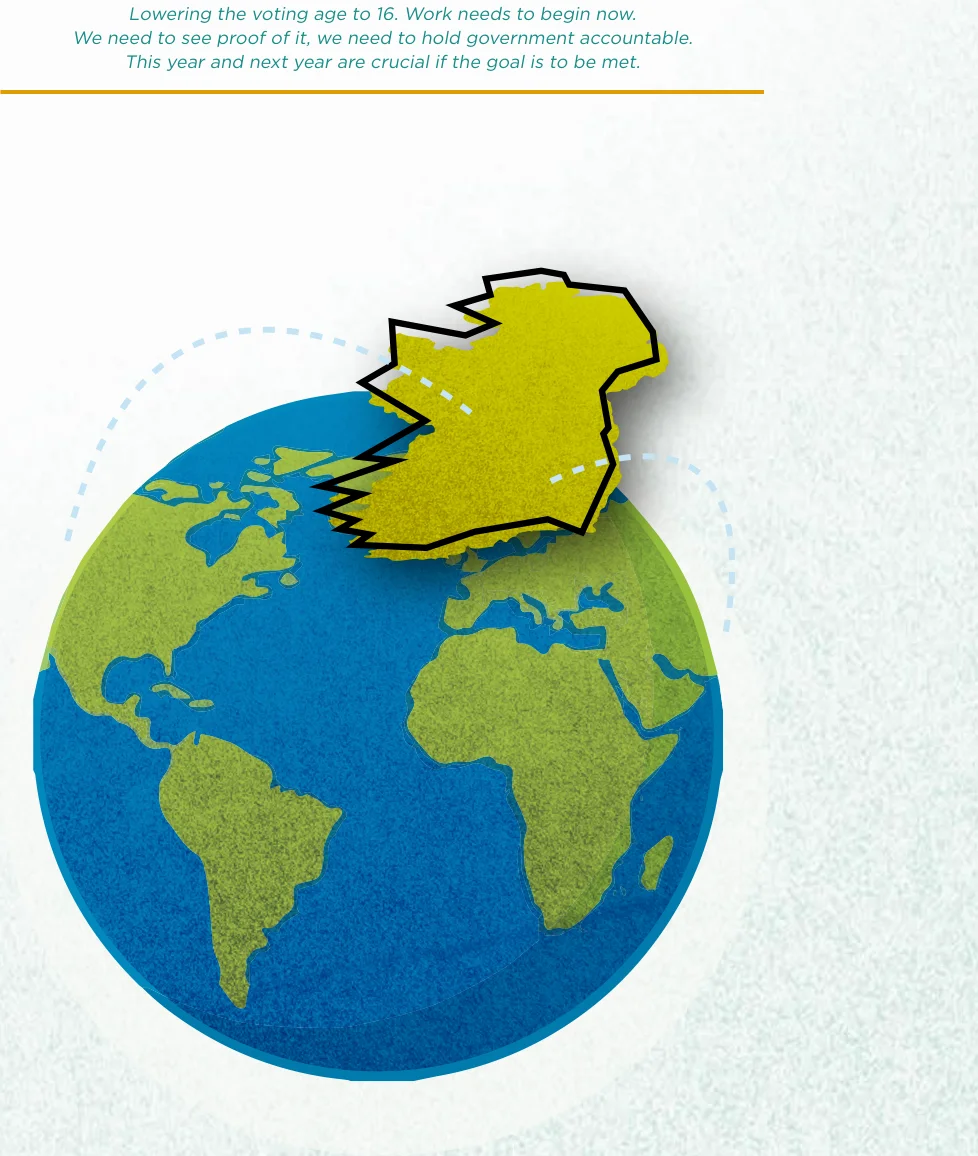
Figure from page 37
Lowering the voting age to 16. Work needs to begin now. We need to see proof of it, we need to hold government accountable.
This year and next year are crucial if the goal is to be met.

Figure from page 38
Pages 32–38 · View in original PDF