Introduction
This is the second update report detailing progress on implementation of the White Paper on Enterprise. The report details progress during 2023, incorporating updates for the second six months of the year, on the 40 key initiatives that were identified and agreed upon as part of the White Paper on Enterprise Implementation Plan 2023-2024. In some instances, more recent updates covering early 2024 have been provided for key initiatives, as well as highlighting forward looking actions for the remainder of the period through to end of 2024.
The Government published the White Paper on Enterprise 2022-2030 (‘the White Paper’), in December 2022. The White Paper sets out Ireland’s medium- to long-term industrial strategy, with the vision for Irish-based enterprise to succeed and deliver rewarding jobs and livelihoods by increasing their sustainability, innovation, and productivity. This will be achieved on a whole-of-Government basis through the pursuit of seven priority enterprise policy objectives:
-
Integrating decarbonisation and net zero commitments
-
Placing digital transformation at the heart of enterprise policy
-
Advancing Ireland’s FDI and trade value proposition
-
Strengthening the Irish-owned exporting sector
-
Enabling locally trading sectors to thrive
-
Stepping up enterprise innovation
-
Building on strengths and opportunities
In addition, the White Paper recognises the importance of ensuring the correct framework conditions are in place to enable enterprise to thrive and deliver strong, sustainable economic growth and quality employment. In particular, infrastructure, the cost of doing business, skills and talent, access to finance, taxation, and regulation are identified as key competitiveness conditions for Irish enterprise. Such conditions are beyond the direct purview of the Implementation Plan 2023-2024, and are the focus of wider cross- Governmental strategies complementing the White Paper, such as Project Ireland 2040, Housing for All, Impact 2030 and others.
The 40 initiatives reported upon, as set-out in the White Paper on Enterprise Implementation Plan 2023-2024, are not intended to be exhaustive of all Government’s activities, but represent critical efforts being progressed across all seven priority policy objectives across the Government system, including by the Department of Enterprise, Trade and Employment, Ireland’s enterprise development agencies (Enterprise Ireland, IDA Ireland, and Údarás na Gaeltachta), other relevant Departments and public bodies.
To realise the vision set out in the White Paper, 15 key targets were also set across the lifetime of the strategy, covering each of the White Paper’s 7 priority policy objectives, as well as employment. Data detailing progress across each of these 15 targets is also provided, where updated information was available.
The Implementation Plan 2023-2024 identified 40 initiatives, with 93 underlying activities, across the seven priority pillars set out in the White Paper on Enterprise. As of the end of 2023, 90 of these activities were undertaken, with 3 not yet scheduled to commence until
2024 as initially planned. 40 activities are currently completed as of end H2 2023, with 31 activities on track for completion against their intended target dates. 19 are currently delayed against their intended targets, but are expected to be completed. (see Figure 1). The status of individual activities across this report are detailed through a series of indicators, namely:
Pending - Scheduled to Commence in 2024 Complete On Track Delayed 2024
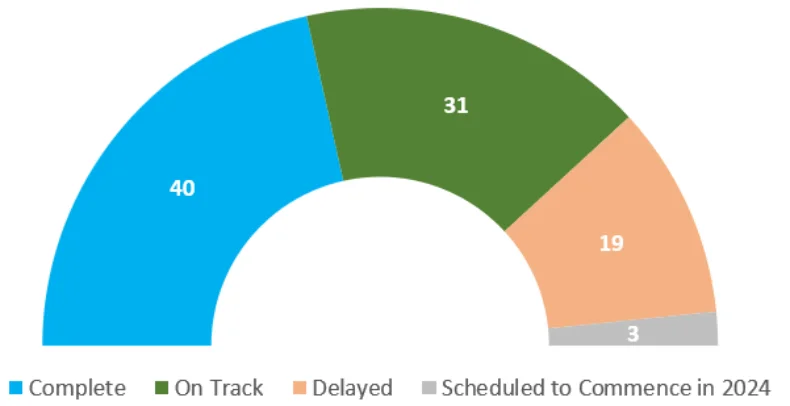
Figure 1: Status of the 93 activities across all 40 Implementation Initiatives
Activities contributing towards the 15 metrics set out in the White Paper continue to progress during the course of 2023, where some instances detail provisional results. At the end of 2023, the seasonally adjusted monthly unemployment rate for persons aged 15-74 years stood at 4.5%, staying below the targeted ceiling of 5% and representing a level of employment consistent with full employment. The employment situation is generally wellbalanced regionally, with only one region exceeding the national unemployment level by more than 1 percentage point, as of end Q4 2023. This region was the Midlands, which exceeded the national unemployment figure for the quarter by 1.4 percentage points.
Other key metrics are also positive. This includes year-on-year increases in IDA Ireland client expenditure, increases in the number of large Irish exporting companies and the number of High-Potential Start-Ups (HPSUs) supported by Enterprise Ireland, as well as productivity growth across Irish-owned enterprise. Moreover, enterprise agency targets for regionally balanced development were met during the course of 2023, with 53% of all FDI investments located outside of Dublin (against a 50% target over multiple years) and 68% of new jobs created in Enterprise Ireland-assisted firms outside of Dublin (against a 2 out of every 3 jobs target). Despite absolute increases in Gross (public and private) Expenditure on R&D (GERD), these increases have failed to keep pace with expanding GNI* in recent
years, falling as a percentage of GNI* year-on-year since 2020, to 1.80% in 2022, against a White Paper target of 2.5%.
The update report also shows that strides have already been made in the implementation of key initiatives across all priority policy objectives. Among other progress made:
Work was completed on the development of a national strategy for offshore wind, with Powering Prosperity – Ireland’s Offshore Wind Industrial Strategy published in early 2024, as well as the 2023 publication of a detailed skills assessment report for the development of offshore wind; The Growth and Sustainability Loan Scheme was launched in Q3 2023, whilst take up of financial supports for green investments under the Green Transition Fund continued to progress during the year; Government published the Bioeconomy Action Plan and launched the Food Waste Charter 2.0, as well as the Environmental Protection Agencys (EPAs) national endof-waste criteria for recycled aggregates and national by-product criteria for site-won asphalt/road planning which were also published in H2 2023; Four new European Digital Innovation Hubs are now fully operational, to support the digitalisation of the economy; The AI Standards and Assurance Roadmap was published by the National Standards Authority of Ireland (NSAI) in H2 2023, along with a progress report on implementation of the National AI Strategy; A high-level Trade Conference took place in Dublin in July 2023, followed by further accomplishments through the signing of the EU-Chile Free Trade Agreement, and the successful completion of the inaugural Team Ireland Trade Mission Week (TITMW) to the Republic of Korea; Enterprise agencies are facilitating green and digital transformation in the FDI and Irish exporting base, with IDA Ireland supporting nearly €130 million in decarbonisation investments over the three year period 2021-2023, and Enterprise Ireland supporting 207 climate projects across 2023, alongside ongoing efforts to enhance digital adoption across the enterprise base; Irish exports have expanded to exceed €30 billion in total value, with efforts to diversify ensuring that more than 70% of exports now go to markets elsewhere than the UK, well ahead of schedule against the end of 2024 target; A review of social enterprise in Ireland was published by the OECD in November 2023, with a new Social Enterprise Policy now at an advanced stage and due to be completed during H1 2024; A framework was launched on a pilot basis to enable LEOs to support companies with international ambition employing more than 10 and less than 50 full time employees; Dedicated funding has been launched to support locally traded enterprise to navigate their decarbonisation journeys, in addition to increased funding to aid decarbonisation and encourage digitalisation and innovation across the enterprise base, through new and existing schemes; The Roadmap for Increased Adoption of Modern Methods of Construction (MMC) in Public Housing Delivery was developed and published, and sets out a range of actions for public bodies to undertake, in order to increase use of MMC in residential construction; Multiple new European Regional Development Fund initiatives were launched during 2023 to increase innovation, commercialisation, and innovative spin-outs;
The total number of Irish companies benefitting from European Space Agency contracts exceeded its 2025 target of 100, achieved by end of Q3 2023; Work is well underway on the development of a Coordinated National Approach to Clustering, which is expected to be launched in 2024; and Work continues on a whole-of-Government basis to enhance Ireland’s competitiveness framework conditions, including enhancements to green skills provisions, the creation of a working group which is due to shortly publish a report on increasing access to finance, and the further roll-out of the modernization of construction and infrastructure provisions through Modern Methods of Construction (MMC), Construct Innovate and Housing for All priority research programme.
Pages 6–9 · View in original PDF