7 Building on Strengths and Opportunities
In areas of existing expertise and future potential, we will continue to build on Ireland’s distinctive areas of competitive advantage which is key for ensuring Ireland remains both resilient in the face of disruptions and can avail of emerging opportunities. This includes building on regional strengths, and developing clusters of firms, higher education institutions and research, for key strategic sectors. Preparations for the launch of a new centrally coordinated, cross-Government, approach to clustering advanced through the development of the National Clustering Programme during 2023. Similarly, the development of Ireland’s National Hub Strategy will seek to ensure Ireland remains an attractive place to live and work, supporting wider economic ambitions across the country. The development of the National Hub Strategy continued to advance during 2023, supported through significant stakeholder engagements and consultations in advance of its launch in 2024. All nine regional Building Better Business conferences were successfully held in locations across the country during 2023, alerting and informing SME`s on the range of opportunities and challenges arising from digital transformation and decarbonization, including government and agency supports available in this effort. The €145m Smart Regions Enterprise Innovation Scheme was launched through a first call in late 2023, and support early-stage funding that promotes regional job creation and enterprise development throughout Ireland.
7.1 Develop a Coordinated National Approach to Clustering
| Timeline | Q3 2023: Devise a National Clustering Programme | ||||
|---|---|---|---|---|---|
| Q4 2023: Commence implementation with the target to fund five | |||||
| National Cluster organisations under the Programme by 2025 | |||||
| Responsibility | Department of Enterprise, Trade and Employment | ||||
| Update | Update | Work has continued on developing the National Clustering Programme which is being informed by the 2023 Grant Thornton evidence base report commissioned by the Department of Enterprise, Trade and Employment. Since Q2 2023, Department of Enterprise, Trade and Employment officials have also been working with colleagues in the Department for the Economy in Northern Ireland and the enterprise development agencies across the island, to develop a proposal for a clustering initiative to be funded through the Shared Island Fund. This funding stream will support the National Clustering Programme in taking a shared island approach, as set out in the White Paper on Enterprise. The approach to the National Cluster Programme and the establishment of a national coordination mechanism was agreed in 2023 and further development was undertaken during H2 2023, with the aim of funding five National Cluster Organisations under a new National Clustering Programme by 2025. Department of Enterprise, Trade and Employment officials have continued to engage with a range of stakeholders during H2 2023, to ensure the National Clustering Programme is tailored effectively to support and enhance the Irish clustering ecosystem and is in line with International best practice. The target for devising the National Clustering Programme has been revised and is now expected to be met by Q2 2024. | |||
| Following the finalisation of the National Clustering Programme, implementation will commence by Q4 2024. At the outset, the coordination entity will be sited within the Department of Enterprise, Trade and Employment. To this end, the Cluster Ireland Unit was established in Q4 2023 and has responsibility for devising and implementing the National Clustering Programme. |
7.2 Support Balanced, Sustainable Regional Development
| Timeline | Q2 2023 and beyond: First call under the ERDF for regional | ||
|---|---|---|---|
| enterprise development to be held, with further calls on an annual | |||
| basis or every nine months, depending on demand | |||
| Q4 2023: Completion of all nine Building Better Business | |||
| conferences | |||
| Responsibility | Department of Enterprise, Trade and Employment; Enterprise | ||
| Ireland | |||
| Update | In October 2023, the Minister for Enterprise, Trade and Employment, Simon Coveney TD, announced a new €145m Smart Regions Enterprise Innovation Scheme, co-funded under the European Regional Development Fund, to support projects aligned to the Regional Enterprise Plans. The first call of €35m opened for applications in H2 2023. This is the first of a number of calls over the coming years. The Scheme supports innovative clusters, local infrastructure projects, programmatic supports to business and feasibility and priming funding for early-stage project development, ultimately supporting job creation and enterprise development in each region throughout Ireland. | ||
| All nine planned Building Better Business conferences have taken place successfully across the country during 2023. The events focused on supporting SMEs in navigating the green journey and boosting business performance through digital transformation while also hearing from successful indigenous businesses which have scaled and internationalised. The events were held in the North- West (Donegal), Midlands (Laois), Mid-West (Limerick), Mid-East (Kildare), South-East (Waterford), North-East (Louth), West (Mayo), South-West (Cork) and Dublin. |
| Timeline | Ongoing to 2030: Offer qualifying businesses and companies from | ||||
|---|---|---|---|---|---|
| various sectors a range of incentives and supports to start up, | |||||
| develop, expand or locate in a Gaeltacht region | |||||
| Responsibility | Údarás na Gaeltachta | ||||
| Update | Update | Udarás na Gaeltachta approved 13 projects during H2 2023, to incentivise its client companies to commence their green, lean and digital journeys. This brings the total number of projects approved during 2023 to 27. Udarás na Gaeltachta has also agreed a target of 30 applications for the Green Transition Fund, along with a further 30 applications for the Digital transition Fund, from its client companies by the end of 2024. ‘Gaeltacht Glas’, a strategic project of Údarás na Gaeltachta, will enable the Gaeltacht to lead the way in providing innovative leadership in the green sector, promoting sustainability and its accompanying opportunities, while taking into consideration climate, environment, language, community and economy development. Údarás na Gaeltachta has liaised with a wide range of stakeholders in preparing the Gaeltacht Glas Strategy, which will be launched in 2024 pending the conclusion of Gaeltacht energy usage and CO2 emissions baselining research. |
7.3 Develop Ireland’s National Hub Strategy
| Timeline | Q4 2023: Publication of Ireland’s National Hub Strategy | ||||
|---|---|---|---|---|---|
| Responsibility | Responsibility | Department of Regional and Community Development (Co-Lead); | |||
| Department of Enterprise, Trade and Employment (Co-Lead) | |||||
| Update | The Department of Enterprise, Trade and Employment and the Department of Rural and Community Development are working to develop the first National Hub Strategy, in close cooperation with the Western Development Commission. Four stakeholder workshops with hub managers, enterprise agencies, Regional Enterprise Plan Programme Managers and local authorities were held in H1 2023 to inform the Strategy’s development. These workshops focused on the themes of enterprise, community, employment, and climate action. In H2 2023, the Department of Rural and Community Development provided an opportunity for stakeholders to submit written observations further one-to-one consultations took place and the National Hub Summit was held in November. This work continues to inform the development of the Strategy, which is nearing completion with an expected publication date in Q2 2024. |
Appendix I Metrics and Targets
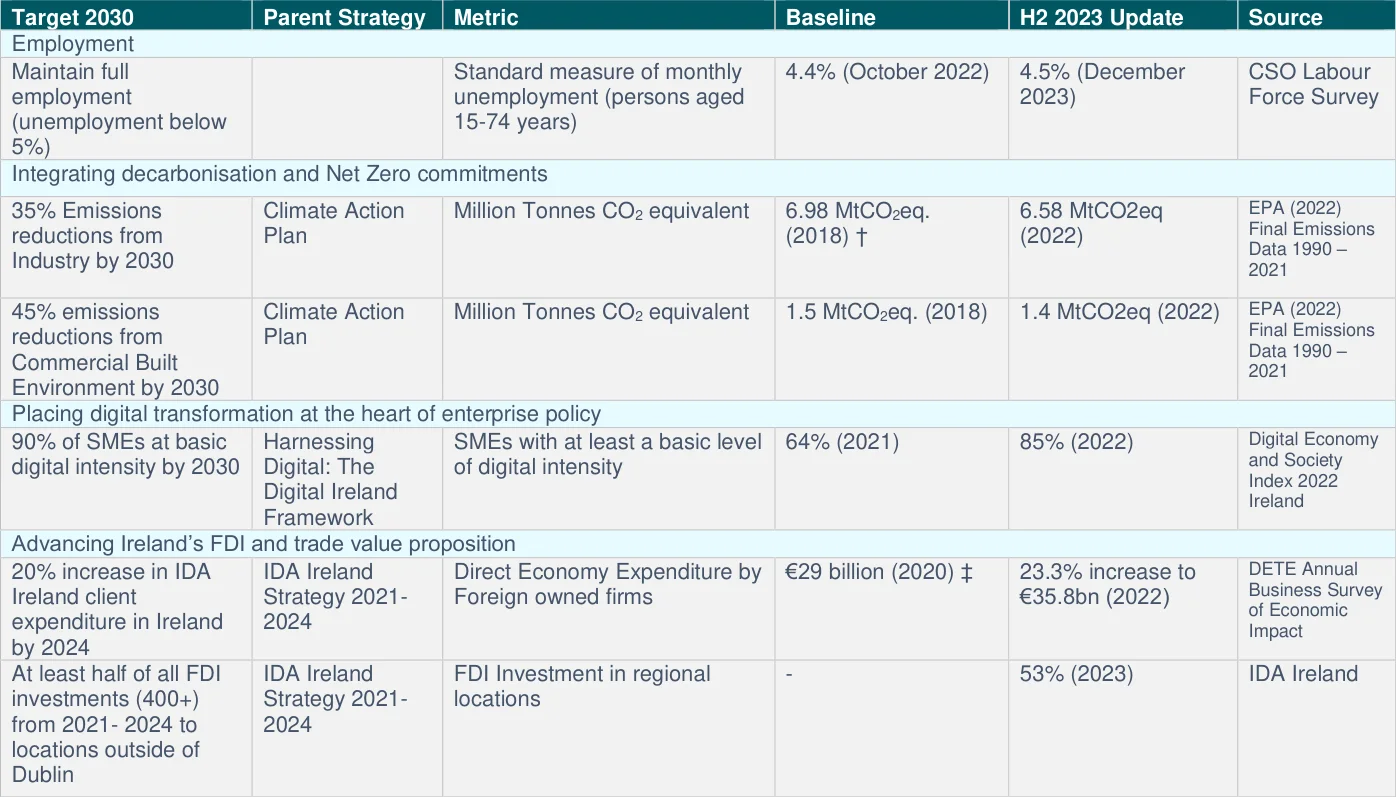
Figure from page 66
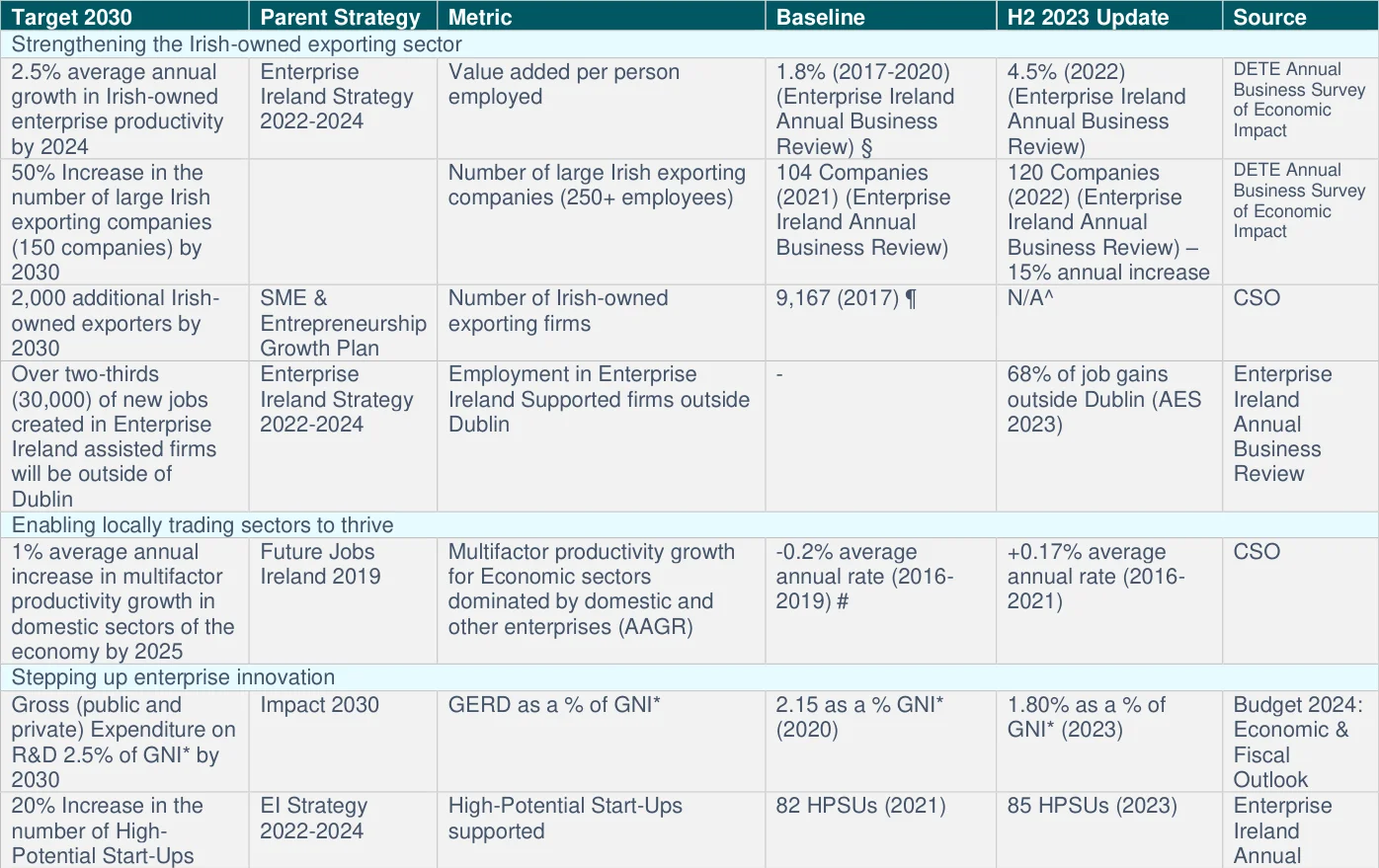
Figure from page 67
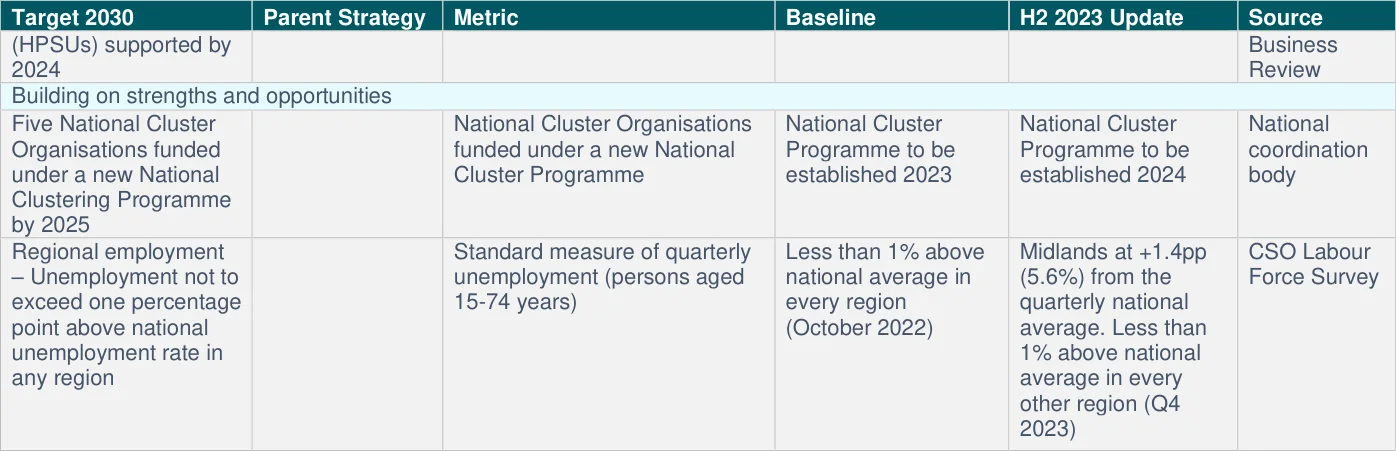
Figure from page 68
† Baseline 2018 figure of 7.014 MtCO2eq. has been restated to 6.98 MtCO2eq. due to revisions in the national energy statistics provided to the EPA by SEAI ‡ Baseline total IDA client expenditure for 2020 has been restated to €29 billion , up from the previously reported figure of €27.9 billion. § Baseline growth rate has been restated from 3.6% in the White Paper on Enterprise, to reflect Enterprise Ireland 2022-2024 Strategy, target to be reviewed in 2024/2025 ¶ Irish-owned Enterprise Agency Clients # Baseline annual productivity growth has been restated from -0.6% average annual rate (2016-2019) in the White Paper on Enterprise, to reflect revised estimates to annual productivity over the period by CSO ^ No latest figures available, under review by the CSO

Figure from page 69
Figure from page 70
Pages 62–70 · View in original PDF