2 Placing Digital at the Heart of Enterprise Policy
Ireland has set its ambition to be a digital leader, reflecting the key role that digital technology will continue to play in shaping competitiveness and driving productivity. The continued roll out of the Digital Transition Fund during 2023 supports companies, and especially SMEs, to advance in their digitalisation journeys, while 4 European Digital Innovation Hubs are operational in Ireland as of 2023, further supporting the digital transformation of SMEs. The EU’s Digital Economy and Society Index now shows at least basic digital intensity among SMEs at 85% in Ireland, well above the EU-wide average and on track to meet the White Paper’s target of 90% by 2030. Meanwhile, almost 1 in 10 enterprises in Ireland used AI in 2023. digital integration of enterprise will be further supported by the forthcoming launch of the Digital Portal, which is now in its final phase of development, as well as the ongoing implementation of the National AI Strategy and the recommendations of the Expert Group on Future Skills Needs, which both continued to progress during 2023. Support for the enhancement of digital manufacturing continues to increase strongly, with Digital Manufacturing Ireland and NIBRT just two of various technology centres and gateways which are facilitating Irish based manufacturers in accelerating their adoption of Digital Transformation and Sustainable Manufacturing Practices 2.1 Support the Digital Transformation of Enterprise
| Timeline | Ongoing roll out of Digital Transition Fund to 2026 | ||||
|---|---|---|---|---|---|
| Responsibility | Responsibility | Department of Enterprise, Trade and Employment (Lead); Enterprise | |||
| Ireland; IDA Ireland; Údarás na Gaeltachta | |||||
| Update | The Digital Transition Fund (DTF) continued to be rolled out during 2023, supporting enterprises in digitalising across products, processes, supply chains and business models. The DTF is administered by Enterprise Ireland, IDA Ireland and Údarás na Gaeltachta, through a range of schemes to boost uptake of digital technology. Since its launch in June 2022, the Digital Transition Fund has supported 233 companies across 278 digitalisation projects. This funding is in place to help companies at all stages of their digital journey, with particular emphasis on SMEs – from simply bringing businesses online, to the digitalisation of products and business processes, as well as facilitating exporting and using digital technologies to develop new markets and business models. |
2.2 Establish European Digital Innovation Hubs
| Timeline | Q4 2023: Ireland’s EDIH programme will be operational by end of 2023 | ||||
|---|---|---|---|---|---|
| Responsibility | Responsibility | Enterprise Ireland (lead); Department of Enterprise, Trade and | |||
| Employment | |||||
| Update | Ireland successfully established four new European Digital Innovation Hubs (EDIHs) as part of the European Commission’s Digital Europe Programme. These hubs were all fully operational by end of 2023, and will support digital transformation in SMEs and public sector organisations by encouraging the adoption of the latest advances in the three key technologies of Cybersecurity, Artificial Intelligence (AI) and High-Performance Computing. FactoryxChange led by the Irish Manufacturing Research in Mullingar commenced in Q1 2023, and is supporting manufacturers to integrate ecological, digital, and societal solutions into their core business models to become ‘Factories of the Future’. Data2Sustain led by Atlantic Technological University Sligo also commenced in Q1 2023, and is supporting digitalisation with a particular emphasis on the circular economy, operations and business sustainability across all sectors. ENTIRE, led by Tyndall National Institute Cork, started in Q2 2023, and supports companies to become more competitive in their business/production processes using digital technologies such as Internet of Things and sensors as well as introducing cybersecurity advances. The fourth EDIH, CeADAR AI, is led by the UCD Technology Centre CeADAR and commenced in Q3 2023. This Hub supports Artificial Intelligence (AI) transformations, data analytics and machine intelligence. |
2.3 Develop a Digital Portal for Enterprise
| Timeline | Q4 2023: Digital Portal is live | ||
|---|---|---|---|
| Q4 2024: Continuous development and refinement of portal | |||
| Responsibility | Department of Enterprise, Trade and Employment (Lead); Enterprise | ||
| Ireland; IDA Ireland; Údarás na Gaeltachta; Local Enterprise Offices | |||
| Update | The “Grow Digital” Portal will help businesses to self-assess their digital needs as well as signposting to training, resources, and funding options. Following the award of the tender in H1 2023 for the development of the Portal, the Department of Enterprise, Trade and Employment officials alongside Enterprise Ireland have engaged with the contractors on the design, functionality and operation of the Portal. The Portal is currently in the final stages of development and is scheduled to be delivered in H1 2024. | ||
| Following the Portal’s launch, a development and refinement phase will commence to ensure that the Portal remains up to date and that the process of digital transition is made as simple and understandable as possible for businesses. |
2.4 Drive Uptake of Artificial Intelligence (AI) Tools in Enterprise
| Timeline | Q4 2023: Publish a Standards and Assurance Roadmap for AI | ||||
|---|---|---|---|---|---|
| Ongoing to Q4 2024: Implement the recommendations of the Expert | |||||
| Group on Future Skills Need | |||||
| Ongoing: Monitoring of uptake of AI tools as part of the EU Digital | |||||
| Decade to 2030 | |||||
| Responsibility | Department of Enterprise, Trade and Employment | ||||
| Update | Update | The AI Standards and Assurance Roadmap was published by the National Standards Authority of Ireland (NSAI) in H2 2023. The Roadmap sets out a number of actions to support implementation of the Standards and Assurance aspects of the EU AI Act, ensuring that Ireland can safely unlock the potential that AI can provide. The Roadmap was developed by the Top Team on Standards for AI process, which is led by the NSAI and represents a collaborative effort based on input from various stakeholders and experts from across the Irish AI community, including industry, academia, civil society, the private and public sectors. |
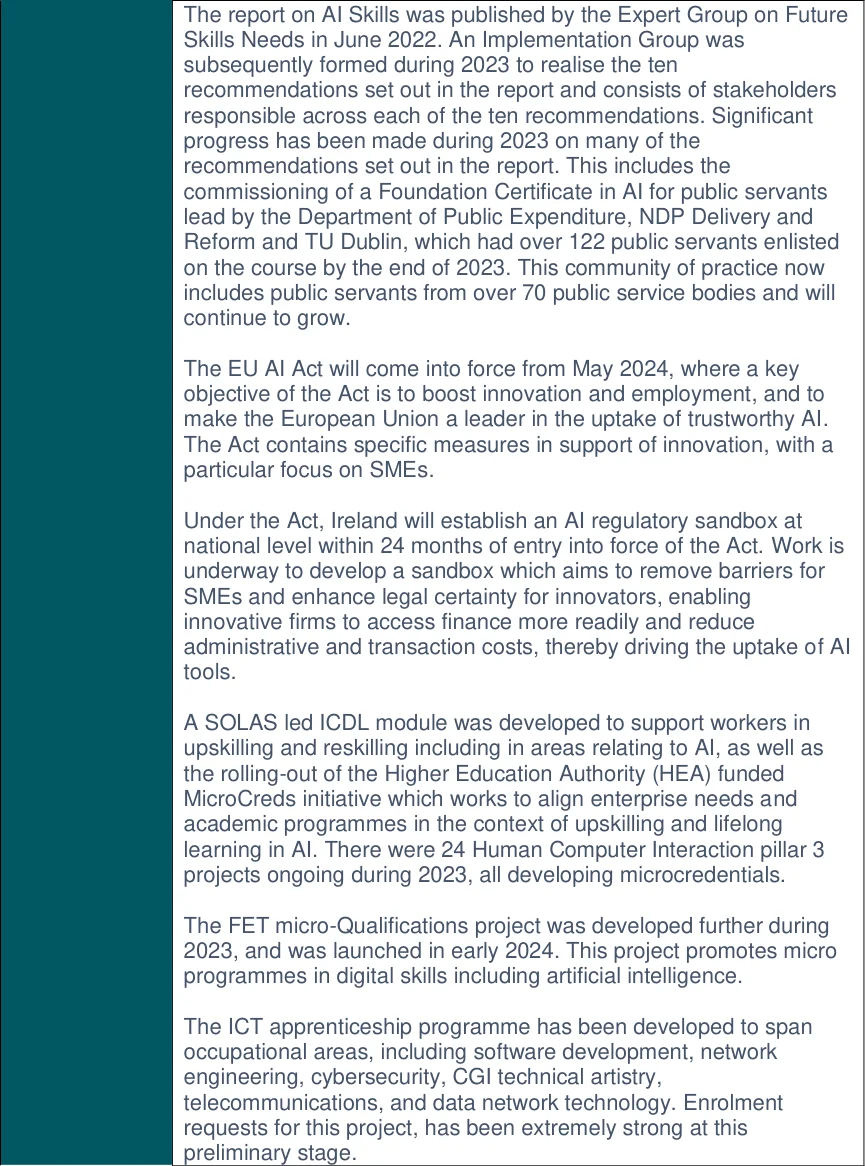
Figure from page 27
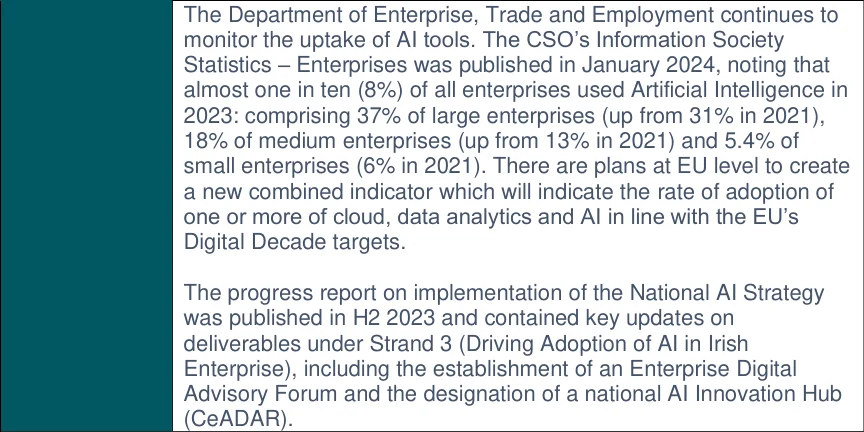
Figure from page 28
2.5 Drive Digital Manufacturing Objectives Through Support for Industry 4.0
| Timeline | Ongoing: Implementation of Industry 4.0 | ||||
|---|---|---|---|---|---|
| Responsibility | Department of Enterprise, Trade and Employment | ||||
| Update | Update | Digital transformation of the manufacturing sector remains a key priority for the Department of Enterprise, Trade, and Employment. Ensuring the resilience of this sector is essential to maintain employment and the productivity of this core component of our economy. While Industry 4.0 epitomises the drive towards the deployment of digital technologies underpinning step changes in productivity and efficiency, an expanded scope to include wider societal issues such as sustainability and the net zero agenda, human centric manufacturing perspectives, supply chain resilience and an emphasis on culture, skills and training, are the core focus of what is now termed Industry 5.0. To quantify progress in the context of both Industry 4.0 and 5.0, three core sets of activity have progressed during 2023. The first of these is ongoing work of the enterprise agencies to deploy a suite of support mechanisms designed to develop and sustain the manufacturing enterprise base. Key support tools such as digital assessment and benchmarking, skills and training assessment, and sustainability mechanisms have been developed and join a suite of measures designed to enhance innovation, productivity, and the sustainability of the manufacturing base. The second distinctive activity of the enterprise agencies to support the digital transformation agenda of manufacturing companies. This approach is strategic and takes into account the innovation profile of the company as well as training and talent, and sustainability and net zero targets. Support mechanisms administered by the enterprise agencies are tailored to companies depending on their specific needs and digital maturity levels. Collaborative innovation forms a third set of activity where companies are actively engaging with state supported infrastructure and programmes to develop their internal operations and commercial products and services. A growing cohort of manufacturing companies continue to engage with technology centres, technology gateways, and with National Institutes and centres of scale such as Tyndall, NIBRT and Digital Manufacturing Ireland. In addition to these core centres of activity, there are additional centres which have specialist capability with certain technology sets or in certain market sectors such as Artificial Intelligence, Software, Data Analytics, and with Dairy, Nutrition or Renewable Energy which serve the innovation agenda of companies. Furthermore, collaborative innovation programmes such as the Disruptive Technologies Innovation Fund and access to European Funding programmes are also servicing further development and innovation functions within manufacturing companies across the enterprise sector. |
| Timeline | Q3 2023: Commencement of further funding of technology | ||||
|---|---|---|---|---|---|
| gateways | |||||
| Ongoing: Further development of IMR Technology Centre | |||||
| Responsibility | Enterprise Ireland | ||||
| Update | Update | Since 2013, the number of Technology Gateways has increased from 12 to 17, covering all regions of the county and sector of the economy. These Gateways operate in a range of sectors and work with companies from start-ups and SMEs through to Multinationals, providing knowledge, experience, funding support and innovation solutions. The latest funding call closed in Q1 2023, and received 17 applications. All 17 applications received were evaluated and subsequently approved for funding by the Enterprise Ireland Board in Q2 of 2023. Contracts were issued to all 17 Gateways for review & signature in Q3 2023, where contract value across the Gateways totals €36.47 million. The Gateways have now completed over 7,300 industrial projects in collaboration with local industry, to a total value of more than €64 million, of which €34million was funded from industry. | |||
| The external evaluation of Irish Manufacturing Research Technology Centre was successfully completed in Q4 2023. This evaluation included an economic appraisal of the Centre’s impact, as well as an analysis of the Centre by an international expert panel which will further inform the development of the Centre in the future. Following the successful evaluation results, Irish Manufacturing Research has been requested to submit a business plan for their next phase, covering the period 2025 - 2029. This plan is expected to be completed for review towards the end of Q2 2024, and will focus on the future of manufacturing in Ireland to significantly expand its influence. |
| Timeline | Q4 2023: NIBRT–Completion of Advanced Therapeutics extension | ||||
|---|---|---|---|---|---|
| Q4 2023: DMI–Development of a pipeline of digitalisation projects | |||||
| for Ireland’s manufacturing sector | |||||
| Responsibility | IDA Ireland; Department of Enterprise, Trade and Employment | ||||
| Update | Update | NIBRT’s Advanced Therapeutics Extension was completed on time and on budget at the end of H1 2023. NIBRT is continuing to build its global brand. This will lead to a significantly expanded institute that will deepen its research capabilities and enable the continued growth of the Biologics sector in Ireland. Success will be demonstrated in Ireland’s ability to maintain current momentum in a highly competitive global market and secure further new Biologics job creation over the next 10 years with significant related capital investment. | |||
| Digital Manufacturing Ireland (DMI) is an Irish Government initiative, aligned with Government’s Industry 4.0 Strategy 2020-2025. It is supported by IDA Ireland, and facilitates Irish based manufacturers (MNCs and SMEs) in accelerating their adoption of Digital Transformation and Sustainable Manufacturing Practices including the necessary upskilling and business supports to facilitate such deployment. DMI works with Irish based and international clients, industry leaders, academia and other Research & Technology Centres. As of end H2 2023, Digital Manufacturing Ireland had approximately 50 client digitisation projects underway in relation to digital transformation needs. DMI, in its engagement with industry has established several cross-sectoral collaboration groups designed to take an industry-led approach to addressing manufacturing challenges and driving competitiveness. These groups, which consist of over 100+ company participants, include an Industry 5.0 Lighthouse Network, the Vision Cognitive Manufacturing Group, the Data Driven Manufacturing Group as well as the successful launch of the Human Centric Manufacturing Group in March 2024. As part of wider digitalisation efforts, IDA Ireland also utilises diagnostics tools (Advanced Manufacturing Diagnostic, Innovation Scorecard and Digitalisation Diagnostic for Services) to support its client base in Ireland to position themselves for future growth as technology adoption and digital transformation accelerate. A total of 282 diagnostics having been completed by IDA Ireland clients by the end of H2 2023. Feedback has been provided to client companies during this process, and areas for further development around innovation, sustainability, talent development and digitalisation have been identified for improvements moving forward. IDA Ireland will continue to work with clients to develop roadmaps to address these areas, such as digitalisation transformation plans, talent development strategies as well as sustainability assessments and resultant action plans. |
Pages 23–31 · View in original PDF