3.6 EU–UK Trade and Cooperation Agreement
3.6 EU–UK Trade and Cooperation Agreement
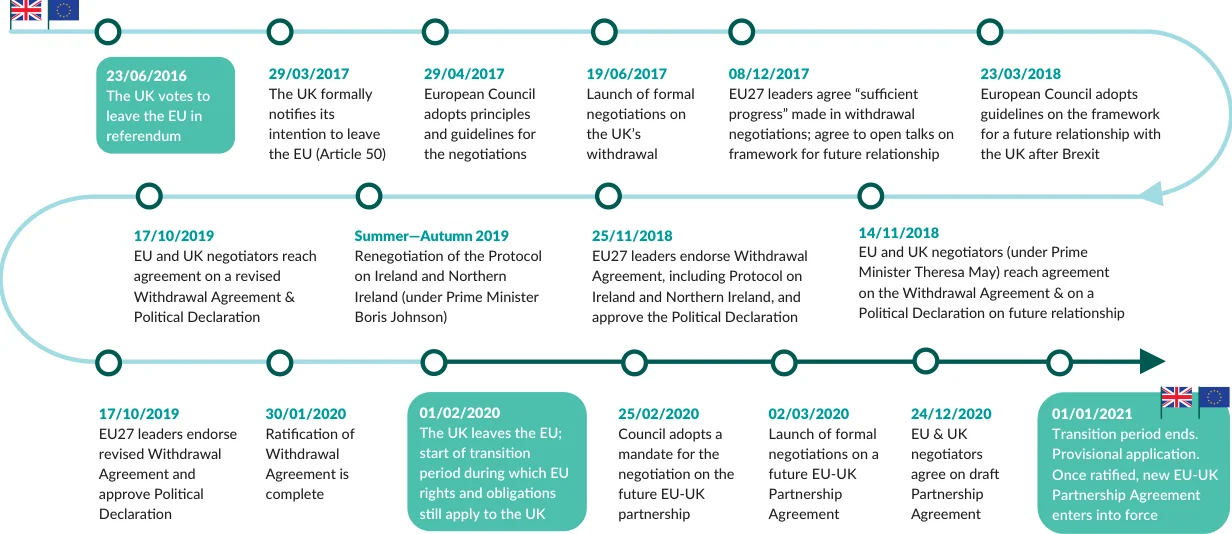
Figure from page 25
29/03/2017 The UK formally notifies its intention to leave the EU (Article 50)
29/04/2017 European Council adopts principles and guidelines for the negotiations
19/06/2017 Launch of formal negotiations on the UK’s withdrawal
23/03/2018 European Council adopts guidelines on the framework for a future relationship with the UK after Brexit
08/12/2017 EU27 leaders agree “sufficient progress” made in withdrawal negotiations; agree to open talks on framework for future relationship
23/06/2016 The UK votes to leave the EU in referendum
14/11/2018 EU and UK negotiators (under Prime Minister Theresa May) reach agreement on the Withdrawal Agreement & on a Political Declaration on future relationship
17/10/2019 EU and UK negotiators reach agreement on a revised Withdrawal Agreement & Political Declaration
Summer—Autumn 2019
25/11/2018 EU27 leaders endorse Withdrawal Agreement, including Protocol on Ireland and Northern Ireland, and approve the Political Declaration
Renegotiation of the Protocol on Ireland and Northern Ireland (under Prime Minister Boris Johnson)
01/02/2020 The UK leaves the EU; start of transition period during which EU rights and obligations still apply to the UK
17/10/2019 EU27 leaders endorse revised Withdrawal Agreement and approve Political Declaration
30/01/2020 Ratification of Withdrawal Agreement is complete
02/03/2020 Launch of formal negotiations on a future EU-UK Partnership Agreement
25/02/2020 Council adopts a mandate for the negotiation on the future EU-UK partnership
24/12/2020
01/01/2021 Transition period ends. Provisional application. Once ratified, new EU-UK Partnership Agreement enters into force
EU & UK negotiators agree on draft Partnership Agreement
Source: EU Commission 2020
The United Kingdom (UK) left the European Union (EU) on January 31st, 2020, marking the end of frictionless EU trade with the UK. The EU–UK Trade and Cooperation Agreement avoids the worst-case scenario of no deal – but is unique in being a trade agreement that reduces rather than enhances market access.
Why is this agreement different from other agreements covering trade?
Figure from page 26
• This is the only time the EU negotiated an agreement with a former member of the European Union. It deals with the management of divergence, rather than seeking convergence.
• The agreement covers a wide range of areas, from fisheries to justice and home affairs, that go far beyond usual Free Trade Agreements.
• The agreement is unprecedented given the geographic proximity of the UK and the degree of economic convergence and mutual interdependence.
It allows for tariff and quota free EU-UK trade in goods, subject to significant nontariff barriers e.g., customs formalities, rules of origin requirements and level playing field provisions. The agreement includes very limited provisions on trade in services, significantly reducing EU-UK market access.
| Consequences of UK exit from EU, Single Market and Customs Union | Key provisions under the EU-UK Trade and Cooperation Agreement (TCA) | |
|---|---|---|
| Goods | • Increased red tape for businesses trading between EU and UK. • Customs formalities & regulatory checks on UK goods when entering the EU, and vice versa. • No mutual recognition of standards across the two markets for highly regulated goods (known as conformity assessments) – producers must meet both EU & UK standards. | • Provisions to ensure a level playing field for open and fair competition. • Zero tariffs and quotas on goods trade (provided rules of origin are met). • Mutual recognition of trusted trader programmes (Authorised Economic Operators) to reduce some customs formalities. • Some sector specific steps to facilitate trade and regulatory cooperation (e.g. recognition of Good Manufacturing Practice inspections). |
| Services | • UK service suppliers lose automatic right to access EU Single Market (e.g. no ‘country of origin’ principle or ‘passporting’). • UK service providers required to comply with host-country rules of each EU country (which often vary). • No automatic recognition of professional qualifications. | • Non-discrimination obligations to ensure suppliers/investors from EU will be treated no less favourably than UK operators in the UK (and vice versa). Prevention of ‘unjustified’ barriers to digital trade, including prohibition of data localisation requirements (in line w/ GDPR). |
The Withdrawal Agreement and the Ireland/Northern Ireland protocol upholds measures to:
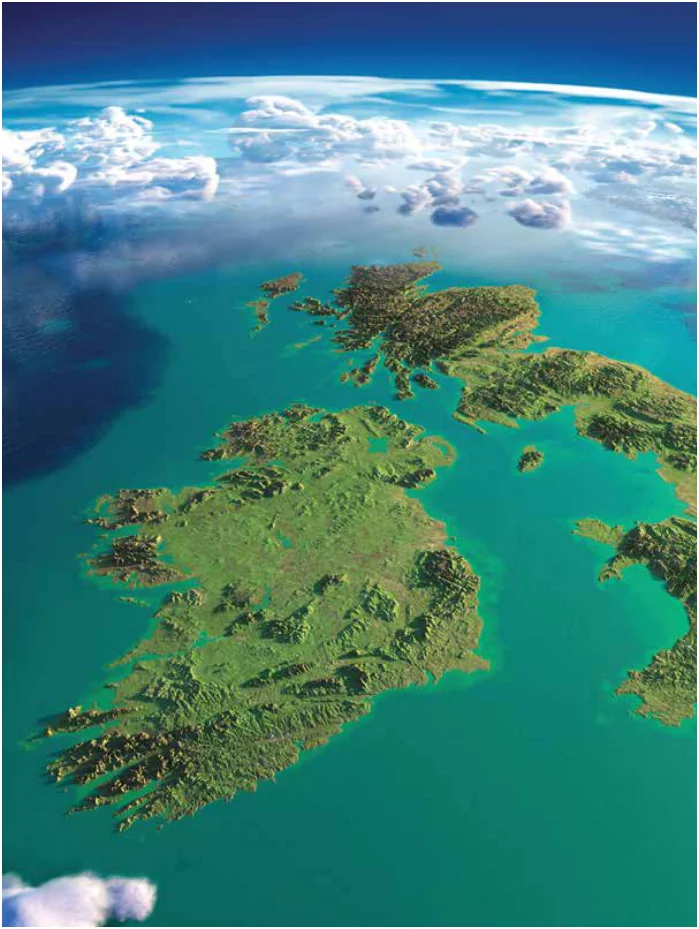
Figure from page 27
• Avoid a hard border between Ireland & Northern Ireland
• Protect the EU Single Market and Ireland’s place in it
• Recognise the Common Travel Area
• Continue North-South cooperation
• Maintain the Single Electricity Market
To avoid a hard border on the island, Northern Ireland is in the UK customs territory while also continuing to apply EU customs rules and certain EU legislation.
Companies in Northern Ireland maintain access to the EU Single Market for Goods – subject to the same level playing field terms that apply to companies in the EU. The movement of goods from Great Britain to Northern Ireland is subject to some checks and controls.
Northern Ireland is now outside of the EU Single Market for Services.
Extensive contingency planning by Ireland for new EU-UK trading relationship
While the US and EU are more significant trading partners, Ireland is however uniquely exposed to Brexit within the EU due to close economic and geographic ties with the UK. Numerous mitigating actions and extensive contingency planning since 2016 to reduce the impacts of Brexit on businesses. This work is continuing to ensure disruption is limited.
Budget 2021 takes expenditure on Brexit measures across successive Budgets to over €1 billion. Financial supports include the €300m Brexit Loan Scheme, the €800m Future Loan Scheme, the ‘Ready for Customs’ grant.
The €3.4 billion Recovery Fund announced in Budget 2021 in response to COVID-19 will also provide support for businesses impacted by Brexit.
Pages 25–27 · View in original PDF