9.2 Child protection
9.2 Child protection
There have been considerable advances in the Inspectorate’s monitoring of child protection practice and procedures in schools
Under the Child Protection Procedures for Primary and Post-primary Schools 2017, the Inspectorate is required to monitor and report on schools’ compliance with these procedures. The Inspectorate’s monitoring work in this regard is one of a range of quality assurance and oversight measures to ensure that schools and their staff are operating in compliance with the Children First Act 2015. The 2017 Procedures are also designed to provide guidance and direction to school personnel and school authorities in relation to meeting their obligations under the Children First Act 2015 and in the continued implementation of the best practice, non-statutory guidance set out in Children First: National Guidance for the Protection and Welfare of Children (2017).
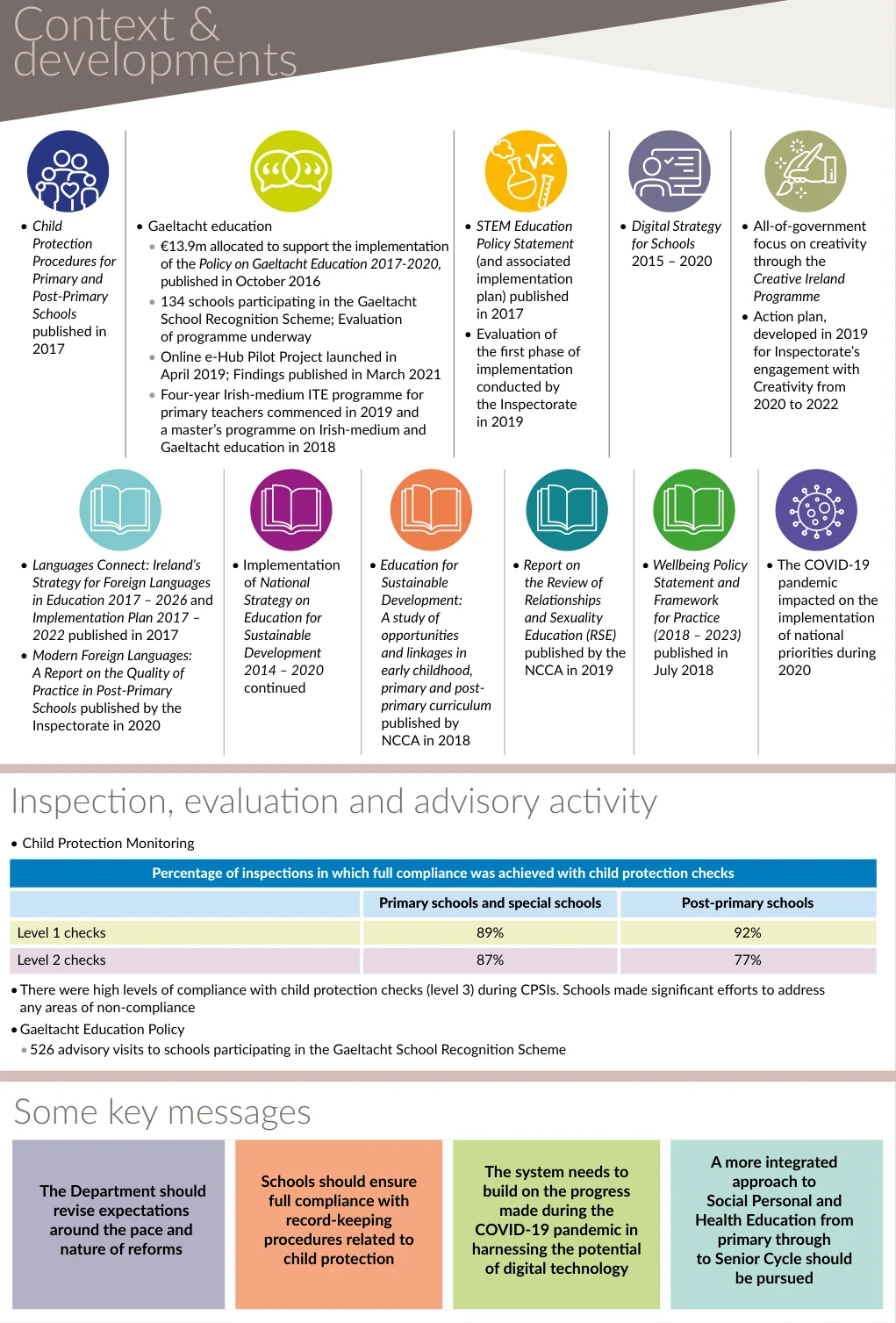
Figure from page 247
• STEM Education Policy Statement (and associated implementation plan) published in 2017 • Evaluation of the first phase of implementation conducted by the Inspectorate in 2019
• €13.9m allocated to support the implementation of the Policy on Gaeltacht Education 2017-2020, • 134 schools participating in the Gaeltacht School Recognition Scheme; Evaluation • Online e-Hub Pilot Project launched in April 2019; Findings published in March 2021 • Four-year Irish-medium ITE programme for primary teachers commenced in 2019 and a master’s programme on Irish-medium and
• Education for Sustainable Development: A study of opportunities and linkages in early childhood, primary and postprimary curriculum published by NCCA in 2018
• Report on the Review of Relationships and Sexuality Education (RSE) published by the NCCA in 2019
Inspection, evaluation and advisory activity
| Percentage of inspections in which full compliance was achieved with child protection checks | ||
|---|---|---|
| Primary schools and special schools | Post-primary schools | |
| Level 1 checks | 89% | 92% |
| Level 2 checks | 87% | 77% |
• There were high levels of compliance with child protection checks (level 3) during CPSIs. Schools made significant efforts to address
• 526 advisory visits to schools participating in the Gaeltacht School Recognition Scheme

Figure from page 247
As part of the Department’s oversight measures, the Inspectorate checks on compliance with the key aspects of the Child Protection Procedures for Primary and Post-Primary Schools 2017 during all school inspections. The level of checks on compliance depends on the inspection being conducted:
| Level 1 a e checks o f sc lev docu respons carried out i | ||||||||
|---|---|---|---|---|---|---|---|---|
| vel 1 a e ecks o f sc lev docu respons carried out i | ||||||||
| l 1 a e ks o f sc lev docu respons carried out i | ||||||||
| Level 2 a checks w ( D an eigh undert detail at as | ||||||||
| vel 2 a ecks w ( D an eigh undert detail at as | ||||||||
| l 2 a ks w ( D an eigh undert detail at as | ||||||||
| Level 3 checks are u inspec in Janua with the pro consultatoi n | ||||||||
| ecks are u inspec in Janua with the pro consultatoi n | ||||||||
| are u inspec in Janua with the pro consultatoi n |
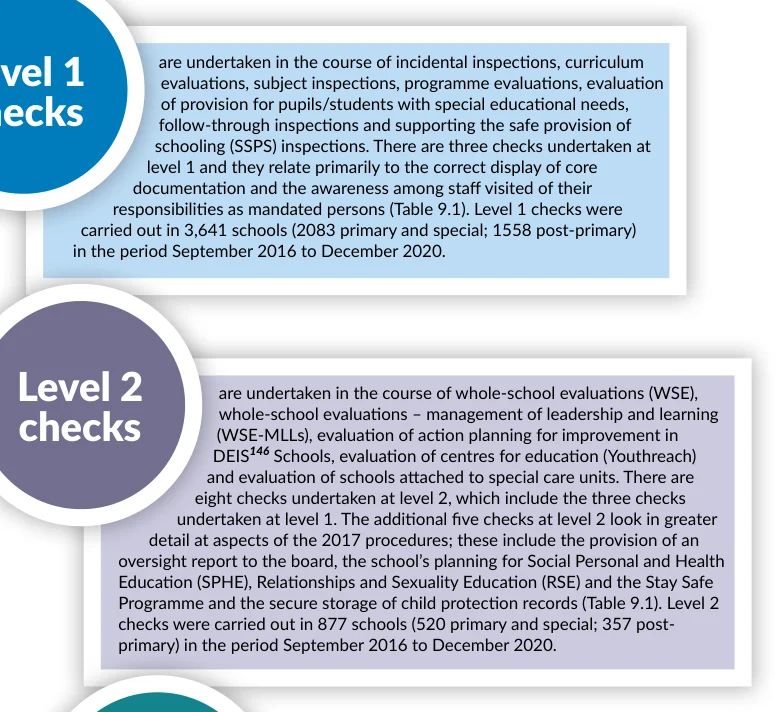
Figure from page 248
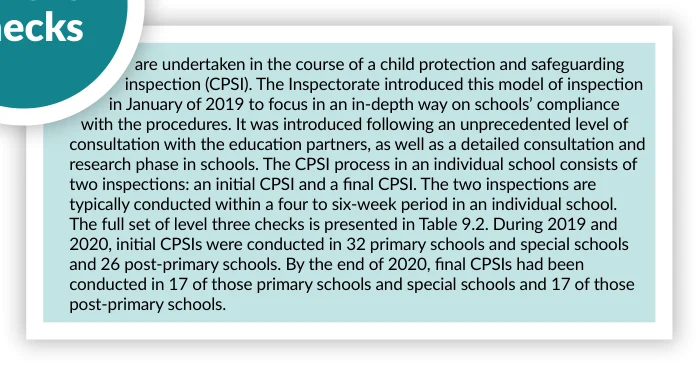
Figure from page 248
research phase in schools. The CPSI process in an individual school consists of two inspections: an initial CPSI and a final CPSI. The two inspections are typically conducted within a four to six-week period in an individual school. The full set of level three checks is presented in Table 9.2. During 2019 and 2020, initial CPSIs were conducted in 32 primary schools and special schools and 26 post-primary schools. By the end of 2020, final CPSIs had been conducted in 17 of those primary schools and special schools and 17 of those post-primary schools.
If a school is not compliant with any aspect of child protection procedures, the Inspectorate continues to engage with the school until the school becomes compliant. Should the inspection model result in a published report, the school’s compliance with the checks conducted during the inspection is always reported on in the published report.
146 Delivering Equality of Opportunity in Schools (DEIS) is the Department’s action plan for educational inclusion.
| Figure 9.1: Level 1 and level 2 child protection checks Check Level 1 Level 2 The name of the Designated Liaison Person (DLP) and the Child Safeguarding Statement are prominently displayed near the main entrance to the school. The Child Safeguarding Statement has been ratified by the board and includes an annual review and a risk assessment. All teachers visited reported that they have read the Child Safeguarding Statement and that they are aware of their responsibilities as mandated persons. The Child Safeguarding Statement meets the requirements of the Child Protection Procedures for Primary and Post-Primary Schools 2017. The records of the last three board of management meetings record a child protection oversight report that meet the requirements of the Child Protection Procedures for Primary and Post-Primary schools 2017. The board of management has ensured that arrangements are in place to provide information to all school personnel on the Child Protection Procedures for Primary and Post-Primary Schools, 2017. School planning documentation indicates that the school is making full provision for the relevant aspects of the curriculum (SPHE, Stay Safe, RSE, and Wellbeing). Child protection records are maintained in a secure location. Source: Inspectorate, Department of Education | ||
| 249 |
| Check | Level 1 | Level 2 |
|---|---|---|
| The name of the Designated Liaison Person (DLP) and the Child Safeguarding Statement are prominently displayed near the main entrance to the school. | ||
| The Child Safeguarding Statement has been ratified by the board and includes an annual review and a risk assessment. | ||
| All teachers visited reported that they have read the Child Safeguarding Statement and that they are aware of their responsibilities as mandated persons. | ||
| The Child Safeguarding Statement meets the requirements of the Child Protection Procedures for Primary and Post-Primary Schools 2017. | ||
| The records of the last three board of management meetings record a child protection oversight report that meet the requirements of the Child Protection Procedures for Primary and Post-Primary schools 2017. | ||
| The board of management has ensured that arrangements are in place to provide information to all school personnel on the Child Protection Procedures for Primary and Post-Primary Schools, 2017. | ||
| School planning documentation indicates that the school is making full provision for the relevant aspects of the curriculum (SPHE, Stay Safe, RSE, and Wellbeing). | ||
| Child protection records are maintained in a secure location. |
Figure 9.2: Level 3 child protection checks
| Check | |
|---|---|
| Check 1 | The school has communicated the required aspects of the Child Protection Procedures for Primary and Post-Primary Schools 2017 to relevant stakeholders. |
| Check 2 | A Designated Liaison Person (DLP) and a deputy DLP have been appointed in line with the requirements of the Child Protection Procedures for Primary and Post-Primary Schools 2017. |
| Check 3 | The board of management reports that it is aware of and discharges its responsibilities to provide information to all school personnel relevant to child protection and to ensure that available training is undertaken by all or some members of staf fas required. |
| Check 4 | The board of management reports that it is aware of its responsibilities in relation to vetting of all school personnel and report that they discharge these responsibilities. |
| Check 5 | A child safeguarding statement and risk assessment have been prepared in line with the template and requirements of the Child Protection Procedures for Primary and Post- Primary Schools 2017. |
| Check 6 | The minutes of the board meetings that were checked contained a record of a child protection oversight report being provided in line with the requirements of the Child Protection Procedures for Primary and Post-Primary Schools 2017. |
| Check 7 | Correct record keeping procedures were found in the child protection cases examined. |
| Check 8 | The procedures to report child protection concerns were implemented in the records examined. |
| Check 9 | The procedures to report allegations or suspicions of abuse against school personnel were implemented in the records examined. |
| Check 10 | The quality of planning for and implementation of the SPHE curriculum* and the Stay Safe programme in primary schools and of the SPHE curriculum and the RSE programme in post-primary schools, as evident during the inspection. |
Source: Inspectorate, Department of Education * RSE is a key component of the SPHE curriculum in primary schools
Overall compliance with level 1 and level 2 child protection checks was high; issues of non-compliance were addressed through follow-up engagements with the schools involved
In order to be fully compliant, a school must be compliant with all of the checks carried out during an inspection. As can be seen from Table 9.3, while there was a high level of compliance with level 1 and level 2 checks, it is notable that almost a quarter (24%) of post-primary schools were found to be noncompliant with at least one of the level 2 checks. All issues of non-compliance were addressed through follow-up engagements with the schools involved.
Table 9.1: Compliance with level 1 and level 2 child protection checks: September 2016 to December 2020
| Level 1 | Level 2 | |||
|---|---|---|---|---|
| Fully compliant | Not fully compliant | Fully compliant | Not fully compliant | |
| Primary and special schools | 89.3% | 10.7% | 87.3% | 12.7% |
| Post-primary schools | 92.1% | 7.9% | 76.5% | 23.5% |
Source: Inspectorate, Department of Education
In general, there were high levels of compliance evident during child protection and safeguarding inspections, and schools made substantial efforts to address any issues of non-compliance
As part of the CPSI model, two separate inspections are undertaken in the school by a team of two inspectors. During each inspection, they carry out the ten checks outlined in the published guide. For checks one to nine, inspectors use the following scale to describe the school’s level of compliance: fully compliant, substantially compliant, partially compliant or not compliant. As can be seen from Table 9.4, there were high levels of compliance with most of the checks during the 58 initial CPSIs conducted during 2019 and 2020.
Figure from page 251
Table 9.2: Findings from checks 1 – 9 conducted during initial CPSIs in 2019 and 20201
| Fully compliant | Substantially compliant | Partially compliant | Not compliant | |
|---|---|---|---|---|
| Check 1 | 74.1% | 22.4% | 3.4% | 0.0% |
| Check 2 | 98.3% | 1.7% | 0.0% | 0.0% |
| Check 3 | 65.5% | 27.6% | 5.2% | 1.7% |
| Check 4 | 94.8% | 1.7% | 3.4% | 0.0% |
| Check 5 | 79.3% | 20.7% | 0.0% | 0.0% |
| Check 6 | 36.2% | 34.4% | 19.0% | 10.3% |
| Check 7 | 19.2% | 46.2% | 34.6% | 0.0% |
| Check 8 | 33.3% | 33.3% | 29.4% | 3.9% |
| Check 9 | 54.5% | 9.1% | 36.4% | 0.0% |
Source: Inspectorate, Department of Education
Table 9.3: Findings from check 10 conducted during initial CPSIs in 2019 and 2020147
| Very good | Good | Satisfactory | Fair | Weak | |
|---|---|---|---|---|---|
| Check 10 | 36.2% | 37.9% | 15.5% | 10.3% | 0.0% |
Source: Inspectorate, Department of Education
While not all of the schools inspected had had their final CPSI by the end of 2020, the findings from the final CPSIs conducted indicated that schools had made significant efforts to address the areas of noncompliance that had been identified in the initial CPSI. In almost all cases, full compliance was achieved (Table 9.6). In cases where a school was less than fully compliant with a particular child protection requirement following their final CPSI, the Inspectorate continued to engage with the school until the issue of non-compliance had been addressed.
147 Percentage figures are based on instances where the check was applicable.
Table 9.4: Findings from checks 1 – 9 conducted during final CPSIs in 2019 and 2020
| Fully compliant | Substantially compliant | Partially compliant | Not compliant | |
|---|---|---|---|---|
| Check 1 | 100.0% | 0.0% | 0.0% | 0.0% |
| Check 2 | 100.0% | 0.0% | 0.0% | 0.0% |
| Check 3 | 97.1% | 2.9% | 0.0% | 0.0% |
| Check 4 | 100.0% | 0.0% | 0.0% | 0.0% |
| Check 5 | 91.2% | 8.8% | 0.0% | 0.0% |
| Check 6 | 97.1% | 2.9% | 0.0% | 0.0% |
| Check 7 | 100.0% | 0.0% | 0.0% | 0.0% |
| Check 8 | 93.3% | 6.7% | 0.0% | 0.0% |
| Check 9 | 85.7% | 14.3% | 0.0% | 0.0% |
Source: Inspectorate, Department of Education
Table 9.5: Findings from check 10 conducted during final CPSIs in 2019 and 2020
| Very good | Good | Satisfactory | Fair | Weak | |
|---|---|---|---|---|---|
| Check 10 | 52.9% | 35.3% | 11.8% | 0.0% | 0.0% |
Source: Inspectorate, Department of Education

Figure from page 253
Findings from child protection safeguarding inspections indicate that parents were positive in relation to school climate and atmosphere, and well informed in relation to child safety; there was some scope to improve parents’ knowledge about their child’s learning in relationships and sexuality education
During an initial CPSI, parents are invited to complete an online survey.
The parent survey focuses on four main areas:
■school atmosphere and climate
■the provision of the school’s child safeguarding statement and anti-bullying policies to parents
■parents’ knowledge of the school’s procedures should they have a concern about their child or
another child in the school
■parents’ awareness of their child’s learning in SPHE including RSE and the Stay Safe Programme
(primary only).
Overall findings were generally positive about the provision of information to parents, and in relation to school climate and atmosphere. For example, over 90% of parents reported that they had been informed of the school’s anti-bullying policy and that they knew who to approach if their child experienced bullying. Also, more than 95% of parents reported that they felt welcome in the school and that their child was safe and well looked after in the school. However, survey responses point to some concerns in relation to parents’ awareness that their child was learning about RSE or SPHE or completing the Stay Safe Programme in school. For example, 29% of parents who responded either did not know if their child learned about RSE or said that they did not learn about RSE. At primary level, 19% of parents reported similar sentiments in relation to the Stay Safe Programme.
There were high levels of compliance by boards of management in relation to reporting on child protection; more work is required in relation to record keeping
One of the checks completed during a CPSI is:
‘ The board of management reports that it is aware of and discharges its responsibilities
to provide information to all school personnel relevant to child protection and that available training is undertaken by all or some members of staff as required.’
In 66% of initial CPSIs, the school was found to be fully compliant with this check. The figure for final CPSIs conducted during the period was 97%.
Another check, completed as part of a CPSI, is:
‘ Correct record keeping procedures were found in the records examined.’
For this check, of the schools that had child protection records, full compliance was found in just 19% of cases during initial CPSIs. In the remainder of cases where schools had child protection records, the schools were either substantially compliant or partially compliant. In 10% of schools, the check did not apply because no child protection records had been created. Reassuringly, full compliance with this check was achieved in all final CPSIs conducted during the period.
Pages 246–254 · View in original PDF