9.11 Approach to national strategy development
9.11 Approach to national strategy development and implementation
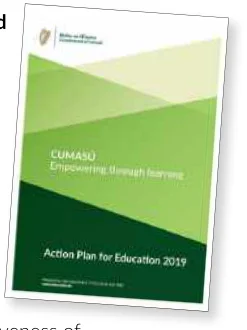
Figure from page 281
Consideration needs to be given to the range of national priority areas and the expected pace of their implementation
During the period to which this report refers, a considerable number of national initiatives were introduced within the school system and, at times, within schools. Many of these included a provision that the Inspectorate evaluate their implementation. Supporting and monitoring the implementation of these strategies places additional responsibilities on the various support services that work with schools, and can also lead to teachers feeling significant pressure to implement new projects, while also delivering on the curriculum objectives and assessment requirements of their subjects. It is to be welcomed that the Action Plan for Education 2019 reduced the number of initiatives, and noted the importance of considering the most appropriate time for change.
CUMASÚ Empowering through learning
Action Plan for Education 2019
Prepared by the Department of Education and Skills www.education.ie
The COVID-19 pandemic placed a whole new range of demands on schools. The responsiveness of schools in providing remote teaching and learning, and their engagement in the associated CPD provided by the support services are praiseworthy. Because of the pandemic, some national priorities, including digital learning, have been advanced while others have been delayed. The scope and ambition of some of the strategies may now need to be adjusted, and additional accommodation made for priorities which have ongoing importance in light of the pandemic. An example of such a priority is the use of digital technology in schools, both as a support for teaching and learning, and also for online assessment.
The Chief Inspector’s Report 2013-2016 cautioned that the provision of CPD opportunities had been weighted heavily toward the provision of national CPD programmes to support curriculum change, while schools and teachers varied in their CPD needs. It advised that the investment made in CPD should address the needs of individual teachers and schools more specifically. Some notable progress has been made in this respect during the period of this Chief Inspector’s report, including the provision by the PDST of a significant level of bespoke support to individual schools, large numbers of teachers accessing CPD outside of school time through the education centres, and the growth of online CPD provision as facilitated by some education centres during the pandemic. Nonetheless, there remains a degree of pressure on schools to accommodate national priorities while also addressing their specific CPD needs. The establishment of the Primary Education Forum, at which stakeholders and the Department can plan
the pace at which strategies and initiatives are implemented more effectively, has been a welcome development. Similar structures at post-primary level would also be beneficial; the success of the Advisory Group on State Examinations, which operated in 2020 and 2021, provides a blueprint for how this could be achieved.
It is acknowledged and accepted that, in times of significant reform, there is a need to sequence change more effectively. In line with this, and to allow reforms to become embedded, the Department should revisit the strategies and consider whether they are independent of one another or part of a cohesive whole. There is a need for properly integrated initiatives and CPD in wide-ranging, long-term change such as Senior Cycle and primary curriculum. To facilitate this, the Department should reconsider the number and range of national priority areas, and its current expectations about the pace of these reforms.
It is important to build on the progress made to date in ensuring that connected and coherent learning experiences are provided at all stages of education from early learning and care to post-primary
A number of national strategies were published, or their implementation was progressed, during the September 2016 to December 2020 period. These strategies provide for the development of provision at all stages of education from the early learning and care sector to the post-primary sector. These include Department strategies such as the National Strategy on Education for Sustainable Development in Ireland 2014-2020, the National Strategy to improve Literacy and Numeracy 2011-2020, the Wellbeing Policy Statement and Framework for Practice 2018 - 2023 and the Policy on Gaeltacht Education, 2017-2022. They also include whole-of-Government policy strategies and frameworks such as the National Strategy on Children and Young People’s Participation in Decision-Making 2015-2020, Better Outcomes Brighter Futures 2014-2020: The National Policy Framework for Children and Young People 2014-2020 and First 5: the Whole-of-Government Strategy for Babies, Young Children and their Families. Cross-sectoral thematic inspections carried out by the Inspectorate in the September 2016-December 2020 period have also assisted with the promotion of continuity of provision in relation to curriculum and pedagogy in areas such as STEM, digital learning and language learning.
The cross-sectoral focus in these strategies is helping to support the provision of connected, coherent learning experiences for children and young people at all stages of education, particularly in relation to the development of the core skills, knowledge and learning dispositions necessary to support learner achievement in areas such as STEM, Creativity, Wellbeing and sustainable development. Their implementation will also help to ensure that all adults involved in the provision of education in the early learning and care, primary and post-primary sectors are striving towards the common goal of improved learner outcomes and experiences in these important areas. This will involve collaboration and communication and the promotion of positive transitions between the relevant settings and engagement in partnerships with families and communities. It is important that this promotion of cross-sectoral continuity and development continues, and is built upon, as existing policies and strategies are implemented and revised, and as new policies and strategies are developed.

Figure from page 282
Pages 281–282 · View in original PDF