6.3.6 The School Excellence Fund
6.3.6 The School Excellence Fund
The School Excellence Fund encourages the use of innovative approaches to tackling educational disadvantage
The School Excellence Fund (SEF) was established in 2017 to enable early learning and care (ELC) settings, schools and other education settings to participate in innovative programmes that take account of the particular context of each school or setting, and are aimed at improving learning outcomes for children and young people. Projects associated with the SEF established during the period to which this report refers include:
■SEF-DEIS
■SEF-Digital
■SEF-STEM
■SEF-Creative Clusters
■SEF-Step Up
The programme was designed to ensure that innovative approaches and proposals to tackle educational disadvantage were supported and recognised. Schools in the SEF-DEIS were challenged to promote innovation by adopting new evidence-based approaches to tackling underperformance in a range of areas such as literacy, STEM or the Arts.
113 Inspectorate (2020) Evaluation of the Support Teacher Project. Available at: https://www.gov.ie/en/publication/5b4f1- evaluation-of-the-support-teacher-project/
During the period to which this report refers, thirty cross-sectoral clusters, comprising sixty primary schools, twenty-four post-primary schools, and fifteen early years settings, participated in the initiative.
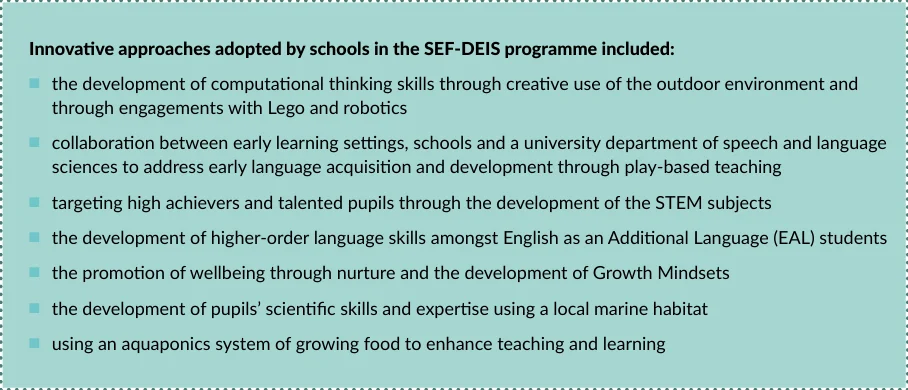
Figure from page 192
Innovative approaches adopted by schools in the SEF-DEIS programme included:
■the development of computational thinking skills through creative use of the outdoor environment and
through engagements with Lego and robotics
■collaboration between early learning settings, schools and a university department of speech and language
sciences to address early language acquisition and development through play-based teaching
■targeting high achievers and talented pupils through the development of the STEM subjects
■the development of higher-order language skills amongst English as an Additional Language (EAL) students
■the promotion of wellbeing through nurture and the development of Growth Mindsets
■the development of pupils’ scientific skills and expertise using a local marine habitat
■using an aquaponics system of growing food to enhance teaching and learning
An initial evaluation of a cross-section of clusters in the initiative by the Education and Training Inspectorate (ETI) in Northern Ireland in 2019 found key gains arose from the initiative in the area of leadership and learning. These included the development of effective communication, coordination and collaboration between cluster schools to the benefit of both teachers and learners, and wider involvement of external partners and engagement with parents. The findings also indicated that the link inspectors played a significant role in giving momentum to and/or providing challenge to the clusters as appropriate.
The findings indicated that there was a wide range of gains for learners including improved behaviour, enhanced personal capabilities, increased enjoyment, development of their thinking skills, and noteworthy improvements in learning outcomes and in learning experiences. Benefits to teachers included professional development in their subject knowledge and pedagogic approaches. The findings also indicated that developing approaches to assessment, tailored to the specific purposes of each cluster, had the potential to inform self-evaluation leading to further improvement.
There are plans in place for schools in the SEF-DEIS clusters to conduct a rigorous system of internal self-evaluation of the initiatives. This will be complemented by ongoing external evaluation by inspectors from the ETI in Northern Ireland with a view to ensuring that the learning from the initiative informs policy and practice at local and national level.
Pages 191–192 · View in original PDF