5.2.2 Teaching and learning
5.2.2 Teaching and learning
The quality of teaching and learning was good or very good in most post-primary schools
Over the period September 2016 to December 2020, inspectors found the overall quality of teaching in post-primary schools to be good or very good in 92% of inspections (Table 5.1). It was found to be satisfactory in 7% of inspections and less than satisfactory in fewer than 1% of inspections. Similarly, the overall quality of learning was of a high standard; it was found to be good or very good in 90% of inspections, satisfactory in 9.3% of inspections and less than satisfactory in just over 1% of inspections.
Table 5.1: Quality of teaching and learning in post-primary schools: September 2016 - December 2020
| Overall quality of teaching (%) | Overall quality of learning (%) | |
|---|---|---|
| During incidental inspections, subject inspections and WSE- MLL inspections | ||
| Very good | 33.6% | 31.6% |
| Good | 58.8% | 58.0% |
| Satisfactory | 7.0% | 9.3% |
| Fair | 0.6% | 1.1% |
| Weak | 0.0% | 0.0% |
Source: Inspectorate, Department of Education
Teaching approaches were good or very good in a majority of lessons
Effective teachers use a broad range of methodologies that are appropriate to the learning intention and to the varying needs and abilities of students. This stimulates substantial student response, facilitates deep engagement with students and encourages productive student participation. Ultimately, teaching in this way gives a better balance between the input of the teacher and that of students.
Teaching approaches were found to be good or very good in 74% of the lessons observed during unannounced inspections and in 76% of lessons observed during announced inspections (Table 5.2). They were found to be satisfactory in 20% of lessons observed during unannounced inspections and in 19% of lessons observed during announced inspections. Teaching approaches were found to be less than satisfactory in 5.5% of lessons during announced inspections and 5.9% of lessons observed during unannounced inspections. In their responses to inspection surveys administered during whole-school evaluations - management, leadership and learning (WSE-MLLs), 83% of parents agreed that teaching was good in their child’s school, while just 69% of students concurred with this. This finding highlights the importance of seeking regular feedback from students on the quality of their learning experiences. Such feedback would support schools in adapting their provision to further meet the diverse needs and learning styles of their students.
Table 5.2: Quality of teaching approaches in post-primary schools: September 2016 - December 2020
| Teaching approaches | Unannounced inspections | Announced inspections |
|---|---|---|
| Very good | 38.3% | 37.9% |
| Good | 36.0% | 38.0% |
| Satisfactory | 19.8% | 18.6% |
| Fair | 5.2% | 4.8% |
| Weak | 0.7% | 0.7% |
Source: Inspectorate, Department of Education
There is a need for greater emphasis on classroom discussion and on collaborative learning in postprimary schools
Inspectors found that teachers need to place a more consistent emphasis on classroom discussion and collaborative learning. While inspectors noted that teachers were using more group work at Junior Cycle, their findings showed that more progress is needed to make sure that students have good opportunities to collaborate in lessons.
During unannounced inspections, opportunities for talk and discussion were good or very good in just 71% of lessons (Table 5.3). There was scope to provide greater opportunities for students to learn through talk and discussion in over a quarter (29%) of lessons.
Table 5.3: Provision of opportunities for students to learn through talk and discussion (unannounced inspections) in post-primary schools: September 2016 - December 2020
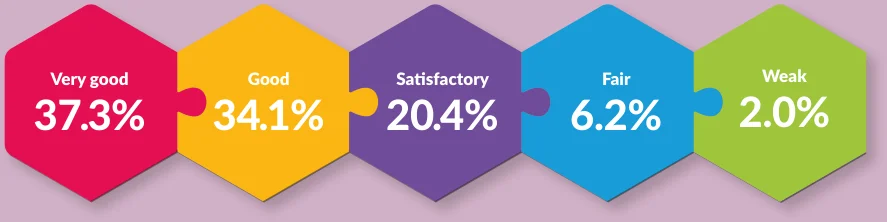
Table 5.3: Provision of opportunities for students to learn through talk and discussion
Weak 2.0%
Very good 37.3%
Good 34.1%
Satisfactory 20.4%
Fair 6.2%
Source: Inspectorate, Department of Education
Findings from unannounced inspections indicate that in 64% of lessons, opportunities for students to learn in collaboration with their peers were good or very good. While satisfactory provision was made in 24% of lessons, in the remaining 12% of lessons, students’ opportunities for collaboration with their peers in their learning were less than satisfactory. In responses to inspection surveys administered during wholeschool evaluations, 81% of students agreed or strongly agreed that they got opportunities to work together with other students in their classes. However, 10% either disagreed or strongly disagreed that this was the case, and 9% reported that they did not know.
Following the re-opening of schools in September 2020, a significant minority (43%) of post-primary teachers who participated in an Inspectorate survey in November 2020, indicated that they were not able to continue to provide opportunities for their students to work collaboratively during lessons. Similarly, students who participated in focus group discussions with the Inspectorate, also in November 2020, reported that they were being provided with fewer collaborative and practical learning opportunities and that this had impacted negatively on their learning experiences.
These combined findings indicate that there is considerable scope to extend the provision for collaboration in classes with the easing of social distancing measures associated with COVID-19.
Table 5.4: Enabling students to work collaboratively (unannounced inspections) in post-primary schools: September 2016 - December 2020
Table 5.5: Opportunities for students in post-primary schools to work together with other students in their classes: September 2016 - December 2020
Students are enabled to work collaboratively (unannounced inspections)
I get opportunities to work together with other students in my classes (Student surveys: whole-school evaluations)
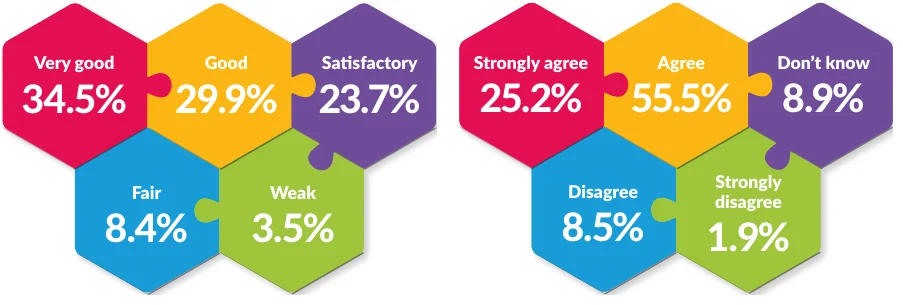
Figure from page 137
Strongly agree
Agree 55.5%
Don’t know
Very good 34.5%
Good 29.9%
Satisfactory 23.7%
25.2%
8.9%
Strongly disagree 1.9%
Disagree 8.5%
Fair 8.4%
Weak 3.5%
Source: Inspectorate, Department of Education Source: Inspectorate, Department of Education
Catering for the varying abilities of students continues to require attention and improvement
One of the key skills of teaching is to recognise the different learning needs and the learning styles of students and then to respond to those needs and styles in the most appropriate way. Effective teachers take a differentiated approach in their teaching by adjusting their teaching approaches, or the pace or content of the lesson, to suit the differing needs of students.
During the period September 2016 to December 2020, inspectors found that improvements were needed in the extent to which teachers catered effectively for the needs of different students. Differentiation was good or very good in 64% of the lessons observed across post-primary unannounced inspections (Table 5.6). Opportunities for the further development of differentiated approaches existed in the remaining 36% of lessons, with practice judged by inspectors as being satisfactory in 27% of lessons and less than satisfactory in 9.7% of lessons. In announced inspections, in-class support for learning needs, where the subject teacher with the support of the special education teacher provides for the needs of students with special educational needs in the mainstream class setting, was found to be good or very good in 73% of cases. Inspectors found practice to be satisfactory in 20% of lessons and less than satisfactory in 6.5% of lessons. In addition to catering for the needs of students who experience challenges in aspects of their learning, inspection findings indicate that teachers also need to be mindful that students who are more able in aspects of the curriculum should be challenged suitably. These findings are reflected in those of the international assessment, Programme for International Student assessment (PISA) 2018, which found that there was just an average proportion of high-achievers in Science and a significantly lower proportion of high-performing students in Mathematics in Ireland, compared to the average across Organisation for Economic Co-operation and Development (OECD) countries. Teachers also need to make provision for exceptionally able students, some of whom may require different approaches to their learning on a daily basis in the mainstream classroom. Schools and teachers should use the continuum of support, a graduated solution-orientated framework of assessment and intervention in schools80, to identify the needs of these students, and to plan for short and long term interventions where appropriate.
Table 5.6: Quality of differentiation and in-class support for learning needs in post-primary schools: September 2016 - December 2020
| Difef rentiation is evident (unannounced inspections) | In-class support for learning needs (announced inspectoi ns) | |
|---|---|---|
| Very good | 27.8% | 37.3% |
| Good | 35.8% | 36.0% |
| Satisfactory | 26.7% | 20.2% |
| Fair | 7.6% | 5.5% |
| Weak | 2.1% | 1.0% |
Source: Inspectorate, Department of Education
80 Department of Education (2007) Special Educational Needs a Continuum of Support. Available at: https://www.gov.ie/en/ collection/dca316-special-education-needs-a-continuum-of-support/
High levels of enjoyment and motivation were evident in lessons
Good or very good levels of student enjoyment and motivation were evident to inspectors in 80% of the lessons observed during announced inspections in post-primary schools. However, in their responses to inspection surveys administered during WSE-MLLs students, themselves, were somewhat less positive; just 64% of students agreed or strongly agreed that they enjoyed attending classes and just 63% concurred that their classes were interesting (Table 5.7). As noted earlier, this finding underlines the need to seek regular feedback from students in relation to their learning experiences.
Table 5.7: Perspectives of post-primary students on their classes: September 2016 - December 2020
| I enjoy going to my classes | My classes are interesting | |
|---|---|---|
| Student surveys: WSE- MLL inspections | ||
| Strongly agree | 9.9% | 10.8% |
| Agree | 54.5% | 51.7% |
| Don’t know | 17.2% | 17.5% |
| Disagree | 14.9% | 15.8% |
| Strongly disagree | 3.5% | 4.2% |
Source: Inspectorate, Department of Education
In most instances, the quality of the learning environment in post-primary classrooms was good or very good
The quality of the learning environment was found to be good or very good in 85% of lessons observed in post-primary schools during announced inspections (Table 5.8). Inspectors found that it was just satisfactory in 12% of lessons and less than satisfactory in 2.8% of lessons. Inspection reports frequently referenced the important role of the learning environment in strengthening students’ oral communication skills. Advice given to teachers in this regard highlighted the need to develop the learning environment further to encourage small group and whole class discussions and collaborative conversations (‘a talking classroom’) in which there was a balance between teacher input and student participation.
During the COVID-19 pandemic, the learning environment changed dramatically for students as learning moved online for an extended period of time. The findings from parent and student surveys conducted during this time are dealt with in Chapter 10. They point to considerable successes for many students in cases where teachers and schools were able to adapt their practices rapidly. However, the surveys also pointed to considerable issues with regard to equity of access to online learning due to socio-economic and other factors.
Table 5.8: Quality of the learning environment (announced inspections) in post-primary schools: September 2016 - December 2020
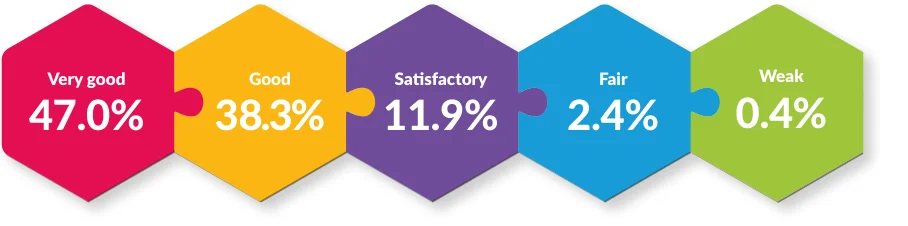
Table 5.8: Quality of the learning environment (announced inspections) in post-primary schools:
Source: Inspectorate, Department of Education
Pages 135–140 · View in original PDF