4.5 Looking forward
4.5 Looking forward
Teaching approaches
■To ensure that all pupils are challenged sufficiently, teachers should develop their approaches to
differentiation further.
■To further extend learning beyond the acquisition of knowledge, greater focus should be placed in
settings and schools on the development of skills and on fostering dispositions for learning.
■Greater attention to the development and embedding of whole-school assessment strategies is
required. Pupils should be provided with more frequent and enhanced opportunities to reflect on their progress as learners.
Language learning
■Pupils’ opportunities for language learning and development should be extended more consistently
through the use of active and collaborative learning opportunities across all curriculum areas.
■There is a need for primary schools to receive intensive support to enable them to introduce
appropriately challenging, targeted interventions to enhance pupils’ attainment and engagement, enjoyment and motivation in Irish language learning.
Learning from the pandemic
■Learning from the pandemic should be built on, particularly with regard to the use of digital
technologies in teaching and learning, and in supporting and enhancing communication with parents and their involvement in their child’s education.
Co-curricular, cross-curricular and extracurricular activities
■There is need to explore how the Primary Curriculum Framework can be implemented in a
manner that enables schools to extend and embed the provision of effective co-curricular and cross-curricular activities for pupils.
■There is a need to support schools more systematically in their provision of extra-curricular
activities in light of the potential of these activities to support pupils’ social and emotional development and to extend learning experiences and skills development beyond the curriculum.
Figure from page 130
and learning in post-primary schools
5.1. Introduction
This chapter presents the key findings of inspections conducted in post-primary schools from September 2016 to December 2020. During this period, the National Strategy to Improve Literacy and Numeracy among Children and Young People, which had been introduced in 2011, became well embedded and revised targets were introduced in 2017. The phased introduction of the new Junior Cycle, introduced in 2014, continued.
Due to COVID-19 and in line with public health advice, post-primary schools were closed without notice on 13 March 2020 and did not re-open until August/September 2020. During the challenging March-June 2020 period, extensive work was undertaken by post-primary schools in mediating the curriculum and facilitating learning for students, primarily through digital learning. School management and teachers also cooperated with revised assessment arrangements for junior cycle and Leaving Certificate students when the state examinations could not be held, as planned, in June 2020. Final examinations for junior cycle students were replaced with school-based assessments. Teachers and school management collaborated with the Department in the collection and moderation of estimated marks for the calculated grades process that the Minister for Education had put in place for Leaving Certificate students. Schools also embraced the very considerable challenges of re-opening, and ensuring that teaching and learning could continue during the ongoing public health restrictions in September-December 2020.
This chapter draws from data gathered during announced inspections, including whole-school evaluations: management, leadership and learning (WSE-MLL) and subject inspections. It also draws from data gathered during incidental inspections; these inspections, which are typically unannounced, involve the observation of teaching and learning in a number of lessons over the course of a school day. During the period September 2016 to December 2020, 6,288 lessons were observed in the course of WSE-MLL inspections and 4,807 lessons during subject inspections. Inspectors also evaluated the quality of teaching and learning, and engaged with students about their learning in 2,530 lessons during incidental inspections. In all lesson observations, a key focus was on evaluating the quality of the learning experience of students.
This chapter also draws on the findings from the Inspectorate’s advisory engagements with schools, and on research conducted by the Inspectorate on the experience of remote teaching and learning from March- June 2020 when schools were closed. It also includes findings from Inspectorate research on how well schools were operating from September-December 2020 when schools re-opened.
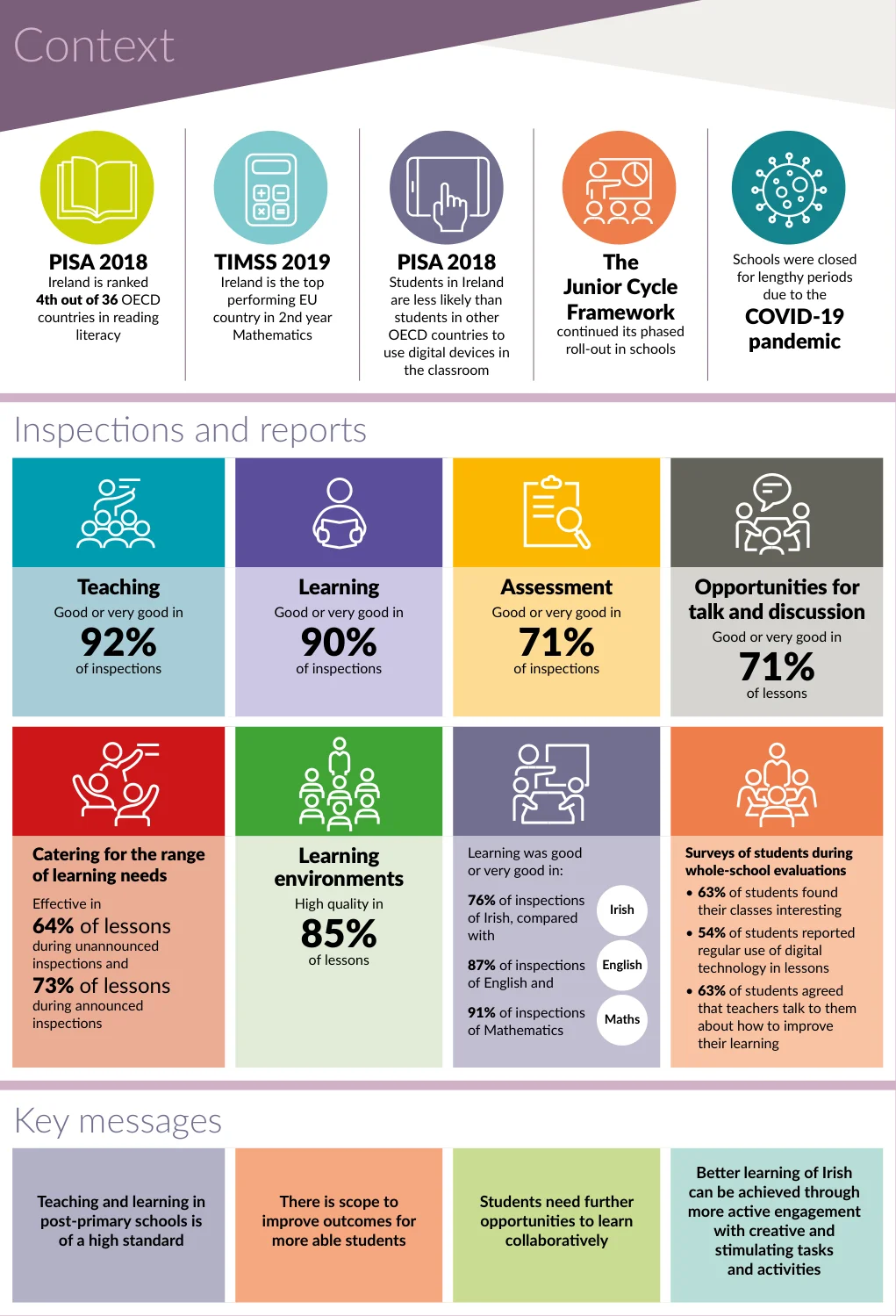
Figure from page 131
Context
PISA 2018 Ireland is ranked 4th out of 36 OECD countries in reading
TIMSS 2019
Ireland is the top
country in 2nd year
literacy
Inspections and reports
| Teaching Good or very good in 92% of inspections | Learning Good or very good in 90% of inspections | Assessment Good or very good in 71% of inspections | Opportunitei s for talk and discussion Good or very good in 71% of lessons |
| Catering for the range of learning needs Efef ctive in 64% of lessons during unannounced inspections and 73% of lessons during announced inspections | Learning environments High quality in 85% of lessons | Learning was good or very good in: 76% of inspections Irish of Irish, compared with 87% of inspections English of English and 91% of inspections Maths of Mathematics | Surveys of students during whole-school evaluations • 63% of students found their classes interesting • 54% of students reported regular use of digital technology in lessons • 63% of students agreed that teachers talk to them about how to improve their learning |
Key messages

Figure from page 131
Inspection findings indicate that the overall quality of teaching and learning in post-primary schools was of a high standard. Initial findings regarding the implementation of junior cycle reform were also positive. Nonetheless, inspectors found that there was scope to enhance students’ learning through increased provision for talk, discussion and collaborative learning. The need to improve the use of assessment information to inform teaching and learning in classrooms and schools was also identified during inspections.
Pages 128–132 · View in original PDF