4.1 Introduction
4.1 Introduction
This chapter presents the key findings of inspections conducted in primary schools and special schools during the period September 2016 to December 2020. It draws from data gathered during announced inspections, including whole school evaluations (WSE), whole school evaluations-management, leadership and learning (WSE-MLL) and curriculum evaluations. It also draws from data gathered during incidental inspections, which are typically unannounced and involve the observation of teaching and learning in a number of curriculum areas in up to three learning settings over the course of a school day. During the September 2016 to December 2020 period, 3,234 lessons were observed in the course of WSE inspections, 7,985 lessons were inspected in the course of WSE-MLL inspections, and 4,376 lessons were inspected during curriculum evaluations. Inspectors also evaluated the quality of teaching and learning, and engaged with pupils about their learning in 6,012 lessons during incidental inspections.
During this same period, several key strategies were launched or progressed. The National Strategy to Improve Literacy and Numeracy among Children and Young People, 2011-2020 became well embedded and, as all the targets set for reading and Mathematics at primary level were reached by 2017, more ambitious targets were set for higher-achieving pupils. The Digital Strategy for Schools 2015-2020 provided an action plan for integrating information and communications technology (ICT) into teaching, learning and assessment practices in schools. The STEM Education Policy Statement 2017–2026 and STEM Education Implementation Plan 2017- 2019 were both launched in 2017, with a view to embedding these skills into teaching and learning. The Policy on Gaeltacht Education 2017–2022 provided a comprehensive set of actions, spanning a range of areas that aimed to strengthen the provision of Irish-medium education in Gaeltacht schools.
Due to the COVID-19 pandemic, schools closed without notice in March 2020. Commendable work was undertaken by many schools in mediating the primary curriculum during the period following the closures, despite challenges such as putting the necessary communication and digital learning arrangements in place, and supporting the wellbeing of pupils and staff. During this first period of school closures, the system became acutely aware of the importance of digital learning, and funding and supports were provided to schools. Schools re-opened in September 2020 with due attention given to the wellbeing, and health and safety of pupils and staff. During this re-opening and operating phase from September to December 2020, we learned through our advisory and research engagements how teaching and learning were impacted during this time, how new approaches to feedback and to the use of digital technologies emerged, and how modes of teaching and learning evolved. We considered the implications of these developments for the future.
The findings from our inspections, evaluations and assessments between September 2016 and December 2020 indicate that the overall quality of teaching and learning in primary schools and special schools in Ireland is very good. These positive findings reflect the commitment and hard work of our school communities and also the significant effort put into curriculum review and redevelopment, and into the implementation of the National Strategy to improve Literacy and Numeracy, the STEM Education Policy Statement 2017-2026, the Digital Strategy for Schools 2015-2020 and the Policy on Gaeltacht Education 2017-2022.
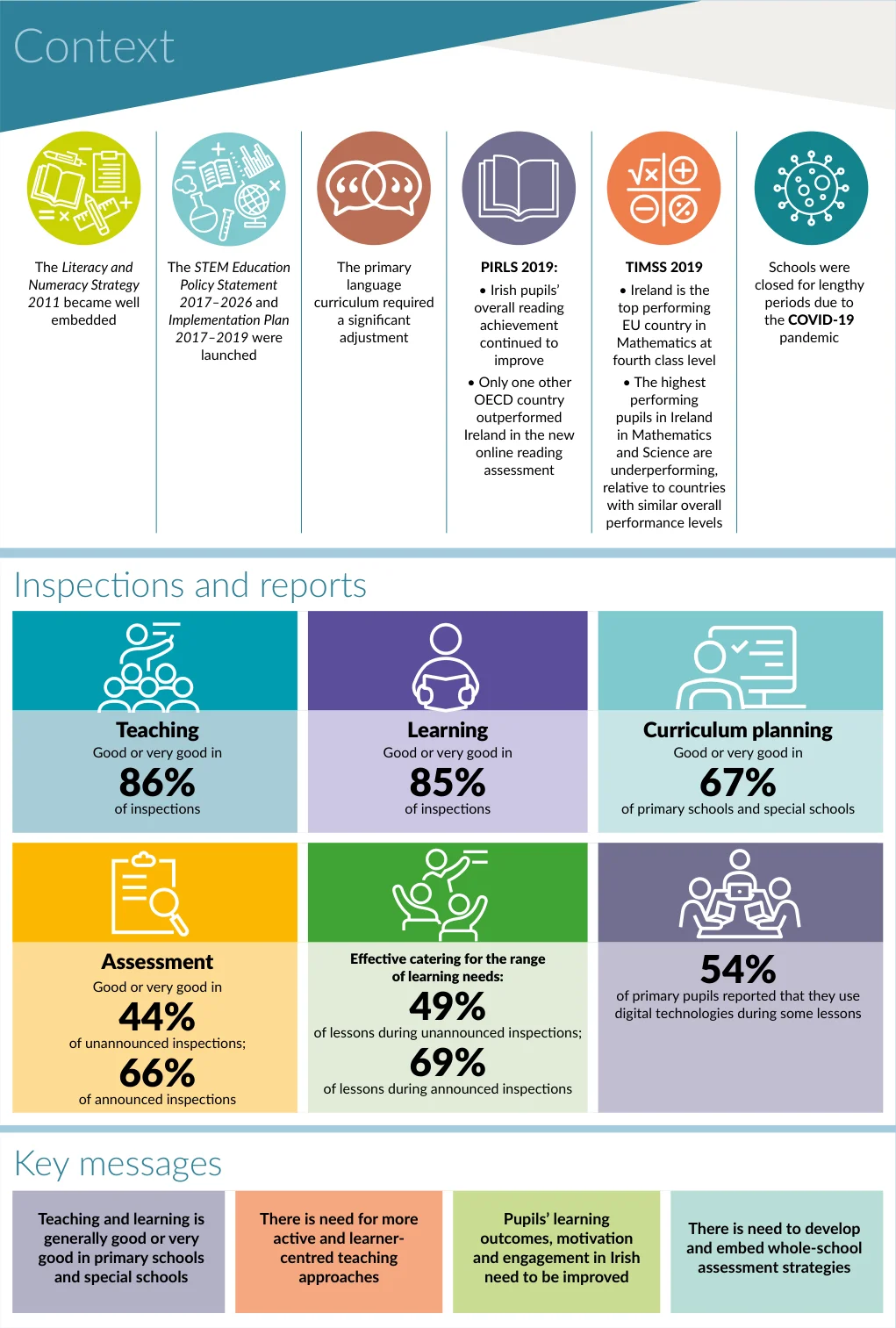
Figure from page 105
PIRLS 2019:
The primary
language curriculum required
• Irish pupils’ overall reading
a significant
achievement continued to
adjustment
improve
• Only one other OECD country
outperformed Ireland in the new
online reading
assessment
| Teaching Good or very good in 86% of inspections | Learning Good or very good in 85% of inspections | Curriculum planning Good or very good in 67% of primary schools and special schools |
| Assessment Good or very good in 44% of unannounced inspections; 66% of announced inspections | Efef ctive catering for the range of learning needs: 49% of lessons during unannounced inspections; 69% of lessons during announced inspections | 54% of primary pupils reported that they use digital technologies during some lessons |

Figure from page 105
Pages 104–105 · View in original PDF