3.1 Introduction
3.1 Introduction
Policy responsibility for the early learning and care (ELC) sector lies primarily with the Department of Children, Equality, Disability, Integration and Youth (DCEDIY). The Department of Education collaborates with DCEDIY in relation to certain policy aspects of ELC, including aspects of quality, workforce development and curriculum. The Early Childhood Care and Education (ECCE) programme, which is funded and managed by DCEDIY, provides universal access to two years of free early learning and care before school-entry. The ECCE programme is available to children between the ages of two years and eight months and five years and six months.
Tusla, the Child and Family Agency, is the independent statutory regulator for the early learning and care and school-age childcare sector. Early years education inspections (EYEI), which are carried out by the Department of Education Inspectorate and focus on the educational dimension of the ECCE programme, were introduced in April 2016 at the request of the then Minister for Children and Youth Affairs to complement the statutory inspections of early learning and care settings that are carried out by Tusla, the Child and Family Agency.
In the 2019/2020 programme year, there were 4,398 services contracted to provide the ECCE programme nationally. Just over 100,000 children were registered for the ECCE programme (attending either their first or second year). It is important to note that all ELC services are owned privately, and that managers/early years educators run services operating either on a not-for-profit or for profit basis. Further information on the ELC sector more broadly, and on ECCE specifically, can be found in the Annual Early Years Sector Profile 2019/2020.
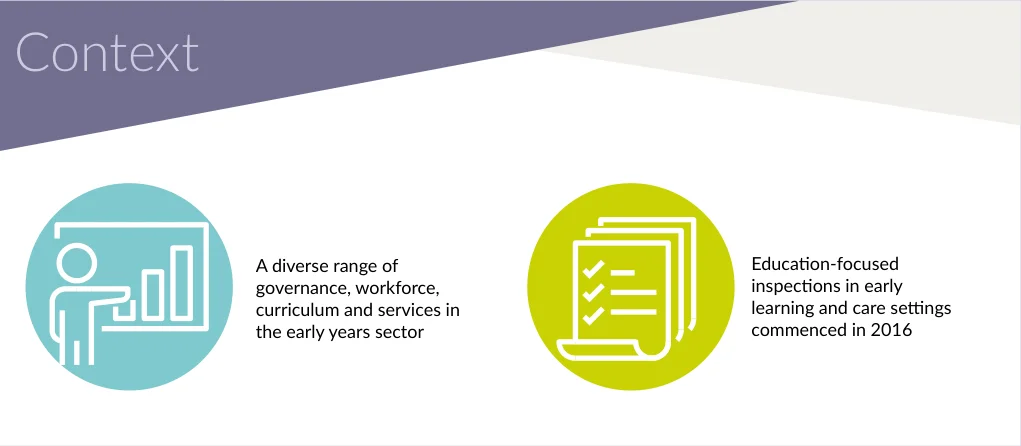
Figure from page 87
Context
Education-focused inspections in early learning and care settings commenced in 2016
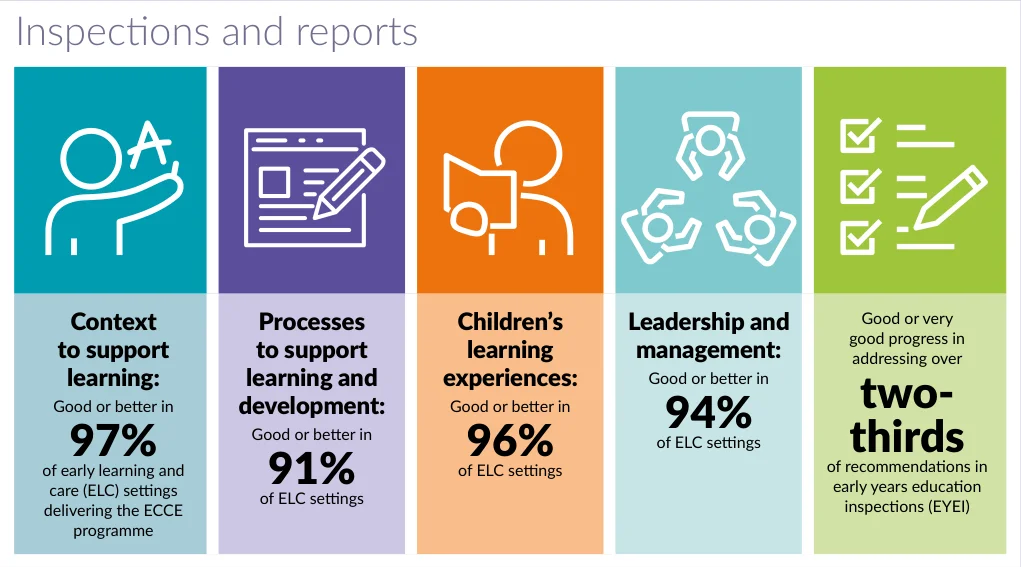
Figure from page 87
Inspections and reports
| Context to support learning: Good or betet r in 97% of early learning and care (ELC) settings delivering the ECCE programme | Processes to support learning and development: Good or betet r in 91% of ELC settings | Children’s learning experiences: Good or betet r in 96% of ELC settings | Leadership and management: Good or betet r in 94% of ELC settings | Good or very good progress in addressing over two- thirds of recommendations in early years education inspections (EYEI) |
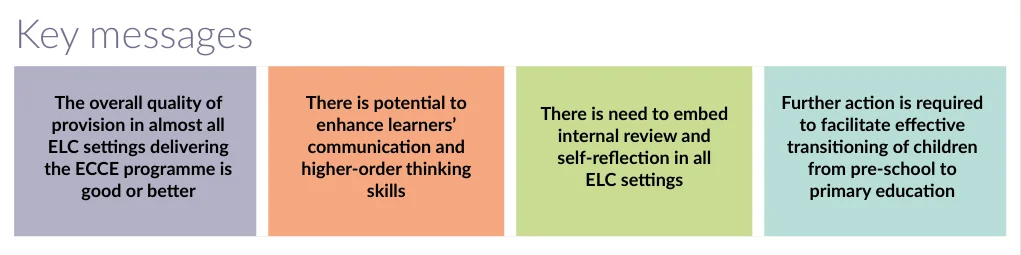
Figure from page 87
Key messages

Figure from page 87
This chapter presents the key findings of evaluations conducted during the period September 2016 to December 2020 in ELC settings delivering the ECCE programme. In assessing the quality of education provision in ELC settings, the primary model of inspection used by the Inspectorate is the early years education inspection (EYEI) model which is complemented by early years follow-through inspection. During the period September 2016 to March 2020, the Inspectorate conducted 2,248 EYEIs and 195 followthrough inspections. These included inspections in a number of Irish-medium and Gaeltacht ELC settings.
It is relevant to note that the provision of universal free pre-school for children in Ireland through the ECCE programme was only established in 2010. During the development of the EYEI model, it was acknowledged by the Chief Inspector that many challenges to the delivery of high quality education which existed in the ELC sector did not apply in the primary or post-primary sectors. These include the diverse governance, workforce capacity, curricula and philosophy, and range of services offered. In advance of the commencement of the EYEI model, the capacity of the ELC sector to engage with education-focused inspection was not established and was predicted to be variable, based upon the considerable heterogeneity of both provision and practice. To respond to this context and to encourage positive engagement with education-focused inspection, the Inspectorate gave a commitment to seek to deliberately identify and validate strengths in both provision and practice during inspection. This translated into a commitment to deliver an evaluation of each setting that reflected its unique context and capacity for operation. These evaluations sought to engage with service providers and early years educators, and build their capacity for quality improvement with authentic, positive and practical external evaluation that was reflective of their immediate situation.
It is evident that this approach was well-judged as, even in the lifetime of this report, there was evidence of improvement in the capacity of the ELC sector to engage with, and respond positively to, educationfocused inspection. This capacity has been enhanced by the increased investment by DCEDIY and its agencies in a range of funding and professional development opportunities for the ELC workforce. In time, as the capacity of the ELC sector is resourced and supported further, education inspections will continue to respond positively to the challenges observed in ELC settings by promoting exemplary and innovative practice and ongoing quality improvement across all settings. In addition to the publication of reports on individual ELC settings, the Inspectorate uses composite reporting to distil the general trends emerging from the experience of settings. We draw on that data in this chapter to illustrate the quality of ECCE provision in ELC settings in the period to which this report refers. Additional material included in this chapter is drawn from other evaluation activities, including cross-sectoral evaluations designed to report on practice in specific aspects of provision; for example, Science, Technology, Engineering and Mathematics (STEM) and Digital Learning have been the focus of recent Inspectorate cross-sectoral publications.
In general, the findings from education inspection of ECCE provision in ELC settings indicate that the overall quality of teaching and learning is good or better. They also indicate that there is scope for improvement, especially in relation to the development of emergent, child-centred learning programmes and approaches to assessment, including the use of assessment information, to ensure that planning for progression and the next steps in children’s learning is fully informed by their individual interests, strengths and abilities.
Pages 86–88 · View in original PDF