11.1.2 Making an urgency broadcast using VHF - PAN-PAN
CALLSIGN EI __ __ __ __ (Or other identification)
The procedures described in this Chapter do not prevent the use by any vessel, survival craft or person in distress of any means at their disposal to attract attention, make known their position and obtain help.
Emergency Procedures
MAYDAY,
‘NAME OF VESSEL’,
CALLSIGN EI __ __ __ __
STATE THE POSITION OF THE VESSEL.
(If possible give the position from a GPS receiver or bearings from and distance to any known fixed points e.g. “Position one mile South of Fastnet Lighthouse”)
11.1 Procedure for making distress or urgency calls using VHF voice 11.1.1 Making a distress transmission using VHF voice broadcasting – MAYDAY
STATE THE NATURE OF DISTRESS. (e.g. sinking, man overboard, fire on board, …)
STATE THE NUMBER OF PERSONS ABOARD.
STATE ANY OTHER USEFUL INFORMATION.
In cases where there is grave or imminent danger to either the vessel or persons on board, including man overboard situations, then a MAYDAY should be broadcast on Channel 16 with the VHF unit set to high power in the following format, after pressing the VHF Distress Button (if your VHF has a DSC function):
OVER”.
11.1.2 Making an urgency broadcast using VHF - PAN-PAN
In circumstances that are considered to be grave but do not require immediate assistance and where there is no imminent danger to the vessel or persons on board, e.g. mechanical failure, loss of propulsion, a “PAN-PAN” Urgency Broadcast should be made on VHF Channel 16 with the unit set to high power in the following format:
“MAYDAY, MAYDAY, MAYDAY,
This is ‘NAME OF VESSEL’, ‘NAME OF VESSEL’, ‘NAME OF VESSEL’
(State the name of the vessel three times)
“PAN-PAN, PAN-PAN, PAN-PAN,
ALL STATIONS, ALL STATIONS, ALL STATIONS,
THIS IS ‘NAME OF VESSEL’, ‘NAME OF VESSEL’, ‘NAME OF VESSEL’.
(State the vessels name three times)
STATE THE POSITION OF THE VESSEL.
(If possible give the position from a GPS receiver or bearings from and distance to any known fixed points e.g. “Position one mile South of Fastnet Lighthouse”)
STATE THE NATURE OF THE URGENCY.
(e.g. Vessel adrift, mechanical failure)
STATE THE NUMBER OF PERSONS ABOARD.
ASSISTANCE REQUIRED AND ANY FURTHER RELEVANT INFORMATION.
OVER”.
Guidance on VHF Distress Alert Procedures
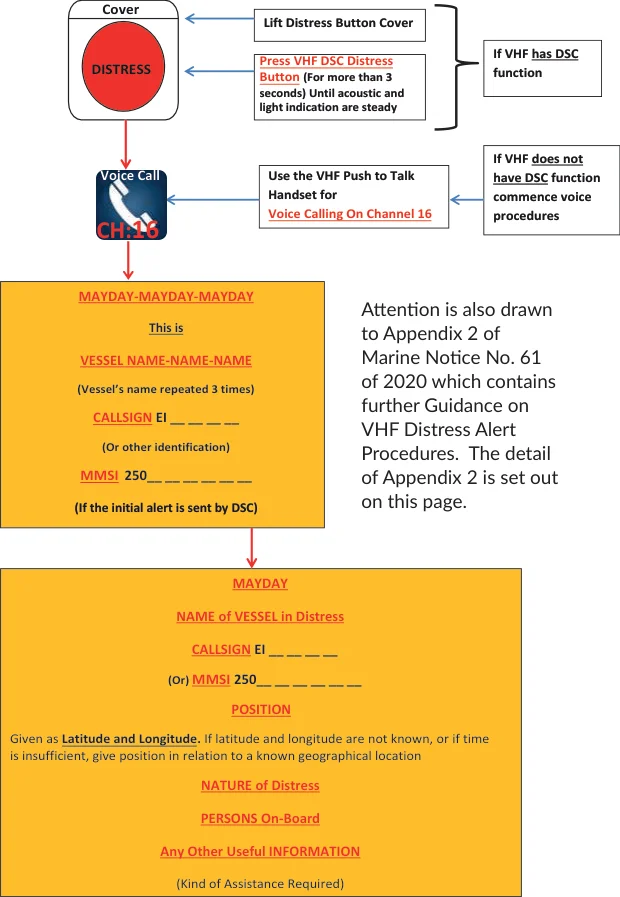
Figure from page 172
Lift Distress Button Cover
If VHF has DSC function
Press VHF DSC Distress Button(For more than 3 seconds) Until acoustic and light indication are steady
If VHF does not have DSC function commence voice procedures
Use the VHF Push to Talk Handset for Voice Calling On Channel 16
Attention is also drawn to Appendix 2 of Marine Notice No. 61 of 2020 which contains further Guidance on VHF Distress Alert Procedures. The detail of Appendix 2 is set out on this page.
NAME of VESSEL in Distress
CALLSIGN EI __ __ __ __
(Or) MMSI 250__ __ __ __ __ __
Given as Latitude and Longitude. If latitude and longitude are not known, or if time is insufficient, give position in relation to a known geographical location
NATURE of Distress
PERSONS On-Board
Any Other Useful INFORMATION
(Kind of Assistance Required)
Pages 170–172 · View in original PDF