Chapter 20: International Climate Action
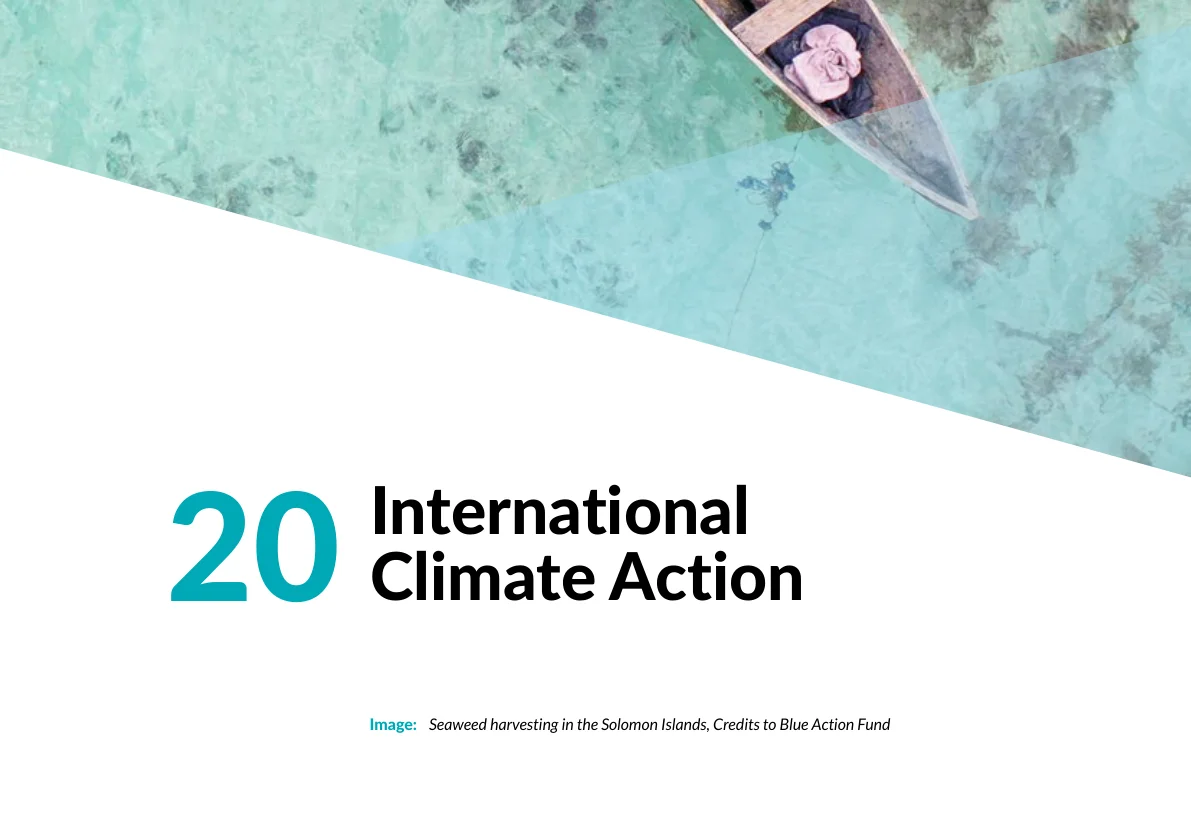
Figure from page 157
International Climate Action
Image: Seaweed harvesting in the Solomon Islands, Credits to Blue Action Fund
Figure from page 158
Key Messages
State of Play
– 2024 continues to see new global temperature records, with June marking a 12-month period in which each month was recorded as the hottest on record according to EU Copernicus Climate Change Service;45
– The first Global Stocktake (GST) which was completed at the UNFCCC COP28 meeting assessed that, on its current course, the world has not done enough to achieve the Paris Agreement temperature goal or to keep the 1.5°C limit in reach;
– At COP29, the parties were able to agree on a new goal consisting of two parts: ‘core’ financing of at least USD 300 billion annually by 2035, and an ‘additional layer’ of up to USD 1.3 trillion primarily encompassing private financing.
Current and Future Action
– Ireland continues to be an advocate for ambitious global action, based on the best available science, on the triple planetary crises of climate change, biodiversity loss and pollution.
Expected Outcomes
– Ireland’s climate diplomacy will continue to promote the voices of those who are most vulnerable to climate change, championing a human rights-based and inclusive approach to global climate action;
– Ireland will continue to scale up its international climate finance, maintaining our focus on support for climate resilience and adaptation, while also expanding to support other priorities such as responding to Loss and Damage and biodiversity protection and restoration.
45 July was second warmest on record, ending record-breaking 13-month streak | Copernicus
20.1 Introduction
In 2024, the world has again experienced record global temperatures. Climate extremes have become the norm for many regions with impacts for human health, wellbeing, nature and biodiversity of grave concern. The concentrations of greenhouse gases (GHG) in the atmosphere have continued to increase, reaching new record levels.
This reinforces the findings of the Intergovernmental Panel on Climate Change’s (IPCC) Sixth Assessment Report and its message that accelerated action to address the causes and consequences of climate change is needed without delay. Ireland will continue to play its part within the international multilateral system, including through its roles in the EU, UN bodies, International Financial Institutions (IFIs), and the Organisation for Economic Co-operation and Development (OECD).
20.2 Developments in International Climate Policy
20.2.1 Multilateral Climate Action
COP28 concluded the first Global Stocktake (GST), which assessed collective progress and stated ambition, through Nationally Determined Contributions (NDCs) in achieving the goals of the Paris Agreement. It found that while some progress was evident, the world is not on track to achieve its goals. The GST decision included clear recognition of the role that fossil fuel use plays in driving climate change. For the first time it called for Parties to transition away from fossil fuels in a just, orderly and equitable manner. Other outcomes included a commitment to a doubling of the rate of energy efficiency, and a tripling of the deployment of renewables by 2030. While the GST outcome is historic, its implementation by all Parties will be key for achievement of the Paris Agreement goals.
COP29, Baku, delivered an agreement on a New Collective Quantified Goal (NCQG), to replace the previous goal, which saw developed country parties commit to deliver $100 billion in climate finance per year, through both public climate finance and the mobilisation of climate finance. This goal was overachieved in 2022, as confirmed in May 2024 by the OECD. The NCQG will replace this goal for the post-2025 period. In Baku, the parties were able to agree on a new goal consisting of two parts: ‘core’ financing of at least USD 300 billion annually by 2035, and an ‘additional layer’ of up to USD 1.3 trillion primarily encompassing private financing
At COP29 and at the invitation of its Presidency, Minister Ryan acted as part of the Ministerial Pair facilitating negotiations on adaptation. Minister Ryan is the first Irish Minister to be given a role as a Ministerial Pair.
Momentum is also building towards COP30, Belém, which will see the delivery of the next round of NDCs, the success of which are expected to play a crucial role in achieving required GHG emissions reductions during this critical decade that keep the 1.5°C limit in reach. Ireland will submit a joint NDC with its EU partners, with the EU’s forthcoming 2040 Target to inform the discussions for this NDC.
Following on from COP28’s agreement on the funding arrangement to respond to Loss and Damage, Ireland was nominated to the Board of the new Fund for responding to Loss and Damage, sharing a seat with the European Union. A key priority for 2024 is to move forward with the operationalisation of the fund as quickly as possible to ensure support reaches the most vulnerable countries affected by climate change.
In respect of the United Nations Environment Programme (UNEP), the sixth United Nations Environment Assembly (UNEA) was held in Nairobi, Kenya from the 26 February–1 March 2024. While UNEA5 had seen agreement reached on the need to end plastic pollution based on a comprehensive approach that addresses the full life cycle of plastics, UNEA6 required parties, including the EU and its Member States, to push for maintaining that level of ambition. The Intergovernmental Negotiating Committee (INC) on Plastic Pollution has been continuing its work during this time, with the final INC5 having taken place in December in Busan, Korea.
20.2.2 Climate Finance
Ireland has more than doubled its climate finance since 2020. Ireland’s climate finance 2023 expenditure is expected to total more than €156 million and 2024 will likely total more than €181 million. We will meet the 2025 target of €225 million.
In response to a call from the International Monetary Fund (IMF) Managing Director, Kristalina Georgieva, to the world’s most advanced economies to help poorer countries tackle current and emerging crisis’s facing them across a range of issues, in April 2024 the Government approved the channelling (i.e. lending) of 20% of Ireland’s 2021 IMF Special Drawing Right allocation to the IMF’s Resilience and Sustainability Trust (RST). The RST was created in 2022 and provides longer-term affordable financing to low-income and vulnerable middle-income countries as they tackle long-term structural challenges such as climate change and pandemic preparedness. Principal repayments to RST lending are not made by borrowing countries until between 10 and 20 years after disbursement. Ireland’s contribution, which is equivalent to circa €800 million in financing assistance, will also be supplemented by a stand-alone exchequer grant of circa €13.5 million. Legislation is being developed by the Department of Finance to give effect to the Government Decision.
To strengthen the alignment of climate action and sustainable development, and in accordance with a commitment in the Programme for Government, the Department of Foreign Affairs has developed a Climate Proofing Strategy to future-proof Ireland’s ODA. This strategy covers a five-year period (2024–2029) and all ODA spending Departments, who were consulted during the development of the strategy, which establishes a common understanding of what climate proofing means for Ireland’s ODA.
20.2.3 Sustainable Development Goals
In September 2024, the Summit of the Future took place at the United Nations in New York. The Summit was a high-level event which brought world leaders together to forge a new international consensus on how we deliver a better present and safeguard the future.
At the Summit, world leaders adopted the Pact for the Future that includes a Global Digital Compact and a Declaration on Future Generations. The Pact covers a broad range of issues including climate change, peace and security, sustainable development, digital cooperation, human rights, gender, youth and future generations, and the transformation of global governance. The Pact is designed to turbo-charge implementation of the Sustainable Development Goals.
20.2.4 Ocean Governance and Biodiversity
Ireland is committed to the protection and restoration of biodiversity, including marine biodiversity, recognising that taking such action can also help us adapt to climate change. Our work in this area includes our negotiations in and advocacy for the Agreement under the UN Convention on the Law of the Sea (UNCLOS) on the Conservation and Sustainable Use of Marine Biological Diversity of Areas beyond National Jurisdiction (BBNJ). As an island nation, Ireland recognises the crucial role that oceans and the sustainable blue economy play in supporting marine biodiversity, climate resilience, and sustaining livelihoods, particularly for coastal LDCs and SIDS.
Ireland continues to engage with international partners, the European Commission, and regional sea conventions, to advocate for stronger ocean and biodiversity governance and dialogue, both regionally and globally, to eliminate the negative environmental impacts of human activities and ultimately restore coastal and marine ecosystems to good status as soon as possible, and for future generations.
Ireland has also participated in the sixteenth meeting of COP16 which took place in Cali, Colombia in October 2024, which advanced efforts to implement the Global Diversity Framework, including the consideration of guidance to agree indicators of the monitoring framework. Ecosystem services, such as those related to climate, are considered in the guidance in order to improve the use of nature-based solutions which increase mitigation of and resilience to climate change impacts while benefiting nature.
20.3 Principles for Climate Action
20.3.1 Championing a Science Based Approach to Climate Action
The election in 2023 of the new Bureau of the IPCC was followed by two Plenary meetings of the Panel in January and July 2024. The January meeting effectively started the work under the IPCC 7th Assessment Cycle by agreeing the reports to be provided. This includes the three Working Group reports that will constitute the 7th Assessment Report (AR7), a Special Report on Cities, and Methodological Reports on Short Lived Climate Forcers (SLCFs) and Carbon Dioxide Removal techniques. The full and the next GST will be completed in 2028. The timing of AR7 will be considered further by the IPCC in 2025 but it is expected to be an input for its the next GST.
Ireland continues to be a strong supporter of the work of the IPCC and promotes the use of the best available science to inform climate policy and actions.
20.3.2 Gender, Youth and Climate Action
There have been continuing developments in the increasingly prominent intersection between human rights and the environment and specifically the right to a clean, healthy and sustainable environment. In April 2024, the European Court of Human Rights (ECtHR) delivered its rulings on the cases of Duarte Agostinho and Others v. Portugal and Others (‘Duarte’), Verein KlimaSeniorinnen Schweiz and Others v. Switzerland (‘Swiss Case’), and Carême v. France. Ireland was a respondent in Duarte and provided written observations and oral submissions as a third party in the Swiss Case. The rulings of the ECHR in these cases will be relevant in future case law regarding the right to a healthy environment and Ireland is considering their impact.
Continuing its support of gender-sensitive climate action, Ireland has partnered with the Global Alliance for Green and Gender Action (GAGGA), a women-led, Global-South focused consortium supporting gender-just climate activism. GAGGA works to strengthen local women’s leadership in inclusive lobbying and advocacy for gender-just mitigation and adaptation processes. In line with Ireland’s strong focus on locally-led development, GAGGA’s funding mechanism operates in support of locally-led solutions, ensuring that funds reach organisations directly.
Ireland’s Climate Youth Delegate Programme is ongoing, with the third Climate Youth Delegate appointed in May 2024. Through a process of ongoing consultations with young people, the Climate Youth Delegates continue to bring valuable inputs from the perspective of Ireland’s youth to the National Climate Delegation.
20.4 Actions for 2025
| Action Number | Action |
|---|---|
| IC/25/1 | Increase Ireland’s year-on-year climate finance contribution for 2025. |
| IC/25/2 | Prepare for Ireland’s Chairing of the Working Party for International Climate Issues during its Presidency, which will include acting as EU Presidency for COP31. |

Figure from page 163
Pages 157–163 · View in original PDF