Chapter 1: The Critical Nature of the Challenge
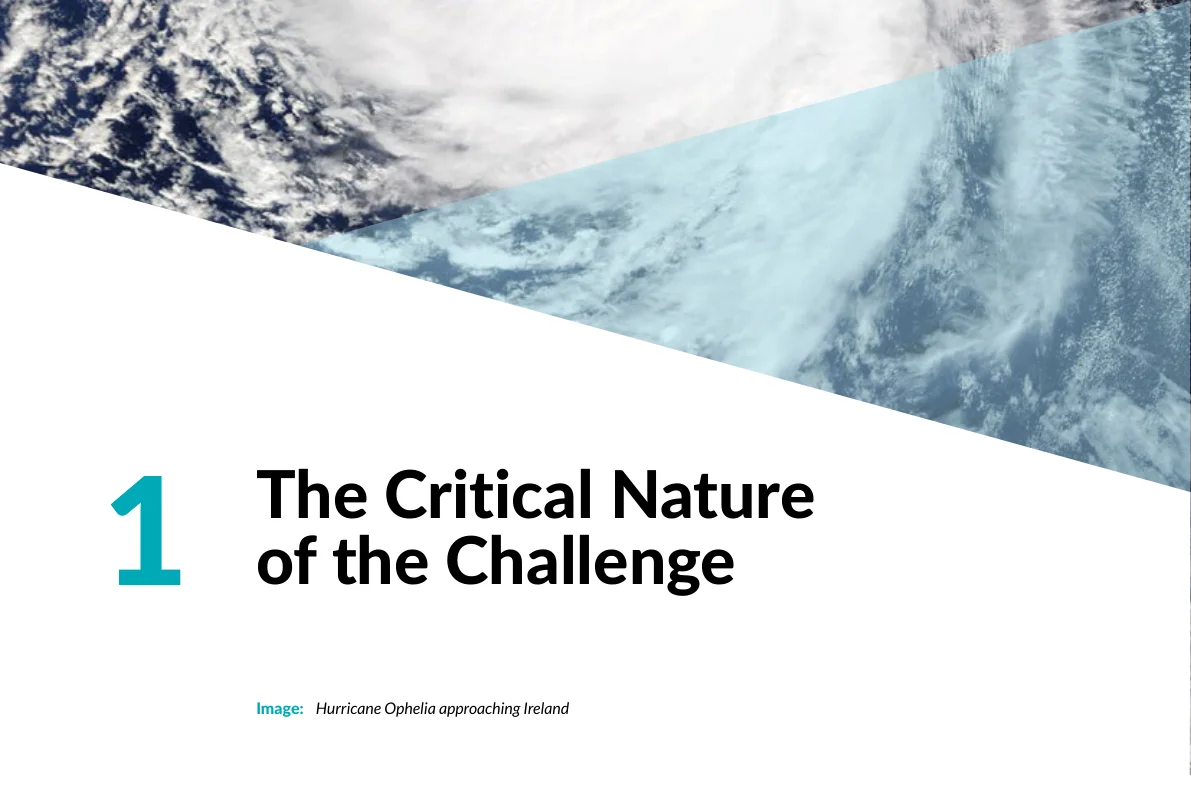
Figure from page 18
The Critical Nature of the Challenge
Image: Hurricane Ophelia approaching Ireland
Key Messages
State of Play
– 2023 was the warmest year on record globally, and record breaking-warming has continued in 2024;
– Continued emissions of GHGs will cause further warming leading to increased economic costs and increasingly negative impacts on people and nature;
– Globally climate solutions, including renewables, are being deployed at an unprecedented pace, with many countries increasing their climate ambition and investment;
– Ireland’s economic competitiveness now aligns with its climate ambition.
Current and Future Action
– Rapid and significant reductions in GHG emissions are required if we are to meet the 2015 Paris Agreement and the UN’s Sustainable Development Goals;
– The European Green Deal commits to achieving climate neutrality in the EU by 2050, with exacting targets set for Ireland under different compliance regimes for 2030 (e.g. Effort Sharing Regulation, LULUCF Regulation, Renewable Energy Directive etc). Under national law, Ireland separately committed to achieving a 51% reduction in emissions to 2030, and to achieving climate neutrality by no later than 2050;
– We need to act now, with urgency, to ensure Ireland’s future in a low-carbon world.
Expected Outcomes
– Climate Action Plan 2025 sets out the roadmap to deliver on Ireland’s climate ambition.
1.1 Global Warming Continues
Human influence continues to warm the atmosphere, ocean and land leading to widespread and rapid changes across the world which are disrupting human and natural systems resulting in climate-related loss and damage to people and nature. Warming is driven by increasing amounts of GHGs (mainly carbon-dioxide, methane and nitrous oxide) in the atmosphere due mainly to our continued use of fossil fuels and the way we manage land.
This year saw confirmation that 2023 was the warmest year on record with the annual average global temperature 1.45°C above the pre-industrial average. It’s also clear that since the 1980s Europe has been warming twice as fast as the global average and is now the fastest-warming continent on Earth. In Europe, 2023 was the joint warmest or second warmest year on record depending on the dataset used, with temperatures 2.48–2.58°C above the pre-industrial average. It was also one of the wettest years on record with widespread flooding across the continent, and average sea-surface temperature across Europe was the warmest on record. There were also large fires in Portugal, Spain, Italy and Greece, which saw the largest wildfire ever recorded in the EU, affecting approximately 96,000 hectares of land.
For Ireland 2023 was the warmest and wettest year on record. This was influenced by the record high sea-surface temperatures across the North Atlantic which contributed to the increase in temperatures and moisture content in the atmosphere over Ireland. In June 2023, the North Atlantic was impacted by a marine heatwave that was classified as ‘extreme’ and in some areas ‘beyond extreme’, with sea surface temperatures as much as 5°C above average.
Warming has continued in 2024 with the average global temperature for the 12-month period July 2023–June 2024 the highest on record at 1.64°C above the pre-industrial average, and with the highest daily average global temperature in recent history recorded on 22 July (17.16°C). In Ireland, Spring 2024 (March, April and May) was one of the warmest and wettest on record. It was the twelfth consecutive season with above average temperatures and the fifth with above average rainfall. Record-high sea surface temperatures continued across the North Atlantic.
1.2 Paris Agreement
It is critical that the international community continues to step up efforts towards meeting the Paris Agreement objectives of holding the increase in the global average temperature to well below 2°C above pre-industrial levels and pursuing efforts to limit the temperature increase to 1.5°C above pre-industrial levels, recognising that this would significantly reduce the risks and impacts of climate change. With the World Meteorological Organisation reporting in June 2024 that there is an 80% likelihood that the annual average global temperature will temporarily exceed 1.5°C above pre-industrial levels for at least one of the next five years, the need for immediate and significant action to reduce GHG emissions is more apparent than ever.
This urgent need for action was reflected at COP28 which agreed that limiting global warming to 1.5°C requires deep, rapid and sustained reductions in global GHG emissions of 43% by 2030 and 60% by 2035 compared to 2019 levels and reaching net zero CO2 emissions globally by 2050. The COP28 agreement also calls on the Parties to triple global renewable energy capacity and double the rate of energy efficiency improvements by 2030, to accelerate efforts globally towards net zero emission energy systems, making use of zero- and low-carbon fuels well before or by around mid-century. While emphasising the importance of a just transition, it also seeks to accelerate efforts to phase down unabated coal power; to phase out inefficient fossil fuel subsidies; and other measures that drive the transition away from fossil fuels in energy systems, in a just, orderly and equitable manner, with developed countries continuing to take the lead. Parties are also encouraged to come forward with ambitious, economy-wide emission reduction targets, covering all GHGs, sectors and categories and aligned with the 1.5°C limit in their next round of nationally determined contributions (NDCs) by early 2025.
In a major step forward, the Parties also agreed on targets for the Global Goal on Adaptation and its framework, which identify where the world needs to get to in order to be resilient to the impacts of a changing climate and to assess countries’ efforts in this regard. COP28 also resulted in unprecedented recognition and momentum for linking efforts to address the climate and biodiversity crises. Alongside pollution, these make up the triple planetary crisis – the three, main interlinked environmental issues facing humanity. Governments were called on to consider ecosystems, biodiversity and carbon stores, such as forests, when developing their NDCs in 2025.
1.3 European Green Deal
The Green Deal makes a commitment to achieve climate neutrality in the EU by 2050. In 2023, work was completed on the revision of the EU’s climate, energy and transport-related legislation under the ‘Fit for 55 Package’ aligning EU laws with the 2030 and 2050 climate ambition. Ireland fully supported this enhanced ambition. Looking ahead and building on achievements to date, Europe aims to become a continent with clean, low-carbon, affordable energy and sustainable food and materials, making it resilient against future crises.
The Climate Law obliges the EU to adopt a legally-binding 2040 climate target. In February 2024 the Commission recommended a net reduction of 90% in greenhouse gas emissions by 2040 compared to 1990 levels. To achieve this, the Commission proposes a range of measures and strategies including a significant increase in investment in energy infrastructure and lowcarbon solutions; support for innovative technologies in industry and agriculture; the creation of a market for low-carbon and circular products; and the development of a sustainable industry and competitiveness agenda. The incoming EU Commission will now make the legislative proposal to include the 2040 target in the European Climate Law and will ensure that the appropriate post-2030 policy framework is in place to deliver the 2040 target.
1.4 Accelerating Climate Action
Action continues across the world to reduce GHG emissions. The first global stocktake under the Paris Agreement found that Parties are putting increasingly effective climate policies in place, but that urgent additional action is needed to achieve the Agreement’s goals. There is also a growing appreciation of the costs and human impacts of a changing climate which are large and increasing. We also face increasing risks of reaching irreversible climate tipping points, with unknown and potentially catastrophic consequences for societies, ecosystems and economies.
Investment in emissions reduction is growing as the urgent need to act is increasingly being recognised and as the benefits of the transition to a low carbon society become clearer. In 2023, zero-carbon technologies comprised more than 40% of global electricity generation for the first time, with solar and wind representing more than 90% of global energy capacity additions. Globally, electric car sales were 35% higher in 2023 than in 2022 and more than six times higher than in 2018, and numbers of electric vehicles have increased again in the first half of 2024. These examples underline the rapid progress that is being made in reducing emissions which we can build on to urgently accelerate action in the coming years.
In short, the economic benefits of the transition to climate neutrality are being recognised and acted upon internationally. This points to the need to act now, with urgency, to ensure Ireland’s future in a low-carbon world.
1.5 Taking Action in Ireland
Under the Climate Action and Low Carbon Development (Amendment) Act 2021, Ireland’s national climate objective requires the State to pursue and achieve, by no later than the end of the year 2050, the transition to a climate-resilient, biodiversityrich, environmentally sustainable, and climate-neutral economy. The Act also requires a reduction of 51% in GHG emissions by 2030, compared to 2018 levels.
The European Climate Law set legally binding EU-wide targets of reducing net GHG emissions by at least 55% by 2030, compared to 1990 levels, and achieving net-zero GHG emissions by 2050. Ireland will play its part in achieving the EU-wide 2030 target by meeting its binding targets under the Emissions Trading Scheme, Effort Sharing Regulation and Land Use, Land Use Change and Forestry Regulation.
Whereas the annual update to the Climate Action Plan is a legal requirement of the 2021 Act, Ireland also publishes other related plans which are submitted to the European Commission under EU law. The National Energy and Climate Plan 2021-2030 outlines Ireland’s plan to address the five dimensions of the energy union https://www.gov.ie/en/ publication/1d2c1-irelands-draft-updated-necp-2021-2030/; and the Long-term Strategy on Greenhouse Gas Emissions Reduction sets out indicative pathways, beyond 2030, towards achieving climate neutrality for Ireland by 2050 https://www.gov.ie/en/publication/ e4e81-long-term-strategy-on-greenhouse-gas-emissions-reductions/.
CAP24 set out an ambitious all-of-Government response to the challenges posed by climate change. The mid-year progress report on CAP24 shows continued progress towards Ireland’s climate targets with 20 out of 33 new actions completed on time. High impact actions delivered in the first half of 2024 include: delivering a low-cost finance scheme for home retrofits; publishing a National Biomethane Strategy; publishing a national EV charging strategy; publishing a decarbonisation roadmap for industrial heat; updating the shadow price of carbon; adopting 31 Local Authority Climate Action Plans and publishing a new National Adaptation Framework.
Oversight of the delivery of CAP25, by the Department of the Taoiseach, will continue to ensure that critical coordination across all Departments and Agencies is in place. This means that stakeholders will remain focussed on timely implementation in their areas and anticipate any corrective measures needed.
While much of this Plan focuses on climate mitigation – the imperative to reduce our emissions of greenhouse gases and thereby reduce warming – we also need to focus on climate adaptation. This is addressed primarily in chapter 22 of this Plan but is also mainstreamed across the Plan as a whole. In addition, the second statutory National Adaptation Framework, published in June 2024, sets out the actions we are taking to reduce our vulnerability and increase our resilience to climate change.
This Climate Action Plan sets out the roadmap to deliver on Ireland’s climate ambition. It aligns with the legally binding economy-wide carbon budgets and sectoral emissions ceilings agreed by Government and will enable Ireland to make progress towards our 2030 targets and be well placed to meet mid-century decarbonisation objectives.

Figure from page 23
Pages 18–23 · View in original PDF