3 Transport
Text from pages 9, 10, 11, 12, 13 of the source PDF is machine-read (OCR) from a scanned image and may contain recognition errors.
3Transport
The Transport sector was responsible for 20.9% of total greenhouse gas emissions in
Ireland in 2024. The emissions from this sector are the second biggest (after Agriculture)
and have experienced the largest increase of all sectors since 1990. Figure 4 indicates
that the measures implemented, and the speed at which this takes place, will determine
the rate at which transport emissions decline by 2030 (to reach between 9.74 and 11.24
Mt CO2 eq. according to the EPA projections, short of the 6 MT target).
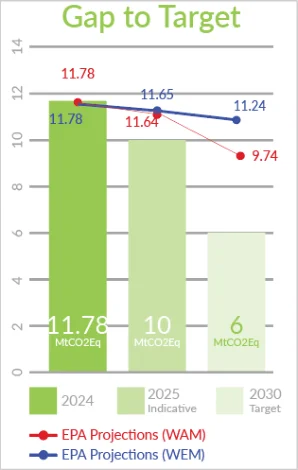
Figure 4: Gap to Target – Transport
| Figure 3: Transport sector emissions share in 2024 |
10 new Transport Actions were due for
completion in Q4 2025. Of these, 4 were
completed on time, including a targeted
follow-up advertising campaign encouraging
a switch to sustainable transport modes, as
well commencing theconstruction of the
Liffey Valley core Bus Corridor scheme in
December 2025 with an expected
completion date of 2028.
Of the 5 delayed CAP25 Q3 Transport
Actions, only one was completed this
quarter – commencement of work to
develop a new Sustainable Mobility Policy
Action Plan for 2026 to 2030.

Figure from page 8
Transforming How We Travel
2025 and 2030 EV Targets
Legacy Actions
Publish National Demand Management
Strategy Q Publish Policy Statement on Mobility Hubs No new high impact reportable actions for Restore Shannon-Foynes to Limerick rail delivery this quarter freight line
go Delivery of c.150 charging points under the Destination Charge Point Scheme
x) Progress renewable fuel legislation
g Completed on Time ’) Completed subsequently
x) Delayed 4
- Based on Fuel Excise Clearances data which provide a proxy for sales and the associated level of consumption.
Delayed CAP25 Action TR/25/15 Roll out of key elements of electric vehicle (EV) Infrastructure Strategy
While all schemes under this Action have been launched, the roll out of key elements of the EV Infrastructure Strategy has been delayed in 2025. Significant work in this area has taken
place. For example:
e An initial batch of Light Duty Vehicle (LDV1) sites have been connected to the grid (8 chargers) and were operational before the end of 2025 and work is now continuing to move the LDV1 charging programmes into full delivery. Most of these sites were impacted by a lack of grid capacity. It is expected that the remaining sites will have access to the grid in H1 2026.
These initiatives will significantly expand high-power charging availability across the national, regional and local road network, creating a more convenient and reliable system for drivers nationwide. The LDV2 scheme was awarded in 2025, and several locations were energised in 2025, as per CAP24 legacy action TR/24/22.
Local Authorities are continuing to develop their EV Charging Infrastructure Strategies and will commence implementation planning for projects arising from these strategies in 2026.
Zero Emission Vehicles Ireland (ZEVI) has developed a Local Authority EV Charging infrastructure pilot programme, aiming to develop knowledge and explore innovative solutions for EV charging infrastructure across Local Authorities. Work will continue regarding the roll out of 26 pilot projects across 15 Local Authorities. These pilots include new innovations in renewables, battery backup, behind the meter solutions and flexible payments such as discounted off-peak Neighbourhood Charging. The roll out of these pilots will complete in Q4 2026 and follow the delivery of the first pilot in Westside, Galway City earlier in the year. All infrastructure implementation planning will commence in 2026 and thereafter will be multi-annual as move to delivery in 2027.
Overall, there has been steady growth in the number of EV registrations in Ireland. In October 2025, the Minister for Transport announced that Ireland had already met its CAP target of 195,000 EVs on the road by year-end, a key milestone in the nation’s transition to cleaner transport. By the end of Q4 2025, more than 200,000 EVs had been registered. The EV
Infrastructure Strategy will continue to be critical to keeping pace with this continued growth.
4 Electricity
Energy industries (primarily electricity generation) accounted for 12.3% of national
emissions in 2024. Electricity emissions decreased for a third consecutive year in 2024
and are now at an all-time low across the 1990 to 2024 time series at 7.2 Mt CO2eq.
Reductions are in part due to the increased share of net electricity imports as well as
increased renewable generation. In 2024, renewables accounted for c.40% of electricity
demand in Ireland.
Gap to Target
my
Electricity 12%
Figure 5: Electricity sector emissions share in 2024
=—@® EPA Projections (WAM) “© EPA Projections (WEM)
Figure 6: Gap to Target - Electricity
3 new Electricity Actions were due for completion in Q4, none of which were completed on time. These include key Actions such as Develop a data sharing framework regarding low carbon technologies (LCT) connected to the electricity grid and demand
None of the 2 previously delayed CAP25 Electricity Actions nor the 6 outstanding Electricity Actions from CAP23 and CAP 24
were completed in Q4.
As of end-December 2025, Ireland fell short of its 2025 target, achieving 5.028GW of installed onshore wind capacity (c.84% of the 6GW target).
Develop. consumer-led _ flexible
Processes.
hy Powering Renewables
Electricity KPI —Installed wind capacity
10 = 8 @ & = & GS 2 of 0 2018 Baseline 2022 2023 2024 2025
Legacy Actions
Publish the Renewable Electricity Spatial Policy Framework
ooo 8 8 8
Publish a roadmap for the development and implementation of Regional Renewable Electricity Strategies
Revise National Planning Framework to include capacities to allocate national renewable targets regionally
Publish Regional Renewable Electricity Strategies
Develop a Private Wires Policy Framework
Implement Hybrid Connection Roadmap
g Completed on Time iY) Completed subsequently
xX) Delayed
A new National Planning Statement (NPS) on Wind Energy under the new Planning
and Development Act 2024 will address key policy considerations such as noise, setback distance, shadow flicker, community obligation, community dividend and grid
connections.
Work to advance guidance on the noise aspect of the National Planning Statement,
which is highly technical in nature, is now substantially complete.
In line with EU Directive requirements, a Strategic Environmental Assessment (SEA) will be carried out on the draft National Planning Statement. It is intended to undertake a public consultation on updated draft NPS as part of the SEA process whereby all interested parties will have an opportunity to submit observations on the draft National Planning Statement. The finalised National Planning Statement will be prepared following detailed analysis and consideration of the submissions received
during the consultation phase.
fi ~) 13
Pages 8–13 · View in original PDF