2 Agriculture
Text from pages 6, 7 of the source PDF is machine-read (OCR) from a scanned image and may contain recognition errors.
2Agriculture
Agriculture was responsible for 36.2% of national emissions in 2024, making it the
largest GHG emitting sector in Ireland. There are additional agriculture-related emissions
from grasslands used for farming, which are accounted for within LULUCF emissions. In
2024, agricultural emissions were 20.45 MtCO2eq, a decrease of 1.3% on 2023 levels.
This decrease was driven in large by reductions in overall cattle numbers. In 2024,
methane (CH4) emissions contributed 71.2% to the Agriculture sector, originating from
enteric fermentation, manure management and fuel combustion.
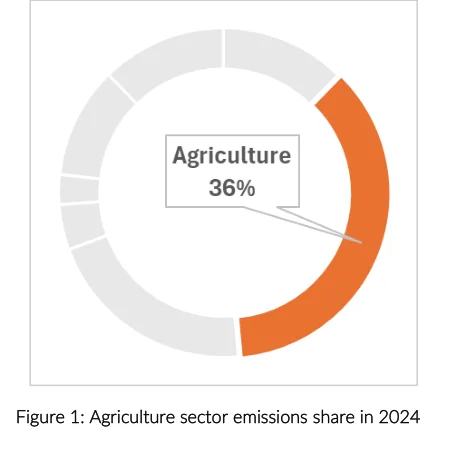
Figure from page 5
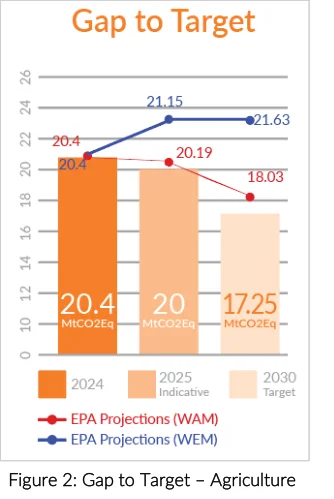
Figure from page 5
Figure 1: Agriculture sector emissions share in 2024
At the end of Q4, one CAP25 Agriculture
Action remains outstanding in relation to the
challenge of securing access to, and cost of,
feed in the organic livestock sector’ (see
case study).
CAP25 Q2 Action AG/25/4, Publish Action
Plan on Reducing Age of Slaughter, has been
completed. Minister Heydon launched the
‘Improved Liveweight Performance Action
Plan,’ to enhance economic and
environmental sustainability across Ireland’s
beef sector.
Makin Eto °
More Sustainable
500,000 400,000 400,000 wo ’ ® 300,000 350,759 348,719 5 312333 345,761 335,266 8 200,000 100,000 0 2018 Baseline 2022 2023 2024 Q4 2025
Legacy Actions
Establish group and finalise an implementation report for a just climate transition in agriculture
Review maximum nitrogen limits Publish draft carbon farming framework
New/updated measures from the Teagasc MACC included in the Climate Action Plan
Industry agreement for tracking the use of methane reducing ingredients
—) Cow reduction scheme
Completed on Time Completed subsequently
Delayed
Discontinued
lreland’s Climate Action Plan sets ambitious targets for expanding organic farming, improving biodiversity, and reducing reliance on chemical fertilisers. A major barrier to achieving these goals has been identified in a lack of domestic organic feed milling
capacity, which limits growth in both organic livestock and tillage sectors.
A 12-month Policy and Strategic Studies Research Call (PSSRC) Project, Feasibility
Assessment for Organic Feed Milling (FARM), has been agreed and a researcher
appointed with work to begin December 2026.
This research will address four core objectives to provide a framework to allow the
sector to move forward, as follows: Assess current and future farm-level production of organic feed crops in Ireland
° Evaluate the technical and economic feasibility of organic feed processing
options post-farm gate
° Analyse environmental, social, and economic sustainability impacts across the
value chain Identify policy and support mechanisms to enable organic feed milling capacity
° The findings will inform farmers, industry stakeholders, policymakers, and the
wider agri-food sector.
Completion date is now expected to be Q4 2027.
Pages 5–7 · View in original PDF