15.1 State of Play
15.1 State of Play
15.1.1 Trends in the Transport Sector
The sectoral emissions ceilings agreed by Government set the required level of abatement to be achieved in the transport sector by 2030 at 50%. In quantitative terms, this legally binding target thus obligates the transport sector to achieve a reduction from its 2018 emissions baseline of 12.2 MtCO2eq. to 6.1 MtCO2eq. by 2030, and to do so in a manner that is consistent with a sectoral emissions ceiling of 54 MtCO2eq. for the first carbon budget period (2021-2025), and a further reduced sectoral emissions ceiling of 37 MtCO2eq. over the second carbon budget period (2026-2030).
Table 15.1 – Required Level of Decarbonisation for Carbon Budgets 1 and 2
| Sectoral Carbon Budget 2021 to 2025 MtCO eq. 2 | Cumulative Emissions to 2022 | Remaining Sectoral Carbon Budget 2023 to 2025 MtCO eq. 2 | Sectoral Carbon Budget 2026 to 2030 MtCO eq. 2 |
|---|---|---|---|
| 54 | 22.6 | 31.4 | 37 |
Table 15.2 – Required Level of Decarbonisation for the Transport Sector
| 2018 Emissions MtCO eq. 2 | Indicative Target for 2025 Emissions MtCO eq. 2 | Indicative Target % Reduction for 2025 | 2022 Emissions MtCO eq. 2 | % Increase (+) / Reduction (-) to date |
|---|---|---|---|---|
| 12.2 | 10 | 20% | 11.6 | -5% |
At the midway point of our first carbon budget, the Environmental Protection Agency’s (EPA) provisional emissions inventory for 2022 and its long-term projections reflect the continuing challenge and scale of the system and behavioural transformation required in transport to meet our emissions abatement targets.
While the structure for the sector’s decarbonisation pathway set out in CAP23 was naturally skewed to deliver the greatest share of emissions abatement in the second half of this decade, the cumulative emissions over the first two years of the carbon budget programme (22.6 MtCO2eq.) suggests that, at present, the transport sector is currently aligned to the required compliance pathway to 2025, with 41.9% of carbon budget 1 consumed over those first two years.
It is important to note however, that the sector’s emissions were artificially depressed in 2021 as a continued legacy of Covid-19 public health restrictions, and transport emissions over both 2021 and 2022 have seen increases in emissions of approx. 6% per annum with the ending of pandemic restrictions and the return to pre-Covid levels of economic activity.
Though the overall emissions trend since 2018 is downward and 2022 emissions were 4.5% lower than 2018 levels, the scale of abatement required (5.2% p.a.) over the period 2023-2025 highlights the urgent need to reverse this recent rebound in emissions to avoid jeopardizing the sector’s capacity to achieve its abatement pathway in future years.
Decoupling the direct correlation between transport emissions and wider social and economic activity thus forms the fundamental challenge for the sector. For this reason, the focus is on pursuing measures to address travel demand - in the first instance by pursuing policy measures that promote greater efficiency in our transport system, allied with significant investment in sustainable alternatives and incentives and regulatory measures to promote the accelerated take-up of low carbon technologies
While factors such as enhanced levels of blended and remote working that were established during the pandemic may have disrupted some linkages across transport and economic activity, the strong rebound in transport demand and associated 6% growth in transport emissions witnessed in 2022 reflects the rapid return to economic growth, full employment, and continued population growth in Ireland, following a prolonged period of artificially reduced activity.
Deepening our understanding of the potential economic impacts – both positive and negative – of various decarbonisation measures in transport, and ensuring that the correct balance is achieved, will continue to be a key consideration in policy and programme development. These economic considerations apply not only to specific measures, but also to the cumulative impacts of all measures given the highly integrated nature of the transport system. Naturally, the social impacts and implications in achieving a Just Transition will also be of paramount importance.
Table 15.3 – Latest GHG Emissions
| Sector Emissions MtCO eq. 2 | Share of Total GHG Emissions | Emissions tCO 2 per capita |
|---|---|---|
| 11.63 | 17.1% | 2.28 |
Table 15.4 – Trends in GHG Emissions
| Timeframe | Percentage Change | Absolute Change MtCO eq. 2 |
|---|---|---|
| 2018-22 | -4.5% | -0.55 |
In the context that CAP23 was the first action plan which took the legally binding carbon budgets and established sectoral emissions ceilings into account, a significant change in transport policy approach was also set out therein – adopting and applying the AVOID- SHIFT-IMPROVE framework for greater transport sustainability, underpinned by detailed transport modelling and stakeholder consultation.
Table 15.5 again sets out the key 2030 metrics required to achieve our emissions targets, and these metrics were informed by a detailed programme of transport modelling undertaken with the National Transport Authority, on the level of change required to be delivered to achieve our 50% abatement ambition. As such, it is not currently expected that these targets will require significant change in future updates in the short- or mediumterm, though the Department will continue to monitor trends and update its modelling where such corrective action is necessary.
This modelling leveraged the NTA’s Regional Modelling System, which is underpinned by a National Demand Forecasting Model (NDFM) that accounts for projected demographic growth and spatial planning data. This is considered to be the most robust tool available to the Department of Transport capable of estimating overall emissions impact and the behavioral responses to potential interventions and policy measures at a national level.
15.1.2 Stocktake of Abatement Progress to Date and Corrective Actions Required
In terms of taking stock of abatement progress to date and in relation to whether any corrective actions are required, EPA projections (as shown below) have estimated a potential cumulative 5-year overshoot of approximately 1 MtCO2eq. of the sector’s first carbon budget by 2025 without further corrective action. Over this period, the capacity to deliver large-scale mitigation measures through the provision of new major public transport infrastructure and services, or through a significant shift of the vehicle fleet to zero-emission alternatives is limited. EPA projections for the second carbon budget period also suggest that this level of overshoot continues over the 2026-2030 period, leading to a cumulative projected deficit of approximately 5 MtCO2eq. relative to the sector’s 37 MtCO2eq. carbon budget over 2026-2030.
Figure 15.1 – Transport Sector Emissions Relative to the Sectoral Emission Ceilings and EPA’s ‘WAM’ Scenario Projections104
Acknowledging that there is a significant difference in the modelling approaches between the two agencies, the Department of Transport will continue to engage with the EPA on differences between the EPA’s and National Transport Authority’s (NTA) projections, including through multi-stakeholder engagement with the Sustainable Energy Authority of Ireland. While a degree of divergence will always be expected between different models, it is expected that further work to align modelling and growth assumptions could result in closer agreement of current emissions projections.
104 A more detailed graphic regarding the Transport sector’s emissions relative to Sectoral Emission Ceilings and EPA projections is available in Appendix 1
FIGURE MAY NOT SUM DUE TO ROUNDING
WAM emissions Emissions remaining under SEC
Emissions used under SEC
Transport sector SEC 2021-2025 and 2026-2030 and projected emissions in WAM scenario, Mt CO2e
• The transport sector has SECs of 54 and 37 Mt CO2e for periods 2021-25 and 2026-30 respectively
55 Mt CO2e
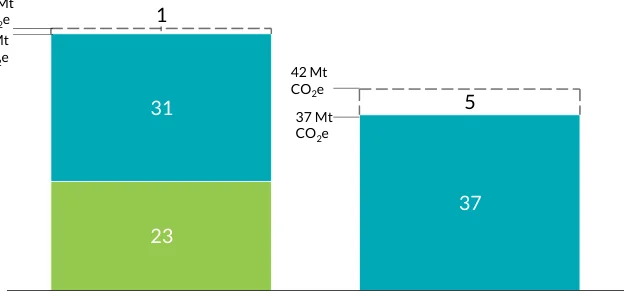
Figure 15.1
1
54Mt CO2e
• ~ 23 Mt CO2e of the transport 2021-2025 SEC were used in 2021-22, leaving ~31 Mt CO2e remaining for 2023-25
42 Mt CO2e
5 31
37 Mt CO2e
• EPA WAM projects transport emissions to be ~1 Mt CO2e above the transport SEC for 2021-25 and 5 Mt CO2e for 2026-30
37
23
2021-2025 2026 -2030
Sources: Climate Action Plan 2023 (Govt of Ireland, December 2022); Ireland’s Greenhouse Gas Emissions Projections (EPA, June 2023 .
Nonetheless, it is also important to recognise that progress is being made in transport and to acknowledge positive signals across several areas.
In public transport, the NTA’s Connecting Ireland Rural Mobility Programme is delivering new rural bus services in our towns and villages at a rate of approximately one new service every week, with over 110,000 weekly vehicle kilometres added to the public transport network in 2022 through new services, frequency enhancements and route extensions. As a result, over 50 settlements were newly connected to the public transport network, facilitating crucial access to health services, education and employment opportunities, and reducing reliance on unsustainable private transport.
As part of a package of cost-of-living support measures, Government introduced a 20% average fare reduction on Public Service Obligation (PSO) services, the first such reduction in 75 years, to help combat the rising cost of living, and to encourage and facilitate greater uptake of our public transport services. Over 328,000 young adults and students have benefitted from a further 50% reduction with the introduction of the Young Adult Scheme on PSO services in May 2022 and in September 2022 on participating commercial services.
Patronage on the expanding network of Connecting Ireland and Local Link bus services, as well as average daily passenger numbers on bus and rail services have also seen exceptional growth and recovery from Covid-19, bucking international public transport trends experienced elsewhere.
The recent CSO Census 2022 data has also highlighted that while levels of transport demand have increased, there are encouraging changes in behavioural trends and an appetite for change when the right type of investments and decisions are made at local and
national level, in particular with respect to reversing the trend in total share of children and young people being driven to school.
Irish drivers are also accelerating the switch to electric, with EV sales remaining ahead of our profiled trajectory to our 2025 targets, with over 100,000 EVs on our roads as of end-August 2023, and electric vehicle uptake can also be expected to be bolstered by significant expansions in our public charging infrastructure in coming years.
The EPA’s data also highlights the increasing role of renewable fuels in transport, which saved an estimated 0.6 MtCO2eq. of emissions in 2022. Regulations supporting a transition to up to 10% bioethanol fuel blending in petrol (gov.ie/E10) came into force on 1 July 2023 in accordance with our Renewable Transport Fuel policy, and similar renewable transport fuel blending in diesel to deliver an equivalent 20% biodiesel blend by 2030 can also be expected to deliver greater levels of abatement in coming years.
2023 has also seen the publication of new national policies, plans and strategies as well as European initiatives under the Fit for 55 package that will bolster and reinforce our decarbonisation pathway. These include:
Our National EV Charging Infrastructure Strategy and associated National En-route EV charging plan;
A revised Greater Dublin Area (GDA) Transport Strategy;
The Renewable Fuels for Transport Policy Statement 2023-2025;
The roll-out and implementation of the first projects under our Sustainable Mobility Policy (SMP) Pathfinder Programme (including the first all-electric town bus service in Athlone);
The launch of the ‘Your Journey Counts’ advertising campaign;
The adoption of key EU files such as the Alternative Fuels Infrastructure Regulation, FuelEU Maritime and forthcoming ReFuelEU Aviation regulation that will enable further emissions abatement.
15.1.3 Managing Risks to Delivery
However, while progress is being made, there are significant internal and external risks and challenges to delivery which need to be acknowledged. Various challenges were recently noted by Government in the context of delivering public transport and active travel infrastructure, with similar challenges experienced across all abatement channels. These are reflected below:
Inflation and Exchequer Funding: Delivering the policies, services and infrastructure required to achieve emissions targets requires sustained and significant Exchequer funding across all areas; including public transport capital investment, enhancements in public transport service provision, EV charging Infrastructure, EV incentives, and improved active travel and public realm projects.
Such state investment can achieve benefits beyond carbon abatement and must be considered in the broadest terms - including the counter-factual costs of inaction. As with all capital projects across Government, high levels of inflation (estimated up to 25%) have reduced the level of output that can be delivered for a fixed level of investment, including in the areas of Public Transport project delivery and active travel infrastructure. Increased inflation results in a re-baselining of forecasted project costs with obvious knock-on implications for National Development Plan (NDP) allocations which were set in 2021.
Project Delivery Delays, including Planning: While progress is being made, there are several institutional processes currently impacting the delivery of transport infrastructure/services to provide more sustainable travel alternatives, including in the overall planning system, as well as stakeholder consultation and other necessary approvals / consenting processes.
Public Service Obligation: Record capital investment in public transport infrastructure will need to be complemented by increased and expanded public transport services as supported under current funding through the Public Service Obligation (PSO) subsidy. A significant expansion of services is required to meet our NDP and CAP commitments, which coupled with inflation-driven contract increases, has meant a higher proportion of the PSO cost has been met by the Exchequer in recent years. To maximise the benefit of capital investment, the Department of Transport will continue its close engagement with the Department for Public Expenditure, NDP Delivery and Reform to align current funding requirements and fare revenue generation for services with the delivery of major infrastructure projects.
Supply Chain Issues: Although recent supply chain issues - which arose from both the COVID pandemic and war in Ukraine - are less of an issue in 2023 than in recent years, the delivery of new bus and rail fleet, as well as the global EV supply chain, is still subject to some delays.
Public and Political Acceptance: The political will and public acceptance for policies required to achieve a necessary reduction in carbon emissions, which in some cases require a fundamental level of individual and societal behavioural change, will continue to be a critical success factor out to 2030 and beyond.
Market Capacity and Skills: Ireland, like many other economies, is experiencing a skills shortage in many areas. Examples include both the local government and private sectors, and range from infrastructure designers, consultants and construction specialists, to operatives, mechanics and public transport drivers. Such shortages, which are not unique to Ireland, inevitably impact the speed of infrastructure delivery (in both public transport and active travel) and the level of public transport services. There are also significant additional demands on transport agencies and local authorities to support the high level of ambition contained in this plan.
Charging Infrastructure and Renewable Transport Fuels: There are a range of technical and supply chain risks to the roll-out of EV charging and alternative fuel supply and infrastructure –
including high powered charging infrastructure - which must be closely managed in order to ensure achievement of our carbon emission reduction targets.
Addressing these risks and challenges requires a range of responses including a clear prioritisation of the demands being made on the system against their potential to contribute to the abatement targets set, along with a cross-Government partnership approach, involving relevant departments, local authorities, industry, academia, and wider society. This collaborative system-wide approach is reflected in the membership and terms of reference of the structures established to steer delivery of the transport decarbonisation pathway (notably the Leadership Group for the Sustainable Mobility Policy, Zero Emission Vehicles Ireland (ZEVI), the Road Freight Forum, the National Steering Group for the Demand Management Strategy and the Inter-Departmental Group on Alternative Fuels for Transport) and the strong emphasis on regular public engagement and stakeholder consultation in the development of the associated policies. Consideration of the wider risks to delivery of the Climate Action Plan, across all sectors, is also a key aspect of the Climate Action Delivery Board role.
15.1.4 Critical Role for Public Sector and Local Authorities
As outlined in Chapter 10, the public sector also has a key leadership role to play, both in embedding climate action as a central value and objective across all its organisations, and as a catalyst for ambitious climate action across wider society.
Local authorities (Chapter 19) are particularly critical to implementation and delivery in transport, owing especially to their role in the spatial and land use planning system, their capacity to promote and implement sustainable settlement patterns and compact growth and in supporting the delivery of EV charging infrastructure networks and other sustainable transport infrastructure, notably through sustainable parking policies the delivery of public realm improvements and reallocation of road space. They also play a vital role in providing leadership and supporting the engagement of communities to move toward more sustainable transport behaviours.
Local authority capacity was recognised as a key delivery risk in the context of the Sustainable Mobility Policy (SMP) and associated Pathfinder Programme. To better understand the risk and identify potential mitigating actions, the Department of Transport has engaged extensively with local authorities in 2023. The output from this engagement was shared with the Department of Housing, Local Government and Heritage (DHLGH) in the context of considering broader policy supports for Local Authorities.
15.1.5 Climate Change Advisory Council Recommendations
The following textbox highlights key recommendations of the Climate Change Advisory Council (CCAC) for the transport sector, which have been considered in this annual CAP update. In its preamble to the recommendations for the transport sector, the CCAC Annual Review 2023 welcomed the CAP23 introduction of the Avoid–Shift–Improve hierarchy for greater transport sustainability, which is retained in Climate Action Plan 2024 (CAP24). Specific references are made to these recommendations in the following measures section (15.2) where they are being addressed or taken into account. Some recommendations relate to policy areas covered in other chapters.
Climate Change Advisory Council Recommendations
-
Ireland’s transport system needs to make accessible, sustainable transport modes more attractive and shift away from car dependency through consideration of the proximity between people and places in land use and housing policy.
-
The compact growth target in the current National Planning Framework is insufficiently ambitious to achieve the low-carbon transition in the transport sector. The review of the National Planning Framework needs to reassess how Ireland approaches compact growth (housing density) and how it is measured from a spatial perspective.
-
Poor economic incentives for urban brownfield/infill development need to be addressed in order to limit further urban sprawl, along with the development of improved incentives for urban living and the revitalisation of vacant urban buildings.
-
Urgent investment is needed to improve the accessibility and reliability of public transport services in addition to road space reallocation, along with a fully interactive app with improved data on bus reliability and capacity. The ongoing programme of Public Service Obligation bus fleet replacement and depot charging upgrades should be expanded and accelerated with a focus on the electrification of public transport to support air quality goals.
-
The Council recommends that choices need to be made now on the design and implementation of demand management measures through the development of the National Demand Management Strategy. This should use proven approaches to drive behavioural change such as road pricing (e.g. congestion charging, low-emission zones), parking restraints and fuel pricing. The TaxSaver commuter ticket scheme and the Cycle to Work scheme should be updates, alongside the implementation of Part 18B of the Finance Act (No. 2) of 2008 (Parking Levy in Urban Areas) in the major urban areas of Cork, Dublin, Galway, Limerick and Waterford.
-
The current reduction in school transport scheme fees and in public transport fares should be continued in Budget 2025. Access to school buses under the scheme should be significantly expanded. The Council recommends an assessment of the impact to date of the reduction in public transport fares on emission reduction as an input to longer term fare strategy development.
-
Local Authority Climate Action Plan Guidelines should include specific actions and indicators in respect of accessibility, modal shift and active travel. The local authority of each city should introduce park and ride schemes along major arterial roads (by 1 January 2030), as well as produce (by 1 January 2025) and deliver (by 1 January 2030) a plan to reduce the number of public city centre parking spaces.
-
Motor tax should be recalibrated to promote resource and energy efficient vehicles and should escalate year by year. Vehicle Registration Tax percentage rates for all category A vehicles (EU category M1) bands, except the least-polluting band, should also increase.
-
Electric vehicles present a means of achieving significant reductions in emissions, particularly in rural areas, and improvements in the charging infrastructure and incentives for uptake are important measures in the short term. A policy for the roll-out of vehicle-to-grid-enabled electric vehicles with bidirectional home charging should also be urgently prepared.
-
It is recommended that the target for commercial electric vehicles should be increased to 150,000 by 2030 from the current target of 95,000 to support decarbonisation of commercial vehicle activity, with consideration of additional incentives to support adoption by businesses.
-
The Council welcomes work carried out in the last year to assess the challenges associated with biofuel blending and recommends continued assessment and transparent reporting in this area.
-
A national certification/accreditation system for eco-driving programmes as identified in the Road Haulage Strategy (December 2022) should be established immediately along with a policy for the development of freight consolidation centres. A step up in ambition is also required on the future role of Ireland’s rail network in order to significantly increase the proportion of inland freight tonnage moved by rail.
-
Ireland needs to develop a strategy for increasing the share of sustainably sourced aviation fuels.
Pages 233–241 · View in original PDF