19.1 State of Play
19.1 State of Play
19.1.1 The Reach and Role of Local Government
Local government in Ireland comprises 31 local authorities and three regional assemblies (see graphic below). Local authorities have a key role to play in implementing the measures needed to meet Ireland’s national climate targets.131 This role will increase with the development and implementation of Local Authority Climate Action Plans in each local authority area.
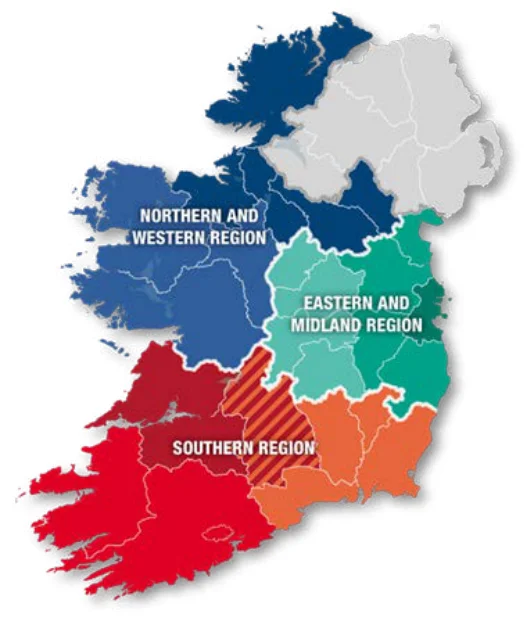
Figure 19.1 Local Government Structures
There are three regional assemblies - the Northern and Western, the Eastern and Midland, and the Southern Regional Assemblies. The Assemblies provide the strategic link between the EU, national and local levels, and coordinate spatial, environmental and economic planning through the statutory Regional Spatial and Economic Strategies. They administer
131 This chapter does not provide detail on the sectoral measures which have local authority involvement. For example, local authorities play a key role in areas such as social housing retrofit and public realm initiatives (Built Environment chapter), spatial planning and Development Plans (Carbon Pricing and Cross-Cutting Policies chapter), facilitating the development of more district heating networks (Built Environment chapter) and expanding renewable energy generation to meet targets for on-shore wind and solar as identified by Regional Assemblies (Electricity chapter), onshore renewables (Electricity chapter) and climate adaptation (Adaptation chapter), transport and roads (Transport chapter), citizen engagement (Citizen Engagement chapter). For full information on local government’s role in these areas the reader is invited to consult the relevant chapters.
European funding and provide a coordination function with a democratic mandate provided through elected members from local authorities.
Local authorities are multi-purpose bodies which are responsible for delivering a broad range of services which impact on climate. This includes economic and community development; environment; recreation and amenity; roads and active travel; social housing; spatial planning; and waste management. As well as playing a critical role in climate mitigation, the sector is at the front line of climate adaptation and emergency planning (see Adaptation Chapter for more on adaptation measures).
In 2021, local authorities invested almost €9.5bn in the services they provide to the public.132 They provide around 135,000 social homes, construct, manage and maintain almost 100,000 km of regional and local roads, and employ close to 30,000 people.
Local authorities and regional assemblies are independent corporate entities. The Department of Housing, Local Government and Heritage oversees the operation of the local government system in broad terms, providing the general policy and statutory framework within which local authorities and regional assemblies work and deliver services. The Irish Constitution recognises the role of local government in providing a forum for the democratic representation of communities and in exercising and performing powers conferred by law.
Local government collaborated with the Department of the Environment, Climate and Communications (DECC) to agree a Climate Action Charter (2019) which acknowledges that local government is ideally placed to provide robust leadership in advancing the climate objective at the local and regional level. The Delivering Effective Climate Action 2030 Strategy (2020) sets out a roadmap to deliver on climate commitments by the local government sector. It sets out objectives for local authorities to maximise their collective impact on Ireland’s national climate targets.
A number of Irish local authorities are signatories to the Global Covenant of Mayors for Climate and Energy, an initiative supported by the European Commission bringing together thousands of local governments that want to secure a better future for their citizens.
19.1.2 Climate Action and Local Carbon Development (Amendment) Act 2021
The policy making and implementation role of local government in support of national and international climate action has been expanded through climate legislation. There is a greater emphasis on local authorities and regional assemblies as leaders in creating more sustainable, cleaner, biodiversity rich administrative areas.
132 Department of Housing, Local Government and Heritage, Local Government Finance Unit. Figures includes capital expenditure and current (revenue) expenditure for 2021.
The Climate Action and Local Carbon Development (Amendment) Act 2021 provides for an additional Section 14B (1) of the Climate Action and Low Carbon Development Act 2015 in relation to the role of Local Authorities. This sets out that each Local Authority shall prepare and make a plan (referred to as a Local Authority Climate Action Plan – LA CAP) specifying the mitigation and adaptation measures to be adopted for a period of five years. The plans are due to be adopted in early 2024, having gone out to public consultation and following adoption by the elected members in each Local Authority.
The Climate Act amends the Planning and Development Act 2000 by stating that Local Authority Development Plans must take account of the Local Authority Climate Action Plans. As stated in the Planning Act, Local Authority Development Plans shall include objectives for the promotion of sustainable settlement and transport strategies including the promotion of measures to reduce emissions and address climate adaptation, taking account of any Local Authority Climate Action Plan, in particular in relation to the location, layout and design of new development. The City and County Development Plans are the key statutory documents in delivering policy change at Local Authority level.
In addition, the Maritime Area Planning Act 2021 inserted section XXI and amended section XV of the Planning & Development Act. Under the Maritime Area Planning Act 2021, coastal Local Authorities have certain responsibilities in an area up to three nautical miles beyond the high-water mark. As a result, they could have a more active role in coastal management in the coming years, which is relevant given increased flooding, erosion, sea level rise, wetland loss, inappropriate development etc.
19.1.3 Taking a Place-Based Approach
Local government impacts on the day-to-day life of citizens by performing vital services that support local communities and economic development. Local Authorities prioritise different needs and implement different climate actions based on prevailing climate change risks, demographics and the characteristics of the area: for example, whether coastal or inland, a large city region or a small rural jurisdiction.
The public sees their Local Authority as a key player in delivering solutions to address the climate and biodiversity challenge. In the Climate Conversations survey, 69% of respondents identified Local Authorities as having an extremely important role in delivering on climate action, fourth highest after the Irish Government, the EU and business and industry.133
Local connectedness and place attachment can be powerful motivating factors in climate decisions. The regional and local scale is a key site for participation to influence policy and gain public acceptance for policy proposals and local government is best placed to harness this.134 Local Authorities being best placed to respond to climate change is their proximity to citizens and that they can take more of a place-based response.
133 Government of Ireland (December 2022), Climate Conversations 2022: Summary Report. 134 See research from, e.g. Tubridy et al., 2021, Lowndes et al., 2006, Burton et al., 2006, Rosenzweig et al., 2010; Carter et al., 2015.
Local Authorities can build momentum as the most direct connection that citizens and local communities have with government.
Local Authorities are the main method for engagement with community groups and organisations. They are conduits for information and consultation and assist them to deliver local projects and initiatives. In each Local Authority area there are Local Community Development Committees which operate as independent committees of the Local Authority and they bring together elected members and officials, state agencies and those working in local and community development and economic, cultural and environmental organisations. They work closely with communities and were established to develop and implement a coherent and integrated approach to local and community development through a Local Economic and Community Plan (LECP), which has a climate focus. Each LCDC is required to proof their plan from a sustainability and climate action perspective.
Box 19.1. Integrating Climate and Community
Sligo County Council – Local Economic and Community Plan
Sligo County Council’s Local Economic and Community Plan, Sligo 2030 One Voice One Vision, was launched in June 2023. It is a strong example of a Local Authority and a Local Community Development Committee (LCDC) working together and taking a collaborative, integrated approach to climate action and smart modelling alongside other key economic and community priorities.
The plan seeks to position Sligo as a progressive county that is aiming to be smart, sustainable, and transformational, embracing change and creating innovative solutions. The vision is for a smart, sustainable, and socially inclusive Sligo – one that cherishes its vibrant communities, protects and celebrates its unique environment and rich culture, and is a champion of innovative growth.
This vision has been developed in a collaborative manner and has been informed and refined through consultation with key stakeholders and the wider community. This is a shared vision which brings together urban and rural communities and generates a shared sense of ownership, driving Sligo forward to realise its potential as it moves towards 2030.
Nine transformational ideas were developed and inserted into the plan, including growing green businesses and next generation business eco-systems, livable neighbourhoods, and local champions of change. These ideas stem from viewing delivery though the smart model lens which frames the pillars of smart living, smart people, smart Government, smart mobility, and the sustainable economy and environment pillars.
19.1.4 Local Authority Leadership
Set against the backdrop of an evolving and more rigorous framework of national climate policy, local government maintains a strong commitment to pursuing a leadership role on climate action. As set out in the local government strategy on climate action, Delivering Effective Climate Action 2030, there is an overarching commitment to leadership to ensure a coherent approach to climate action across the administrative and political structures of all 31 Local Authorities.
This commitment acknowledges how well positioned Local Authorities are in their close relationships with their communities. It builds upon their extensive knowledge of the natural and built environments within their functional areas. It acknowledges their already established engagement in climate action measures with examples such as emergency response to severe weather events, flood alleviation measures, infrastructural provision, supporting the transition to sustainable transport, protecting the natural environment, energy efficiency and reduction and housing retrofits.
The way in which Local Authorities can respond to climate needs is shaped by the extent to which they have direct responsibility for a specific sector or measure. Direct responsibility for reducing carbon emissions relates to Local Authorities managing their own carbon footprint by reducing energy use in Local Authority buildings, infrastructure, vehicles, street lighting and water pumping etc. Local Authorities are directly responsible for typically less than 2% of total emissions in each Local Authority area.
Local Authorities have indirect responsibility for emissions partly through their regulatory role as planning authorities. A core function of Local Authorities is to develop a County or City Development Plan which plays a critical role in climate action. A Development Plan sets out land-use zoning and informs planning decisions. It provides the policy framework within which planning authority decisions on individual development proposals can be made and plays a key role in climate action through its capacity to promote sustainable land use and transport patterns for new development in urban and rural areas.
Development Plans are required to be consistent with higher tier national and regional planning strategies, including the National Planning Framework and the Regional Spatial and Economic Strategies. Development Plans will take account of Local Authority Climate Action Plans and other strategies such the Regional Renewable Energy Strategies to be prepared by the regional assemblies. This will enable spatial planning to be used as a key enabling instrument for emission reductions and prevention.
National and regional climate objectives are given effect in County/City Development Plans through specific policies and objectives that also reflect the local context. Section 10(2)(n) of the Planning and Development Act, 2000 (as amended) identifies climate action (adaptation and mitigation) as a mandatory objective to be included in all Development Plans. Adopted by the elected members of the Local Authority, the Development Plans are subject to a review and evaluation by the Office of the Planning Regulator to ensure consistency with national policy and guidance. See Cross-Cutting Policies Chapter for more.
Local Authorities provide over 1,000 services and many of these impact indirectly on greenhouse gas emissions. It can include supporting nature-based climate solutions through local strategies for blue - green infrastructure and ecosystem services, functions such as managing the public realm, building active travel infrastructure (see Transport Chapter), litter and street cleaning management. 135 This also includes a range of adaptation services at the local level (see Adaptation Chapter).
Much of what local government influences and shapes is through co-ordinating, facilitating and advocating. Local and regional government can champion and show leadership for a particular initiative. Local Authorities are effective in co-ordinating between different players, facilitating projects and identifying funding opportunities. A Local Authority has multiple communication channels which it uses to share information and influence people. Even where the role of a local authority is to deliver a particular service this often encompasses a strong element of local advocacy and engagement to facilitate and champion behavioural change. For example, in the area of active travel the role of Local Authorities is to deliver infrastructure but local advocacy and engagement with communities to encourage its use and to change travel habits is a key component of the work.
Pages 342–347 · View in original PDF