7.2 Just Transition Framework and Principles
7.2 Just Transition Framework and Principles
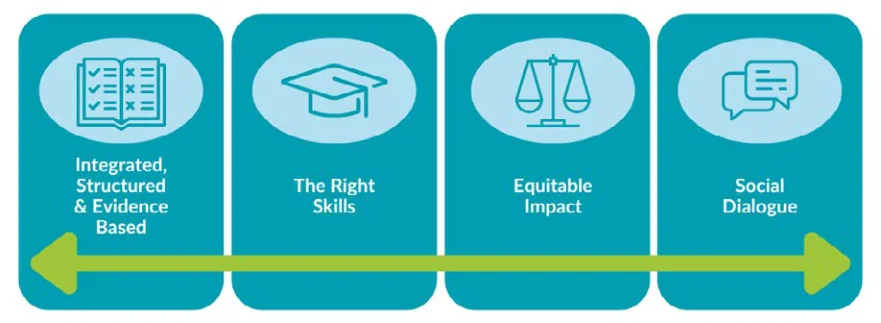
Figure 7.1 – Just Transition Principles
The just transition framework is made up of four principles:
-
An integrated, structured, and evidence-based approach to identify and plan our response to just transition requirements;
-
People are equipped with the right skills to be able to participate in and benefit from the future net zero economy;
-
The costs are shared so that the impact is equitable and existing inequalities are not exacerbated;
-
Social dialogue to ensure impacted citizens and communities are empowered and are core to the transition process.
By aligning design and implementation of climate policy with these principles, we can maximise employment opportunities, supporting those negatively affected by the transition.
7.3 Principle 1: An integrated, structured, and evidence-based approach to identify and respond to just transition needs as they emerge
It is likely that the future impacts of our transition to a climate neutral economy will be both incremental and broadly realised, with occupations closely linked to fossil fuels and agriculture practices more significantly affected. Concentrated impacts may also be seen in specific parts of the country.
7.3.1 An Integrated and Structured Approach
We have integrated the management of a just transition into the annual policy development and reporting cycle for climate action. Following extensive consultation with key stakeholders, Minister Ryan established a Just Transition Taskforce in 2023 which has brought the social partners together to make detailed recommendations to Government on the future structure, functions and membership of a Just Transition Commission. This will build on the mandate for a Commission set out in Climate Action Plan 2023, which proposed the following tasks for the Commission:
Monitoring the implementation of the just transition principles through successive Climate Action Plans , producing reports and recommendations to the Government and to the Oireachtas on progress;
Commissioning research to examine which sectors of the economy are most likely to experience disruption as a result of the transition, as well as exploring solutions to mitigate against these challenges;
Advising and supporting the Minister and Government in relation to social dialogue, including the NDCA, in a manner which effectively integrates just transition considerations;
Examining specific just transition challenges as requested by the Minister and providing recommendations to Government on potential solutions to mitigate against these challenges.
When established, it is envisaged that the Commission will provide long term, evidencebased, independent advice to the Government on the just transition implications of climate policy development and implementation, having regard to the Climate Action Plan and our Long-term Climate Strategy, including identifying potential responses to just transition needs as they emerge. The Commission will be able to build on the strong research evidence base and engagement through the NDCA, and the annual review from the Climate Change Advisory Council (CCAC), in order to develop its advice to Government.
In the preparation of annual Climate Action Plan and our periodic Long-term Climate Strategy, the Government and sectoral Ministers will have regard to the requirement for a just transition to a climate neutral economy which endeavours, as far as is practicable, to maximise employment opportunities, and support persons and communities that may be negatively affected by the transition. Each Minister will consider their respective climate policy responsibilities against the principles of the just transition framework set out above and any recommendations from the CCAC and the Just Transition Commission. Ministers will report to the Oireachtas on how the principles are being addressed within their sector, including the policies, mitigation measures and adaptation measures within each sector.
Figure 7.2 – Incorporation of Just Transition into Annual Climate Policy Cycle
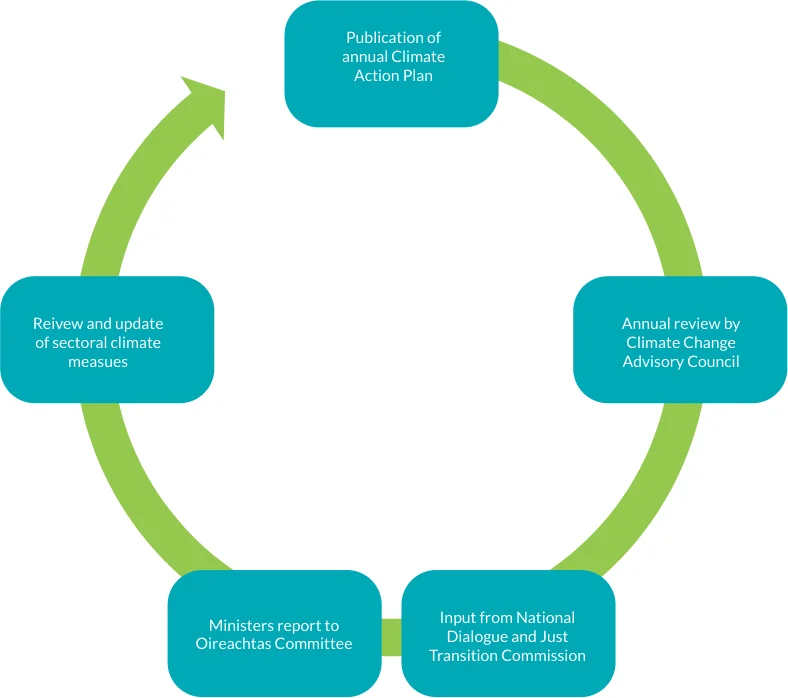
Figure 7.2 – Incorporation of Just Transition into Annual Climate Policy
Publication of annual Climate
Action Plan
Reivew and update
Annual review by
of sectoral climate
Climate Change Advisory Council
measues
Input from National
Ministers report to Oireachtas Committee
Dialogue and Just Transition Commission
The NDCA continues to gather input, on a rolling basis, about the key challenges facing individuals and communities in the transition, and this will be complemented by the development of a set of indicators for a just transition. The NESC will continue to provide strategic advice, research, and analytical support for a just transition and supporting analysis and dialogue in relation to sectoral issues.
7.3.2 Developing our Evidence Base
Our capacity to anticipate and plan for a just transition requires a robust evidence base to support policy development and effective ongoing monitoring. As our climate action progresses, there are incremental risks and opportunities in the context of a just transition – this may impact particular regions, sectors, or occupations. Existing analysis has helped to build a strong quantitative and qualitative evidence base for future policy design and implementation, including:
NESC reports on Addressing Employment Vulnerability as Part of a Just Transition in Ireland (2020) and Exploring a Just Transition in Agriculture and Land Use (2023), and related research publications such as Exploring Place-based Opportunities for Policy and Practice in Transition (2022);
The annual reviews and working papers of the CCAC;
A three-year research programme under the Energy Poverty Action Plan is being carried out by the Economic and Social Research Institute (ESRI), which includes energy efficiency, and income and energy poverty and health outcomes, and is informing the work of the Energy Poverty Action Plan Steering Group;
The Government published several important reports relating to Ireland’s bioeconomy, namely the second progress report on the implementation of the National Policy Statement on the Bioeconomy, the first report of the Bioeconomy Stakeholder Forum and the Circular Bioeconomy Outlook Study 2023-2050;
Teagasc’s annual National Farm Survey, which examines the micro-economic, environmental, and other socio-economic and socio-demographic indicators relating to the principal Irish economic farm types;
Ireland’s Territorial Just Transition Plan for the EU Just Transition Fund, where territorial designation was based on quantitative, qualitative, and spatial statistical analysis of impacts of the transition at municipal district level;
The Environmental Protection Agency’s Thematic Research Areas Assessment, which highlights how research can support the development of greater policy coherence for climate action, including in relation to supporting a just transition.
The 2023 Annual Review of the CCAC recommended the development of evidenceinformed just transition pathways across all sectors to reduce national greenhouse gas emissions and build adaptive capacity and resilience to climate change. It also recommended that a set of national indicators is developed to measure the implementation of the just transition principles across policy actions.
Work will begin in 2024 on the development of a suite of suitable indicators for adoption by Government, guided by measurement tools that currently exist, and by the processes that have been put in place to develop and report on our progress towards the Sustainable Development Goals, as well as the development of a national well-being framework.
7.4 Principle 2: People are equipped with the right skills to be able to participate in and benefit from the future net zero economy
7.4.1 Ireland’s Decarbonisation Opportunity
A climate neutral Ireland will bring new, green employment opportunities. The Climate Action Plan will drive the creation of new jobs with alternative skills requirements in individual sectors, including building retrofits, renewable energy generation, sustainable mobility, and new farming practices.
Climate action presents opportunities for existing supply chains and new business formation. As businesses take steps towards decarbonising and reducing their climate impact, there is an opportunity to develop and seize new employment opportunities.
The Government has committed funding to several different schemes at national and local levels to assist organisations in activities such as re-training, transitioning to lower carbon operations, and research and development. The Climate Toolkit for Business portal45 provides practical and cost-effective actions to support the low-carbon transformation of businesses, including signposts to available funding opportunities. Local Enterprise Offices (LEOs) or Education and Training Boards (ETBs) continue to scope re-training opportunities on a case-by-case basis.
7.4.2 Ireland’s System of Skills Development
SOLAS’s Green Skills for Further Education and Training Roadmap 2021-2030 is guiding the response of the further education and training sector to the future skills requirements of the green economy, including the development of specific and transversal green skills.
Continuous pre-emptive workforce development is required to maximise opportunities in the transition. Ireland’s higher and further education systems are providing in-demand training to respond to the decarbonisation of the economy by adapting existing provision, and putting in place additional training spaces where needed. Our further education model is centred on apprenticeships, transferrable skills, and lifelong learning, to keep pace with future changes. Ireland’s skills architecture will minimise skills mismatches and ensure our approach to skills development is routed towards the green transition and broader areas of opportunity and growth. Lifelong pathways between, and within, further and higher education and training will advance lifelong learning rates.
7.4.3 Forecasting Future Skills Needs
The Expert Group on Future Skills Needs report, Skills for Zero Carbon – The Demand for Renewable Energy, Residential Retrofit and Electric Vehicle Deployment Skills to 2030, sets out the demand for, and nature of, the skills required to deliver on key elements of Ireland’s Climate Action Plan ambitions to 2030. It identifies the nature and scale of the skills needs of enterprises supporting the transition to a low carbon economy and includes a suite of recommendations that can be drawn upon to ensure that these future skills needs are fully addressed. Regional Skills Fora continue to play an important role in identifying future skills needs emerging from a greener economy, feeding directly into the regional skills development pipelines through the ETBs. Each forum provides for ongoing regional engagement between the employment, enterprise, education, and skills sectors, such as LEOs, Enterprise Ireland, the Department of Further and Higher Education Research, Innovation and Science (DFHERIS), Skillnet, and ETBs.
To support Climate Action Plan delivery, and through the Offshore Wind Energy Programme, DFHERIS in collaboration with the Department of the Environment, Climate and Communications have established an Expert Advisory Group on the skills and workforce requirements for offshore wind, while Greentech Skillnet have undertaken an analysis of the skills and workforce requirements for offshore wind, completed in Q3 2023. Recommendations identified in this report will ensure that future output from the
45 www.climatetoolkit4business.gov.ie
tertiary sector is aligned with projected workforce requirements. Close collaboration between relevant partners in the education sector and industry experts will enable delivery of the skills, training, and education requirements for offshore renewables. Other key decarbonisation sectors may be subject to specific skills assessment analyses in future.
7.4.4 Support for Employees at Risk and Labour Market Activation
An upcoming challenge for training providers will be to identify which jobs are at risk and which are in demand, requiring monitoring of new types of jobs emerging and continually reviewing the skills needs of these new employment opportunities. The CCAC annual review 2023 emphasised that understanding vulnerability in the context of a just transition is essential, proposing that vulnerability assessments across society, the economy, the environment, and health are required to ensure a just transition across all sectors. This will ensure the protection of workers and those who will be negatively affected by the transition but also identify exposed groups more broadly, such as vulnerable communities.
Ongoing horizon scanning, including building on the Regional Enterprise Plans and Regional Skills Fora, is required to identify employment opportunities from the green transition, and mapping these to current training provision, setting out where new training and education courses are needed. Existing research highlights that it is critically important to enhance the skills, training advice, and supports for workers before they become unemployed, by delivering one-to-one coaching, counselling, and mentoring. This can be supported by making greater use of skills audits with at-risk workers to better identify transferable skills and competencies, including informal occupational skills, which may link workers to new opportunities they had not considered or did not think they had the qualification for. Employment activation for those on the Live Register, as well as creating supported job placements, will play a key role in providing opportunities for people at the margins to be part of Ireland’s transition to a greener economy.
Box 7.1 – Training Supports
Training Supports
In 2023, provision of a training programme on Nearly Zero-emission Building (NZEB) Fundamentals has commenced as a pilot for prisoners at Wheatfield and the Midlands Prison, and a Quality and Qualifications Ireland (QQI) Level 4 Retrofit Assistant programme has also been developed, focussed on catering to marginalised groups and the unemployed.
Dublin Port Construction project partners with Dublin Port to provide training in construction skills and engages participants with employers, providing work pathways to individuals who may have been out of work for long periods, those who are newly arrived in Ireland or those who may face other barriers such as criminal records, homelessness, or recovery from drug addiction. The project has trained 382 people to date in 2023, with a 60% success rate in participants being employed.
Pages 90–95 · View in original PDF