9.2 Measures to Deliver Targets in 2024
9.2 Measures to Deliver Targets in 2024
This National Campaign of Communication and Engagement on Climate Action will be delivered through two distinct but mutually reinforcing channels: 1) communications, which will be hardwired to 2) engagement channels, and it will be supported by clear governance structures, and a monitoring and evaluation framework. Communications and engagement are inter-related and will need to progress in lock step. Communications will help drive engagement, while engagement will inform communications.
9.2.1 Pillar 1 - Communications
A cohesive and accessible communications campaign will facilitate a well-informed public national and local discourse that clearly identifies challenges and opportunities. It will assist the Government to build support for climate action and will demonstrate Government leadership. It will be an opportunity to promote available supports, particularly for those most vulnerable to the low carbon transition. It will also be an opportunity to communicate the wider benefits of climate action such as health, cost of living, and green jobs.
9.2.1.1 Campaign Specifics
The campaign will build on work already undertaken to create a strong climate action identity across Government;
The campaign will be grounded in a distinctly Irish identity and values, constructing a narrative that climate change touches the lives of people around Ireland in unique ways, but taking climate action is something we all do;
The campaign will support and promote a National Climate Action Communications and Engagement Programme;
The campaign will deliver clear and cohesive messaging;
The campaign will be built on the shared values of positive change, collaboration, and fairness. This basis is informed by audience insights and the experience of communications teams across Government, and will be implicit in all Government of Ireland climate action communication;
The campaign will be led by the Department of the Environment, Climate and Communications (DECC) in collaboration with the Department of An Taoiseach, with reporting on progress to the CCCC and CCET. We will work to develop and roll out the campaign, bringing in outside expertise for creative input and media-buying;
The coordination of cross-Government climate communications and messaging to support the campaign will be led by the Department of An Taoiseach;
The proposed campaign timeline will launch in February 2024 with an initial programme for 2024;
Thoughtful, original, and creative communications will engage different audiences;
A storytelling approach will showcase exemplars in different communities across the country;
The engagement campaign, set out below, will include opportunities to hear from people, building Government’s understanding of key audiences, and utilising what people say and feel in future communications. It will allow Government to identify the best platforms, messengers and framing to use to deliver messages;
Outputs, results, and impacts will be measured and monitored against defined goals.
9.2.2 Pillar 2 - Engagement
Pillar 1 will be intrinsically linked to Pillar 2, Engagement. Ongoing communications will be informed by engagement activities, and delivered in a phased based approach.
9.2.2.1 Phased approach to a National Programme of Engagement on Climate Action
This will be comprised of three phases as set out in Figure 9.1.
Figure 9.1 – Phased approach to the delivery of a National Programme of Engagement on Climate Action
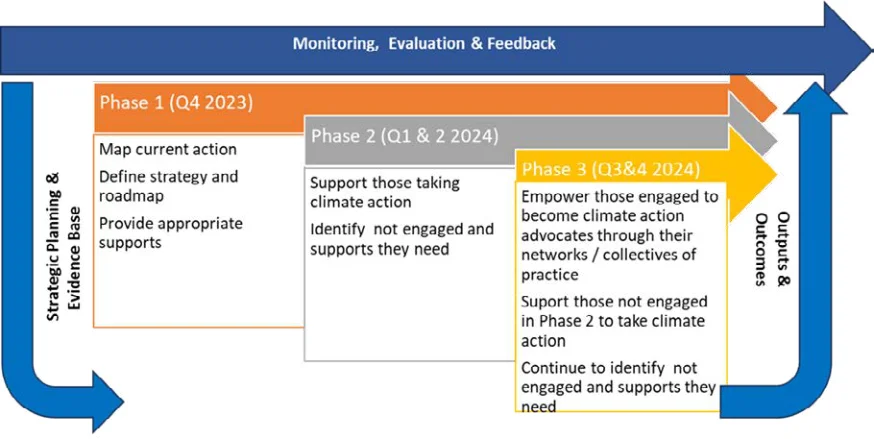
Figure 9.1 – Phased approach to the delivery of a National Programme of
Phase 1 – Mapping of Engagement Activities on Climate Action
Mapping current engagement activities at all levels of society:
– State: Government, Public Sector Bodies, and Local Authorities;
– Business and industry: national network organisations/representative bodies, large companies, and local businesses groups;
– Social and cultural organisations: community and voluntary groups, eNGOs, special interest groups, etc.
Defining a strategic approach to a national conversation through organisations and networks across society founded on fairness, collaboration and positive change including:
– The creation of a Roadmap of Climate Engagement Activities supporting the delivery of the National Campaign of Communication and Engagement on Climate Action, including a detailed overview of planned climate engagement activities, targeted engagement strategies for actions/projects, and developing materials that inform and educate key audiences;
– The identification of appropriate supports to enhance the impact of organisations, networks, and community climate action across society;
– Improved monitoring and evaluation of engagement across Government through the CCET and the CCCC.
Phase 2 – Delivery of a Programme of Engagement on Climate Action
The provision of information, resources, and insights to support those taking climate action including:
– Developing audience and audience personas;
– Toolkits for engagement on climate action;
– Relevant insights from social and behavioural research.
The identification of those not taking climate action and engaging with them to develop strategies which empower them to take such action.
Phase 3 – Engaging the Disengaged, and Empowering the Engaged
Empower those already taking climate action to become advocates through their networks and communities of practice and supporting networks of advocates that are self-sustaining;
Continue to identify others not yet taking climate action and supports they need and engage those not yet taking climate action to begin acting;
Developing a systematic mechanism for capture insights as output and outcome metrics and providing feedback from these climate actions providing inputs to communications and a tool for designing policy.
9.2.2.2 National Engagement on Climate Action
Engagement Actions Across Government and State Agencies
The CCET will support the better coordination of programmes of engagement on climate action being designed and delivered across Government Departments, and their Agencies, to ensure that a coherent approach is being taken; resources and insights are being used effectively across campaigns; and the impacts of these programmes are captured and shared.
National Youth Assembly on Climate
The NYAC acts as a consultative forum on climate issues capturing the voices of young people and facilitating their input into policy development. In 2024, the NDCA will continue to work with the Department of Children, Equality, Disability, Integration and Youth in the evolution of this forum to better engage with young people on climate action and examine the coordination of youth engagement on climate action across society.
National Climate Stakeholder Forum
The National Climate Stakeholder Forum is a deliberative workshop and functions as a consultative forum on climate issues. It involves meetings of the various climate taskforce groups and key stakeholders from across a wide range of societal actors (Government, Departments, Local Authorities, Public Sector Bodies, national organisations, academics, representative bodies, voluntary organisations, and community groups) who have the opportunity to discuss climate policy and provide input into its design and implementation. In 2024 this programme will be expanded to include regional and possibly sector specific forum meetings.
Climate Conversations
Climate Conversations 2024 will build on the approach developed in previous years delivering a more inclusive programme engaging with, and providing insights from, specific populations, bringing stakeholders and the public from more diverse backgrounds and perspectives into the dialogue. This will include:
The annual public consultation on the next Climate Action Plan;
Deliberative workshops involving those not yet engaged with climate action and populations most at risk or impacted by climate change;
In-depth interviews with those taking climate action, building a repository of positive examples.
EPA Climate Conference, Climate Lecture Series and Support Workshops
The EPA hosts a series of annual engagement events, including its annual climate conference, climate lecture series, and workshops on engagement and participation. In 2024, the EPA’s climate conference and lecture series will continue to be shaped by priority areas emerging in scientific research, taking account of priority areas for national and local Climate Action Plans, and issues emerging from the wider NDCA programme of engagement.
9.2.2.3 Communities of Practice
Drawing on a strong evidence base and best practice across Europe, the engagement campaign will enable peer-to-peer conversations about climate change – its causes, impacts and solutions – in workplaces and communities. It will support employers, membership associations and community organisations to tailor their own local communications around the needs and identity of their constituencies, and then build engagement within their own networks.
9.2.3 Education for Sustainable Development and Climate Literacy
The Second National Strategy on Education for Sustainable Development: ESD to 2030 provides a framework to steer and support the contribution that the education sector is making towards a sustainable future by 2030. Through a lifelong learning and whole of institution approach, the strategy seeks to place sustainability and inclusion at the heart of education, across teaching and learning, research, operational environments and engagement with local communities.
In 2024, actions will further embed learning for sustainability within curricula in schools and Further and Higher Education Institutions, supporting the development of green skills and climate literacy among learners. At post-primary level, a new Leaving Certificate subject in Climate Action and Sustainable Development will be introduced to enhance existing cross curricular content, and in Higher Education new climate/sustainability courses will be developed under Human Capital Initiative Pillar 3.
The annual National Forum on Education for Sustainable Development will engage stakeholders in dialogue on priority areas emerging in implementing ESD to 2030 and showcase and celebrate exemplars of quality, excellence and innovation in Education for Sustainable Development across the Irish Education System.
In 2024, work will continue with organisations delivering informal and nonformal education such as An Taisce Green Schools, GAA Green Clubs, ECO UNESCO Young Environmentalist and others which promote climate literacy by providing opportunities for young people across Ireland to take climate action and learn by doing.
9.2.4 Supporting Structures
9.2.4.1 Governance
The following structures will coordinate the activities, and provide oversight of the delivery, of the programme:
The Department of the Taoiseach will develop, in collaboration with DECC, an all of Government climate communications campaign that will support the engagement campaign;
DECC will oversee the design, implementation, and coordination of the public engagement programme under the NDCA, supporting Government Departments in rolling out their engagement activities to align with the communications activities at the sectoral, network, local and community levels;
The Department of the Taoiseach and DECC will work together to deliver fully aligned and effective communications and engagement work programmes.
9.2.4.2 Monitoring and Evaluation
The delivery of the programme will be supported by the expansion of research and evidence gathering to allow for the effective monitoring and evaluation of the programme, and to provide detailed insights for climate policy across Government.
Social and Behavioural Research
The delivery of the objectives of the NDCA will be measured through robust quantitative and qualitative research. In 2024, this will include the:
The second Climate Change in the Irish Minds study;
Climate Conversations 2024;
An expansion of the behavioural research programme (to include research studies examining specific barriers to people taking climate action that have emerged from the existing research);
A sentiment tracker;
The expansion of the role of the Advisory Group on Social and Behavioural Research on Climate Action.
Data Management System
The Roadmap of Climate Engagement Activities will constitute a coordinated approach to the delivery of the National Campaign of Communication and Engagement on Climate Action. Based on the agreed roadmap, outputs, results, and impacts, with associated Key Performance Indicators (KPIs) will be defined, and a measurement system will be designed and implemented. Each engagement activity and campaign will be required to employ existing evidence provided by the NDCA programme in its design, including defining KPIs and agreed mechanisms for their measurement.
Box 9.2 – LOGIC Model to be guide the Monitoring and Evaluation of Citizen Engagement
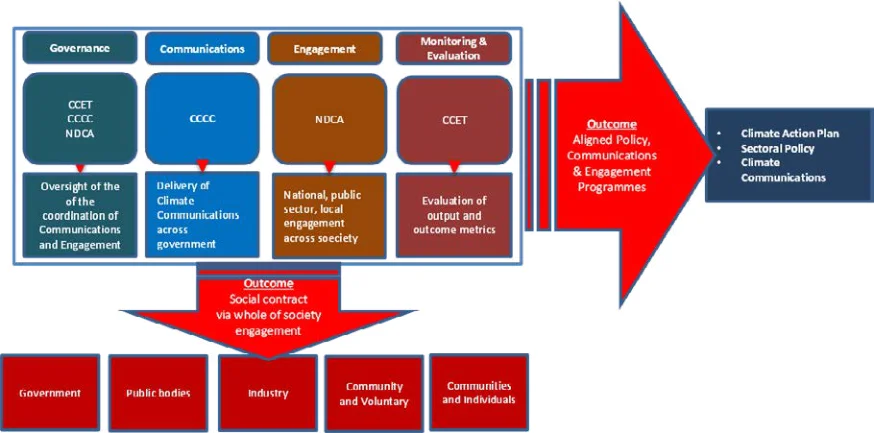
Figure from page 120
The following are the key actions for monitoring and evaluation:
Define KPIs, output (deliverables), result, and outcome (impact) measures;
Consolidate research data to inform communications, engagement, and climate policy;
Better understand the ‘say-do’ gap to empower individuals and communities of interest, via existing networks, to take climate action.
Pages 114–120 · View in original PDF