1.1 Climate change news and activity in Q3 and Q4 2024
Climate change impacts ecosystems, economies, and communities across the world.
Extreme weather reached dangerous new heights in 2024. A report by World Weather
Attribution and Climate Central noted that 2024’s record-breaking temperatures
contributed to the deaths of at least 3,700 people and the displacement of millions in
26 weather events. The Q4 published United Nations Environment Programme report
lays out how the planet is on course for further disastrous heating caused by greenhouse
gas emissions from human activity, potentially far exceeding the 1.5 degrees warming
target limit of the Paris Agreement.
The latest Copernicus climate change report also stated that 2024 is “virtually certain”
to be the hottest in recorded history. The National Oceanic and Atmospheric
Administration’s annual Arctic report card for 2024 further showed that rising
temperatures have accelerated the decomposition of previously frozen organic matter
and ignited more wildfires.
The consequences of climate change for Europe are evident in the first European
Climate Risk Assessment (EUCRA) which identifies 36 climate risks that pose a threat to
Europe’s energy and food security, ecosystems, infrastructure, water, financial stability,
and people’s health. Financial risks for Ireland are also apparent in missing legally-binding
EU climate targets. In Q4 2024, the Irish Fiscal Advisory Council (IFAC) reported that
the State could face a potential cost of up to €20 billion if Ireland fails to achieve required
emissions reductions by 2030 and has to purchase compliance credits from other
Member States. IFAC calls for “more effective action to avoid these costs, reduce energy
costs and pollution, and improve people’s health” by taking further climate action
domestically.
The annually updated CAP aims to spearhead the range of climate action activity
required across sectors, society and the economy. In addition to the actions outlined in
this progress report relevant to Q3 and Q4 2024, continued activity to address climate
change in Ireland in the second half of the year included:
passengers
Responsive Transport (DRT) services.
Energy
The Sustainable Energy Authority of Ireland’s
(SEAI) National Energy Balance for 2023 was
published in Q3 2024. It outlines how much and
what type of energy Ireland used last year.
Highlights include decreased emissions from
the electricity sector due to increased use of
imported electricity which reduced the use of
fossil fuels in Ireland, and an increased use of
renewables. The SEAI outline however that
much more action is needed to avoid the
associated compliance costs of missing EU
emissions and renewable energy targets.
In November, the Irish Government approved
the terms and conditions of Ireland’s second
offshore wind
important milestone in the State’s offshore
renewable energy ambitions. Q4 also saw the
announcement that the Solar for Schools
Programme will be extended to all school
nationwide, further contributing to national
renewable energy sources.
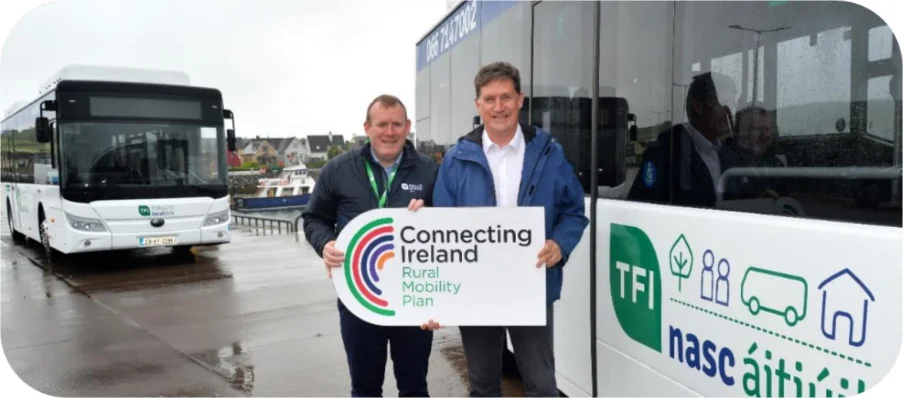
Figure from page 5
Minister Ryan launches two all-electric buses in Dingle / Daingean Ui Chuis area
Buildings
education programmes, publications,
A new Domestic Heat Pump Installation
exhibitions, conservation management plans,
Incentivisation Scheme for plumbers ran
recreational measures, monitoring or surveying
throughout the second half of 2024. The
work, invasive species and fire control
scheme offered up to €500 to help qualified
measures, anti-littering initiatives and local
plumbers cover the costs of taking time off
environmental improvements in peatland areas.
work to complete heat pump training. This will
Q4 also saw the launch of Bioeconomy Ireland
help to address growing demand while also
Week that showcased the range of land use,
helping plumbers’ future-proof their careers.
agriculture and industry diversification options
In December, funding of more than €8 million to
available in Ireland. This year’s theme focused
improve energy efficiency and decarbonise
on “Demonstrating Biobased Solutions for a
buildings in the Further Education and Training
Greener Ireland”, demonstrating how the
sector was announced.The so-called Green
natural environment can be used in a
Devolved Capital Grant will be distributed to 16
sustainable and circular way to help achieve a
Education and Training Boards across Ireland to
fairer and more prosperous society while
assist them in meeting targets set out in the
reducing emissions.
Public Sector Climate Action Mandate.
Community engagement
Land Use
A new report from the Department of the
November 2024 saw the launch of the 2025
Environment, Climate and Communications,
Peatlands and Natura Community Engagement
Climate Conversations 2023 – From Individual
Scheme aimed at community-led projects, with
Action to Collective Engagement published in
up to €600,000 in funding available.
Q3. It reveals that while awareness and concern
Applications were invited across a range of
of climate change is high amongst the Irish
initiatives with community benefit from events,
public, there is a gap between people’s
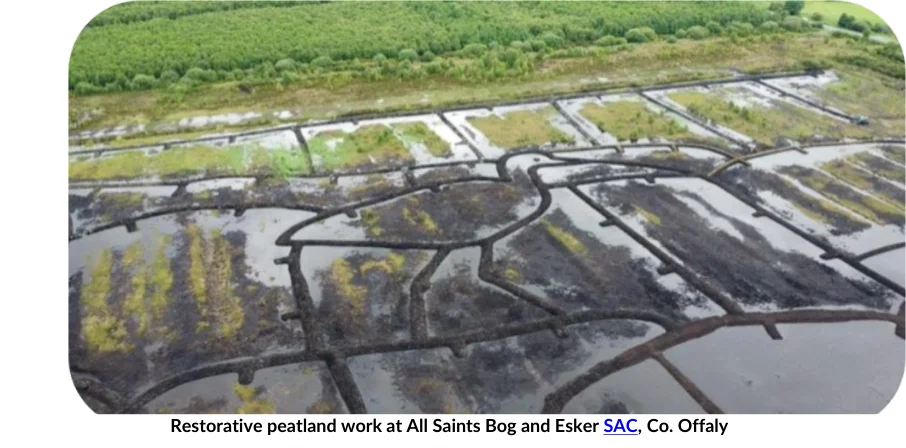
Figure from page 6
Restorative peatland work at All Saints Bog and Esker SAC, Co. Offaly
intentions and actions. Many individuals are
unclear about which actions are most impactful
in reducing emissions. While climate-friendly
actions are on the rise, the report also states
like reducing meat
consumption or living car-free appear to be
more resistant to uptake, despite their potential
for impactful emissions reductions.
In recognition of these challenges and the
power of community climate action, a new
campaign and funding programme called
“Climate Actions Work” was launched to further
support community climate engagement. It
includes a €1 million fund for community groups
climate advocacy, event
organisation, and communication efforts.
Uptake of the Deposit Return Scheme has been
very positive, with over 900 million containers
have returned and deposits refunded to
consumers by the end of Q4 2024. The major
milestone of half a billion containers was
reached in mid-September, while over 5 million
plastic bottle and can returns were recorded on
a number of days in December.

Figure from page 7
Minister McConalogue at Ploughing Championships, September 2024
Pages 4–7 · View in original PDF