7 Land Use, Land Use Change and Forestry
Using current estimates, land uses have net emissions of c.5.6Mt CO2 eq in 2023, more than
the emissions from residential buildings (5.3Mt CO2 eq). The Land Use, Land Use Change and
Forestry (LULUCF) sector has been an emissions source in Ireland since 1990 and has a
challenging future profile for emissions generation.
| Figure 16: Expected LULUCF Emissions |
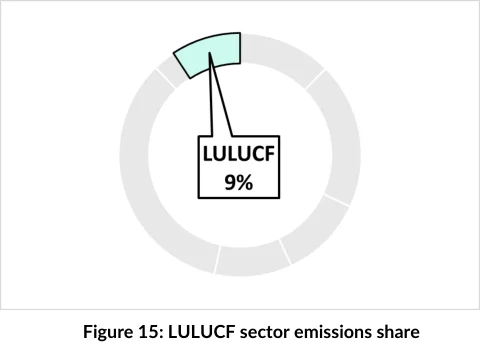
Figure from page 27
Figure 15: LULUCF sector emissions share
The main sources of emissions in LULUCF are from
the drainage of organic soils for grasslands and the
planting on mineral soils, raising the water table on
exploitation of wetlands for peat extraction. Forest
drained organic soils, and restoring peatlands.
land and harvested wood products are a carbon sink
An urgency remains to re-balance LULUCF emissions
(CO2 removal) for all years 1990-2023.
in favour of carbon sinks, with new EU regulations in
Emissions from LULUCF are however projected to
this area holding potential for significant compliance
increase by 40.9% between 2022 and 2023. There
costs. CAP24 details how best to manage emissions
has been a considerable long-term decline in land
from LULUCF going forward. This includes a re-
afforested annually, an increase in the level of
commitment to established activity targets in
harvesting and increased emissions from forestry on
afforestation, peatlands and soils management, and
organic soils, reducing the contribution of the forest
the introduction of some new activity, including in
land sector to the removal of CO2 from the
hedgerows. The approach aims to better align with
atmosphere. Afforestation rates declined to c.1,650
EU targets for the sector and to account for
ha in 2023, well below the 8,000 ha per annum
fluctuating baselines as the scientific understanding
committed to under successive Climate Action Plans.
of LULUCF evolves. Urgent action is required now to
meet national and international commitments and
Under existing measures (WEM) in the latest EPA
ultimate climate neutrality in Ireland by 2050.
projections, emissions from LULUCF are projected to
almost double (99.4% increase) between 2022 and
In the EPA’s CCIM report released this year, a large
- Planned policies (WAM) are set to reduce the
majority of people (91%) support increasing forest
extent of emissions increase to 23%, highlighting the
areas to offset GHGs from agriculture.
need for adjusted forest management, rapid tree

Figure from page 27
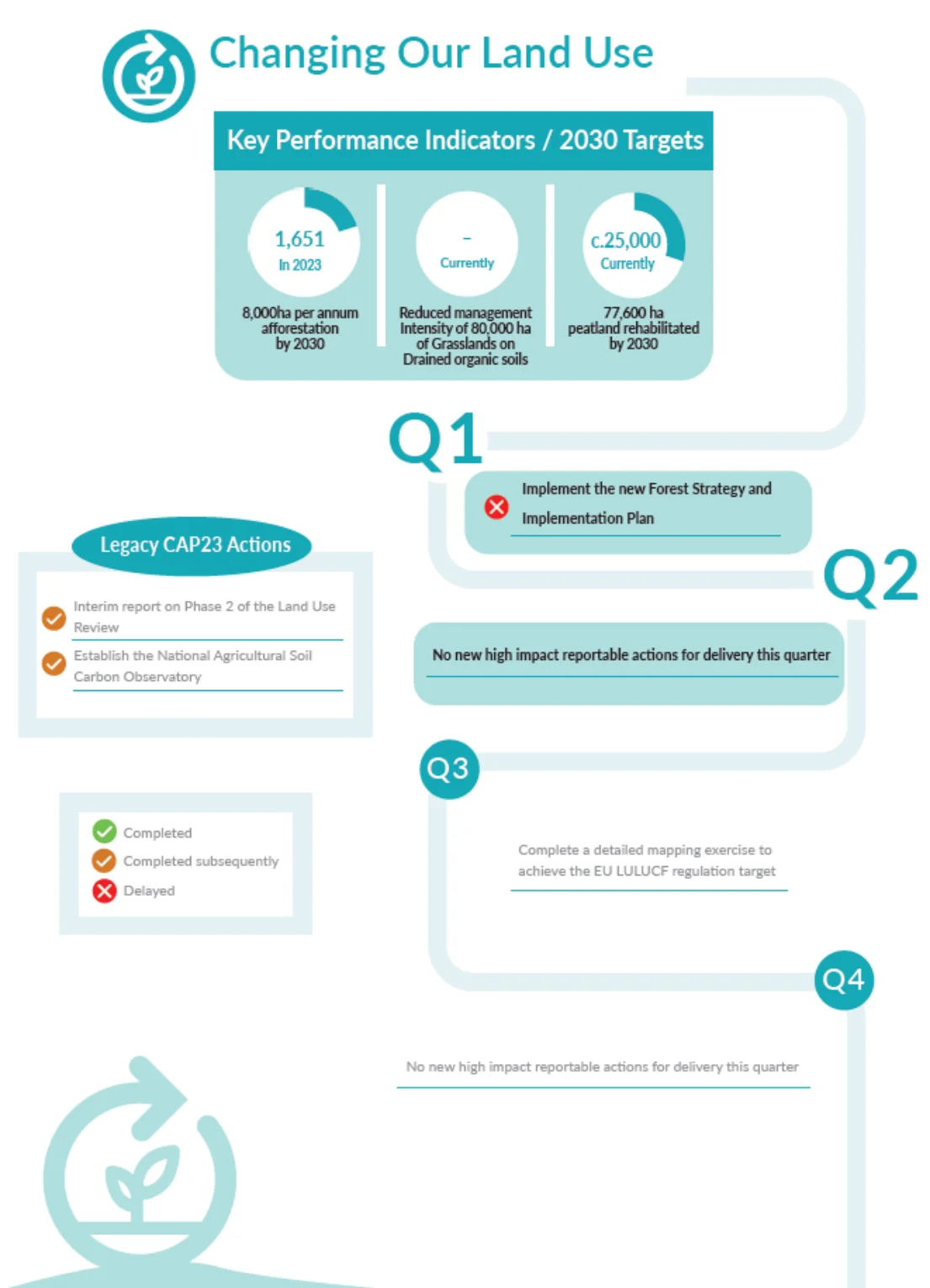
Figure from page 28
LULUCF – Complete CAP23 legacy action
Did You Know? Drained organic soils (including on agricultural grasslands) are a big emissions
source in Ireland, while mineral soils can sequester and store carbon under the right conditions.
Under RE/23/1, commitments were made to establish a National Agricultural Soil Carbon
Observatory to better understand these dynamics. The Observatory aims to provide cutting-edge
research facilities to better refine agricultural emission inventories and help to identify new
mitigation measures to reduce greenhouse gas emissions from soils.
What’s new? As of May 2024, 28 carbon measurement towers have been successfully installed
on sites around the country. Data from all towers is manually collected monthly, and 14 towers
are remotely reporting data to a Teagasc server every half-hour, with the aim of all towers
reporting in data by the end of Q4. A data platform is in development to support the management
of the data and to ensure standardisation of data processing. Additional staff and research
projects have been appointed in Teagasc to support the operation of the Observatory and the
overall objective to publish Irish specific soil carbon sequestration/emission factors by 2027.
LULUCF – Delayed CAP24 Action
Did You Know?Shared National Vision, Ireland’s Forest Strategypublished under CAP23
emphasised the role of trees in Ireland’s economic and environmental future. Implementing this
Strategy will result in increased forest cover nationally, with multifunctional and diverse forests
delivering multiple benefits for climate, nature, wood production, people, communities, the
economy and rural development. Under LU/24/1 in CAP24, a new communication plan for the
Strategy was due for delivery to promote activity in the sector. While significant promotion of
the new forestry programme and forest strategy is taking place, a revised communication plan
was delayed and will be delivered in Q4 2024.
Why is it needed? The overriding objective of Ireland’s Forest Strategy is to urgently expand
the national forest estate on both public and private land in a manner that will deliver lasting
benefits for climate action, biodiversity, water quality, wood production, economic development
and quality of life. Communicating with farmers and landowners is key to promote the uptake
of generous grants and schemes. A new Forest Strategy Consultative Committee was
established this year with membership comprising 15 stakeholders across relevant sectors.
Communication activity is ongoing and the Communication Plan for the programme period is
currently being updated.
Pages 27–29 · View in original PDF