5 Buildings
Emissions from all buildings made up 11% of Ireland’s emissions in 2023. Most of this
(c.9%) was from residential buildings. Energy prices, yearly temperatures, energy
efficiency measures, fuel switching, and remote working all influence emissions from
buildings. Emissions from the residential sector have decreased by c.7% since 2022.
| Figure 12: Gap to Target - Buildings |
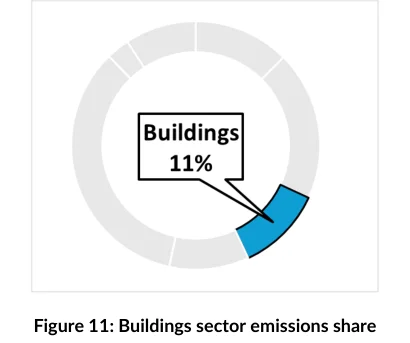
Figure from page 21
Figure 11: Buildings sector emissions share
In the EPA projections, emissions from residential
and more efficient heating systems (77% “strongly
buildings are expected to decrease by 15%-27%
support” and 19% “somewhat support”).
between 2022 and 2030 (Figure 12). For Commercial
and Public Services, a decrease of 19-57% is
Accelerated retrofitting of private, public, and
projected. The higher reduction levels assume,
commercial buildings is required, as re-committed to
among other actions, an effective ban on oil and gas
under CAP24, along with the expansion of renewable
boilers in new dwellings, the installation of 680,000
heating options such as district heating and electric
heat pumps, 500,000 B2 home retrofits/cost optimal
heat pumps. CAP24 also re-states the target for all
equivalents, and achieving full district heating and
new dwellings to be constructed to Nearly Zero
biomethane targets. These are challenging targets
Energy Building standard by 2025, and Zero Emission
and will require concerted and accelerated effort to
Building standard by 2030.
reach their full potential.
Key actions under CAP24 to reduce emissions from
In the CCIM report, banning peat, coal, and oil in
buildings include: continuing the roll-out of the
home heating received majority support amongst the
ambitious National Residential Retrofit Plan;
Irish public (59%). This support has however
strengthening building regulations; supporting
decreased since 2021, reflective of cost-of-living
district heating, heat electrification, and geothermal
pressures. In addition, there is strong support
energy; implementing the Renewable Heat
amongst people in Ireland for residential and
Obligation; and developing roadmaps to decarbonise
commercial building grants aimed at installing cleaner
commercial and public buildings.

Figure from page 21
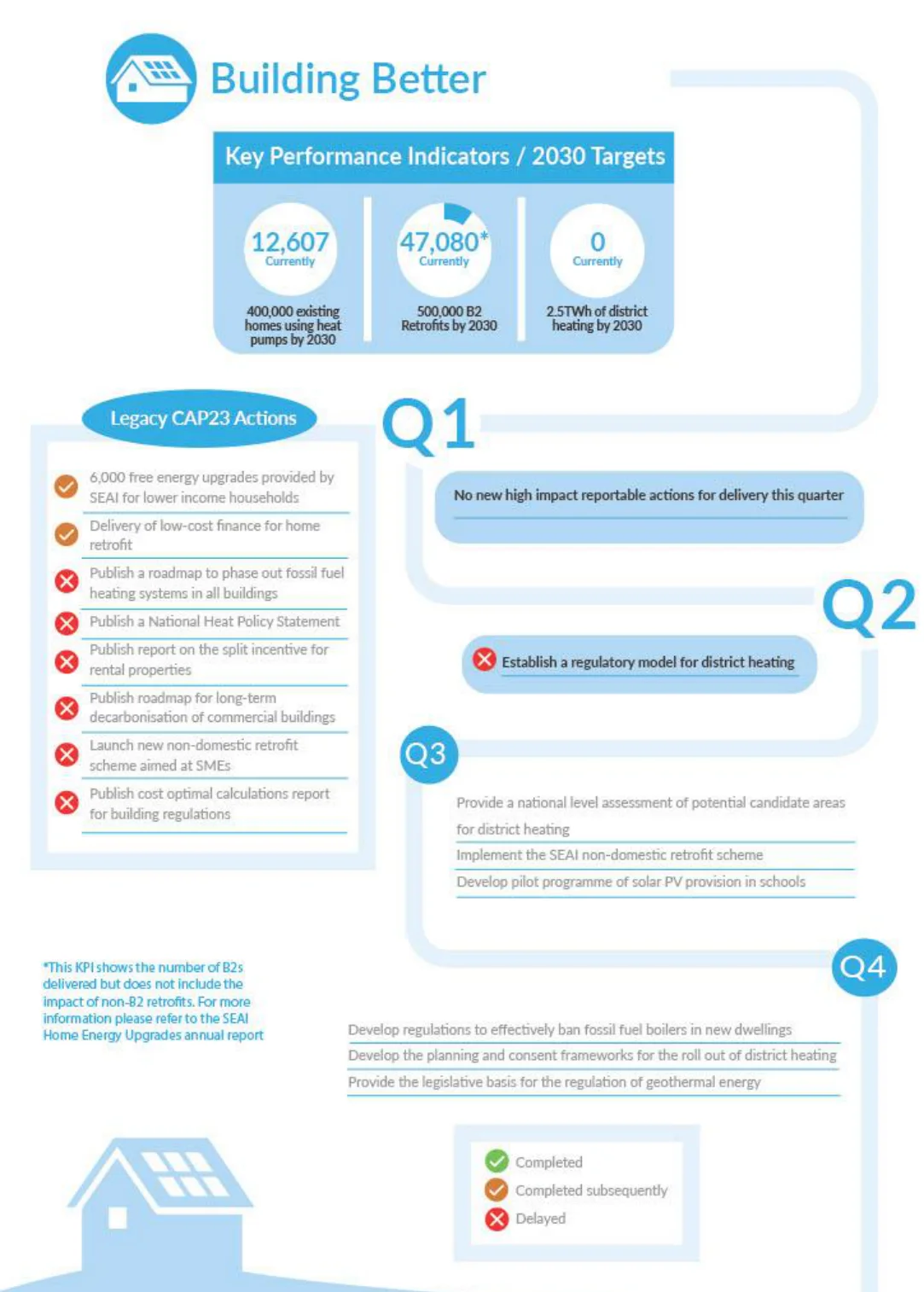
Figure from page 22
Buildings - CompleteCAP23 Legacy Action
Did You Know? Under Action BE/23/12, DECC sought to establish a loan guarantee scheme to
support the delivery of low-cost finance for home retrofit to consumers.The Home Energy
Upgrade Loan Scheme was launched on 24 April 2024 in response. This Government-backed
€500 million scheme will support homeowners to invest in energy efficiency in a more affordable
and accessible way.
What’s new? Homeowners can now borrow from €5,000 to €75,000 at significantly lower
interest rates to make their homes warmer and cheaper to run. Bank of Ireland, AIB and PTSB are
now offering loans to homeowners under the Scheme, with rates from 3%.The loan guarantee
scheme is the first of its kind for both Ireland and the European Investment Bank Group. With
more lenders and increased competition in the market, it is expected that rates will be increasingly
competitive, offering consumers more choice and value.
Buildings - DelayedCAP23 Legacy Action
Did You Know? The Government has committed to decarbonise heating sources including
through developing a roadmap to phase out fossil fuel heating systems in all buildings. Last year,
the Government established a Heat and Built Environment Delivery Taskforceto drive delivery
of retrofitting, renewable heat, district heating, and decarbonising the overall energy needs of
buildings. The development of the promised roadmap falls under the remit of the Taskforce and
a draft roadmap has been made available by the SEAI. The Energy Performance in Buildings
Directive however at EU level requires a similar roadmap to be drafted by all Member States,
with uncertainty on the scope of that roadmap which may impact publication timelines.
Why is it needed? The decarbonisation of residential, commercial and public buildings is a major
focus of successive Climate Action Plans. The Government’s ambitious targets for reducing
greenhouse gas emissions in the built environment recognise the need to significantly and
urgently reduce the use of fossil fuels in heating. Completion of the roadmap to phase out fossil
fuel heating systems will provide a pathway and market certainty to achieve this objective.

Figure from page 23
Pages 21–23 · View in original PDF